
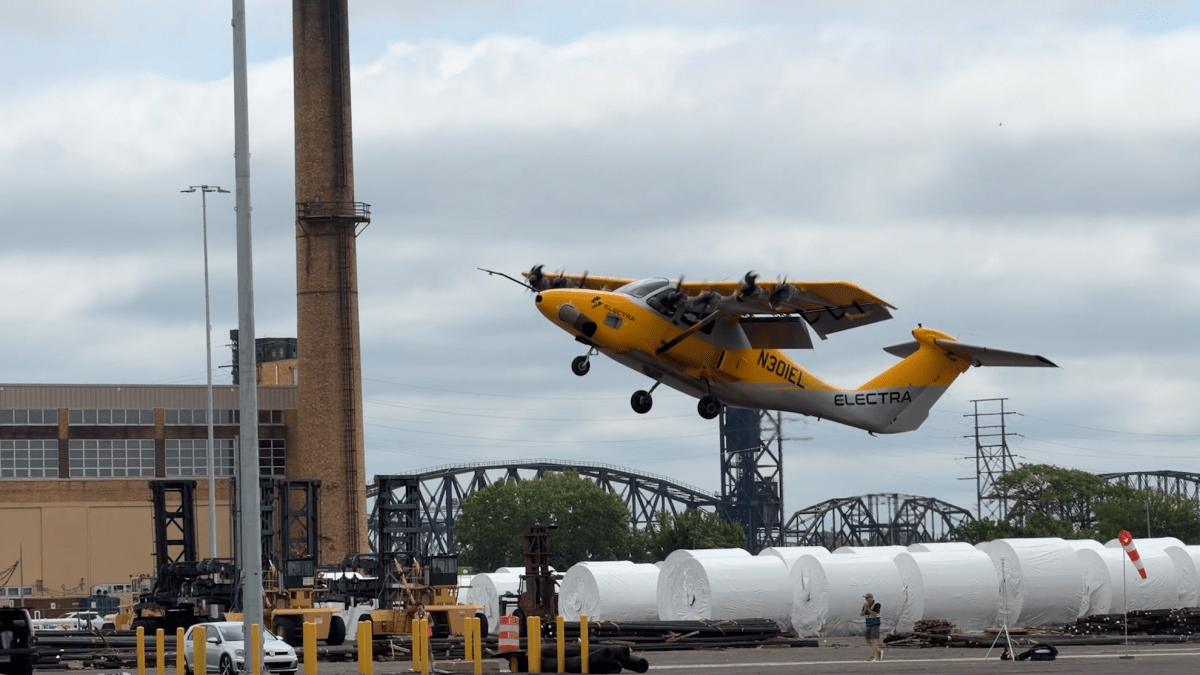
A small aircraft that needs just 150 feet to take off and land could eventually change how travelers catch regional flights, opening the possibility of using smaller landing sites instead of traditional airports.
The small yellow aircraft is hybrid-electric, meaning it runs on conventional aviation fuels and has the ability to charge. It uses hybrid propulsion with propellers on the fixed-wing aircraft to enable short takeoffs and landings.
Electra demonstrated the technology Monday in Philadelphia at the Tioga Marine Terminal, where a crowd of state and local officials watched the aircraft fly and land.
JP Stewart, senior vice president for product development at Electra, narrated the demonstration for the assembled group.
“Because of that short takeoff and landing distance, we can start to create new opportunities for underutilized infrastructure to then create these new point to point routes,” Stewart said.
Possible trips could include Philadelphia to State College and Atlantic City to New York. Electra says a trip from New York to Washington, D.C., could cost $250 and take one hour and 45 minutes.
Electra put together an analysis of potential trips that would experience time-savings here.
Stewart said the company’s goal is to make the technology useful for typical regional travelers.
“This is not for the top 1%. This is average people trying to take work trips, trying to go on vacation with their family in this 50 to 500 mile range,” Stewart said.
“The technology is evolving and it’s something that we used to think it’s all on TV and we’d never see, but it’s coming here to Pennsylvania, so we’re glad we can be part of it,” Pennsylvania state Rep. Ed Neilson said.
Neilson is also the chair of the House Transportation Committee.
The Tioga Marine Terminal demonstration followed successful flights over the weekend to Philadelphia International Airport and Northeast Philadelphia Airport.
The smaller EL2 aircraft is completing the demonstration flights while collecting technical data, the company’s flagship EL9 nine-passenger aircraft will ultimately serve as its primary aircraft.
Neilson, who lives near Northeast Philadelphia Airport, also pointed to the aircraft’s reduced noise level.
“I live by Northeast Airport, and we hear planes and helicopters go by all day long. The noise was like nothing,” Neilson said.
Pa. is one of eight partners working with the Federal Aviation Administration to develop safety regulations for the next generation of aviation under the Advanced Air Mobility pilot operations program (the “eIPP”). Read more from the FAA here.
The technology has started a conversation about the infrastructure needed for these aircraft to take off, land and refuel. Max Tuttleman, founder and CEO of LAND, runs a company that wants to build smaller, cheaper places for planes to land and refuel. (Electra, which is not affiliated with LAND, envisions potential landing sites including piers, rooftops and fields.)
“Everyone understands it’s an ‘if you build it, it will come’ type of technology,” Tuttleman said, highlighting the need for the infrastructure to be in place to support commercial operators.
“This isn’t something that’s 10 or 15 years out. This is right around the corner,” he said.
For the Port of Philadelphia, where the aircraft landed, board chairman Michael Pearson said its about being option to expanding the existing operation to accommodate another mode of transportation.
“This is part of a complete and modern picture of intermodal transportation,” Pearson said.