
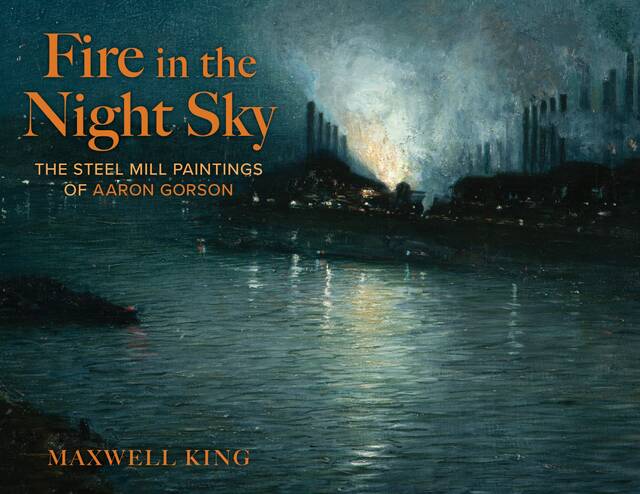
Maxwell King has brought local luminaries Fred Rogers and John Kane to vivid life on the page in recent years with his biographies.
His newest book, published on Tuesday, highlights early 20th-century industrial artist Aaron Harry Gorson.
“Fire in the Night Sky: The Steel Mill Paintings of Aaron Gorson” has been a multiyear endeavor for the former Philadelphia Inquirer editor-in-chief and Heinz Endowments executive.
King, 82, said that the subject of Gorson was presented to him.
“The CEO of Globe Pequot Publishing Group, which has about 15 different imprints and does a lot of history and biography, approached me and said, ‘I really like your book about John Kane, you ought to do a book about Aaron Gorson.’ And I said, ‘Gorson’s boring,’” King said.
With a little bit of research, however, King quickly became enchanted by both Gorson’s artistic style and the way that he portrayed Pittsburgh in paint.
“It’s as much a story about Pittsburgh as it is about Aaron Gorson,” King said. “He was captured by the beauty and the power of the mills, particularly at night.”
Gorson was a Lithuanian immigrant who came to Philadelphia and then went to the Pennsylvania Academy of the Fine Arts. King’s book chronicles the artist’s life, but also places his works into the context of Southwestern Pennsylvania, a center of the industrial world at the time.
In addition to being a thorough chronicle of Gorson’s life and artistic career in the industrial district of Pittsburgh during the very early 1900s, “Fire in the Night Sky” also includes color pictures of about 40 of Gorson’s works.
When King began the journey for this book, his first stops were the museums that heavily feature Gorson’s works: the Carnegie Museum of Art in Pittsburgh, the Westmoreland Museum of American Art in Greensburg, the Duquesne Club in Pittsburgh, and the Steidle Collection of American Industrial Art at Penn State University in State College.
“I got a great start with those four museum collections,” King said.
Those institutions also understand the importance of the artist’s work.
“Aaron Harry Gorson’s dramatic depictions of Pittsburgh’s steel mills made him the best-known painter of industrial landscapes during his time, while also leaving an invaluable visual record of the region’s vital role in America’s Big Steel Era,” said Dr. Erica Nuckles, director of learning, engagement and programs at the Westmoreland Museum of American Art.
Much like his previous two biographies, King spent plenty of time researching and writing simultaneously, following interesting facts wherever they took him to inform the final product.
“You pull on a thread and you get something really interesting, and another thread pops up over here and you pull on that,” he said.
The longtime journalist gained an appreciation for Gorson’s portrayal of Pittsburgh.
“Pittsburgh was quite a center of artistic activity with a lot of artists working in Pittsburgh, and many of them were getting on trains in Downtown Pittsburgh, riding right past the steel mills out to Westmoreland and Cambria counties to paint landscapes,” King said.
Gorson didn’t overlook the urban scenes.
“He saw the industry was a wonderful subject for painting. I think that vision is the most arresting part of his story,” King said.
He also discussed how Gorson’s use of color and light effectively captured the sights of the city at that time. King took the title of his book from some of Gorson’s most striking works.
“His depictions of the steel mills at night have bright gold and yellow and silver colors against really dark gray, blue, purple, black colors.”
After his third biography, King is still writing, just trying something a little different.
“I’ve actually got another book coming out next year,” he said. “It’s a novel, it was really a stretch for me.”
“Fire in the Night Sky: The Steel Mill Paintings of Aaron Gorson” by Maxwell King published Tuesday. Learn more at simonandschuster.com.