
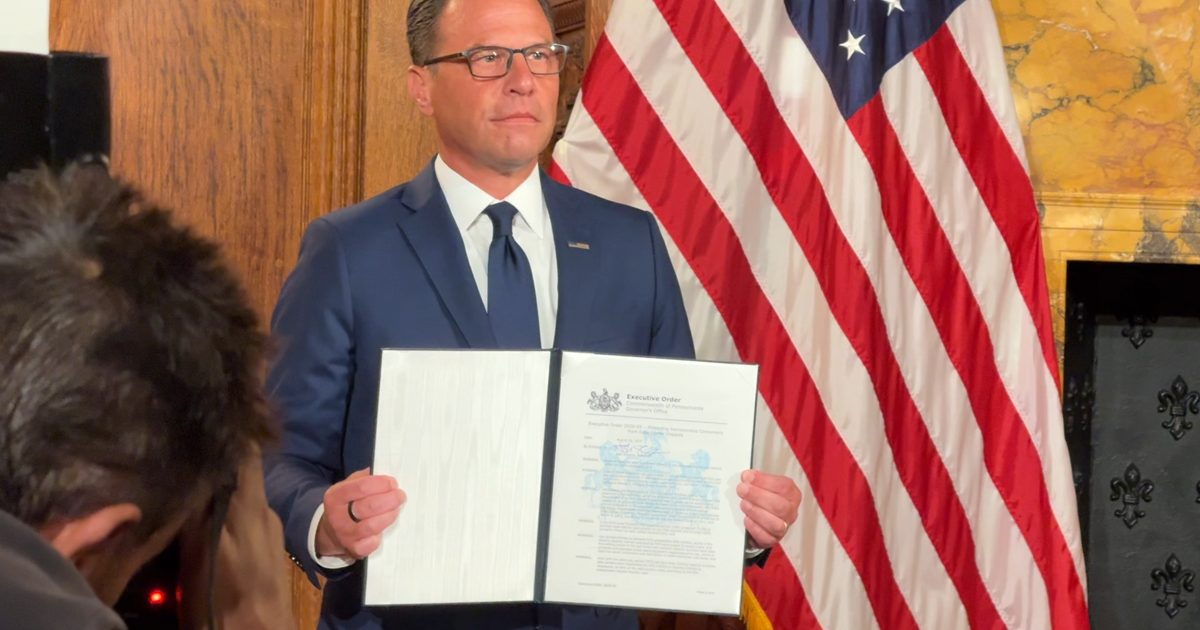
In a show of solidarity, Democratic Gov. Josh Shapiro signed an executive order today that tightens permitting rules around data center development, as public opinion on the industry has soured.
The order, signed Tuesday afternoon in Harrisburg, implements many of the legislative priorities that Democratic lawmakers pushed for during budget negotiations this summer.
It also takes extra steps in transparency and local control issues– like mandating projects to prove they have local government approval before the Department of Environmental Protection issues any state permits.
“The absence of legislative approval has left me with no other option but to protect the people of Pennsylvania by taking executive action,” Shapiro said in remarks before the signing. “To put the strictest guardrails in the nation in place to stop the predatory developers and bad proposals.”
Initially, the Shapiro administration embraced data center development. For example, the governor’s office helped coordinate a $20 billion Amazon project last summer.
As the industry was thrown more into the spotlight, Shapiro proposed his Governor’s Responsible Infrastructure Development (GRID) requirements in his February budget proposal.
The rules focus on transparency, environmental protection, hiring process, and energy supply. Legislation this summer paired the rules with an already existing tax break for data centers.
Project proposals have skyrocketed this year though, and more citizens have vocalized concern about noise pollution, land use, visual blight, water shortages, energy costs, and broader frustration with a lack of transparency in some project processes.
“I hear you. and I thank you for taking the time to share your thoughts and concerns,” Shapiro said. “You want the right to weigh in on decisions about what your community looks like going forward.”
The governor said there are roughly 100 project proposals in Pennsylvania right now, but only five of them have obtained permits. In a departure from previous, more moderate stances on data center development, Shapiro described many of the proposals as bad faith and poorly planned.
“We will not be bullied by developers and bulldozed by the lawyers working for these big tech companies,” Shapiro said.
Organized advocates, like the Better Path Coalition, called for a full pause on data center development and critiqued Shapiro for his GRID policy rewarding instead of demanding compliance.
Today’s executive order does not mandate GRID, but projects that don’t agree to GRID will face unpredictable, prolonged permitting processes.
NO data center projects moving forward will be allowed into a fast track permitting process.
Political opponents critiqued Shapiro’s change in tone on the issue.
“Shapiro lit the fuse on the chaos we are seeing in community-after-community across the Commonwealth,” said Stacy Garrity in an emailed statement. Garrity is the Republican gubernatorial candidate opposing Shapiro in the November election.
We are waiting to hear how data center industry leaders respond to the order.
One of the weightiest requirements of GRID is that projects account for or build their own energy, and if they build, a significant portion of the energy must come from clean sources.
The sheer magnitude of energy use from data centers remains a significant problem for all of society. Stephen DeFrank, chairman of the PA Public Utility Commission, said that one data center project in the midstate will take more energy than the entire city of Pittsburgh.
“Almost think of it as bringing in new territory, new state, new cities, not just new customers. Because that’s the size of the load,” DeFrank said.
Shapiro said today’s executive order will weed out unserious proposals that have not researched or measured the full impact of potential projects.
Even with just a handful of legitimate proposals, the energy demand of the commonwealth could double.
There’s a chance energy production doubles with these behemoth projects. There’s a chance, that without government intervention, data centers plug into grids with no plan to balance their energy use.
There’s a chance that technology evolves, shrinking the size and energy use of servers– making battles over farmland a blip of a bad dream.
“Will any of this even be relevant in 5 years?” asked Sen. Rosemary Brown, a supporter of a statewide moratorium, in an interview earlier this summer.