
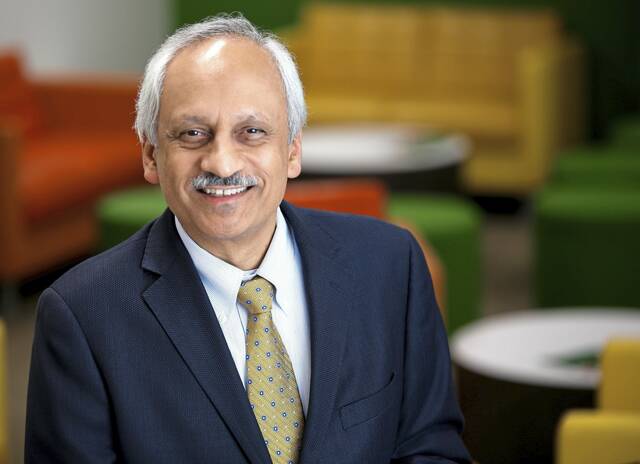
The leader of University of Pittsburgh’s School of Medicine, Dr. Anantha Shekhar, will step down at the end of this academic year.
A world-renowned neuroscientist, Shekhar became dean of Pitt’s medical school dean and also senior vice chancellor for the health sciences and in June 2020.
In a statement, Shekhar said he plans to take sabbatical leave and return as a faculty member, focused on biomedical commercialization.
“Leading through a global pandemic, a shifting federal funding environment, and the ordinary work of institutional change has asked more of this community than anyone could have anticipated,” Shekhar wrote. “That we did not merely survive these challenges but grew and thrived because of them says a great deal about the people I have had the privilege to lead.”
Chancellor Joan Gabel highlighted Shekhar’s accomplishments in increasing federal funding for the health sciences schools, boosting Pitt researchers’ commercialization disclosures, patents and start-ups, and advancements with BioForge, the biomanufacturing facility in Hazelwood Green.
The Pitt School of Medicine’s National Institutes of Health funding increased by 25% since 2020, Shekhar wrote, even in a time of federal funding uncertainty. Pitt’s health sciences schools remain among the top 10 in NIH funding.
In 2025, health and sciences schools drove most of Pitt’s invention disclosures, Shekhar wrote.
He remained optimistic about BioForge, which has attracted hundreds of millions in donations and funding. The facility aims to accelerate innovation and prototyping with cell and gene therapies in precision medicine.
“I believe it will define this region’s role as a life sciences leader for decades to come,” Shekhar wrote.
Shekhar also highlighted infrastructure upgrades, wellbeing initiatives for scientists and clinicians, and community engagement during his tenure.
“I am extremely proud of today’s health sciences leadership, the colleagues who have guided this work since long before I arrived, as well as the new vice chancellors, deans, chairs and department and institute leaders who have joined more recently,” he wrote. “Together, they have helped build what we now call the strength of six: our six schools increasingly working together as one.”