
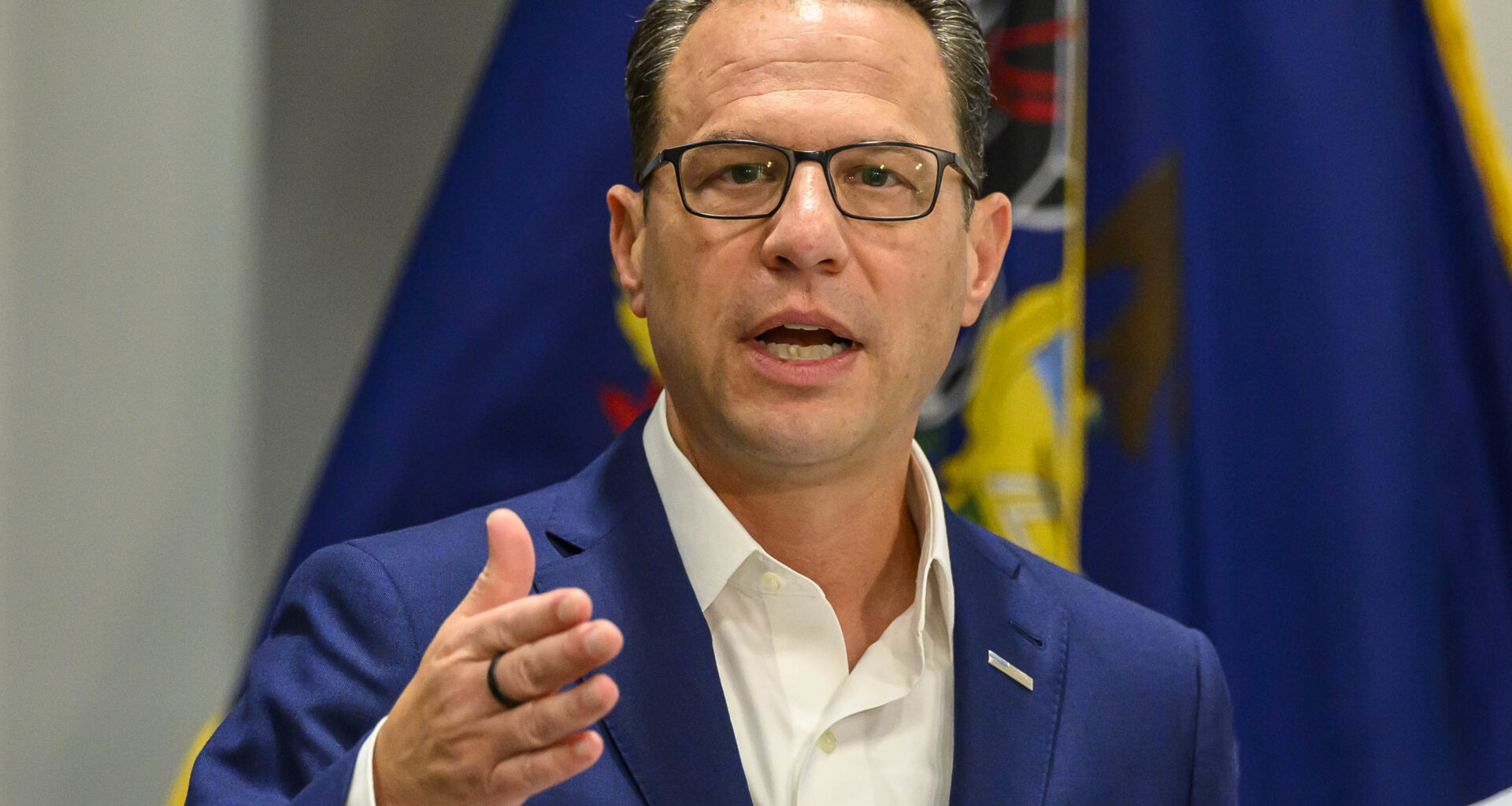
With more than 100 large-scale data centers proposed across the state, Pennsylvania Gov. Josh Shapiro on Tuesday signed an executive order that he said is designed to rein in irresponsible developers who are announcing speculative projects and scaring communities.
Local data center opponents called the order “political damage control” and said it doesn’t go far enough to protect communities.
The order removes all current and future data centers from the PA Permit Fast Track program designed to streamline and accelerate state government permitting for major economic development and infrastructure projects, such as the $3.5 billion Ely Lilly and Co. pharmaceutical plant in Upper Macungie Township.
Under the order, data center developers must first submit a notice of intent to comply with all Governor’s Responsible Infrastructure Development requirements, and must present detailed plans to the state Department of Environmental Protection for review. Developers must also sign a legally binding consent order with the state that includes penalties for noncompliance.
“My message to data center developers is clear: if you can’t agree to our strict requirements and get the community where you want to build to say ‘yes,’ you’re not going to have the commonwealth’s support either. These are some of the biggest companies in the world — they can afford to be good neighbors, follow the rules and do this right,” Shapiro said.
The governor did not repeal the state sales tax exemption on data center equipment that started the rush toward development in the state, but made the tax break conditional on data center operators adhering to GRID standards.
For members of the South Whitehall Civic Alliance, a group of residents fighting to stop the Project Atlas hyperscale data center proposed for land across from Parkland High School, the order didn’t go far enough. The Morning Call also reached out to developers who have proposed data centers in the Lehigh Valley but did not get responses.
“The Governor’s recent executive order is an acknowledgment that large data centers impose serious electricity, water, emissions, noise, grid reliability, and financial burdens on the local electricity ratepayers,” Alliance President Greg Sussman said in a statement. “It does however fall short for any project submitted prior to August 18, 2026 that has not yet received approval. Project Atlas is in this group as are a multitude of other datacenter projects in the Commonwealth. For these projects, the [executive order] has almost zero impact as the strongest permitting safeguards will be applicable only for new applications.”
The order comes after the state’s Republican-controlled Senate declined to act on GRID legislation that passed the House this year. Without a vote on data center regulation, an executive order was the only option, Shapiro said.
State Sen. Jarrett Coleman, R-Lehigh, who co-sponsored a bill that would allow local governments statewide to put an 18-month pause on data center projects, said he hoped the governor’s order would spur action in Harrisburg.
“I’m glad that Governor Shapiro realized he had made a mistake by rolling out the red carpet for data centers and fast-tracking their permits. My constituents want a moratorium, and I’m hopeful that when the Senate returns, we’ll advance my legislation with continued bipartisan support.” Coleman said.
State Sen. Lisa Boscola, D-Northampton, who proposed a six-bill consumer protection package addressing data centers this year, applauded the governor’s decision to sign an executive order.
“I especially support the Governor’s insistence that developers secure local approvals before state permitting advances, provide detailed reporting on their energy and water use, and make binding GRID commitments to qualify for favorable permitting treatment and the state’s data center sales tax exemption. Local residents and officials deserve to know who is proposing a project, what resources it will consume, and how it could affect utility bills and surrounding neighborhoods before key decisions are made,” Boscola wrote in a statement.
Residents who have been fighting data centers in their backyards read the executive order with interest.
“I feel it’s a good first step, but it doesn’t complete the job. Governor Hochul of New York’s step to enact a moratorium went further,” Tom Gilmour, an Upper Mount Bethel Township resident who has advocated against data center development, said in a text.
“Here in Pennsylvania we still need to revise the Municipal Planning Code, so heavy industrial projects like Data Centers aren’t pushed on rural communities, and we need to ensure that the GRID standards are mandatory, and that there’s enforcement tied to them. Environmental standards are an important component, and those need to be tied to ongoing monitoring and strict penalties when they aren’t followed,” Gilmour said.
Environmental watchdogs were skeptical that Shapiro’s order would do anything to protect communities targeted for the projects.
Megan McDonough, Pennsylvania state director with Food & Water Watch, said the governor should have imposed the moratorium that so many residents have asked for.
“Shapiro knows that he’s been acting out of accordance with what Pennsylvanians actually need — clean air and water, affordable utility bills, and preservation of our rural landscapes — and today was his attempt to save face. But he needed to go further. Shapiro has spent years helping create this problem and a few weak guardrails now don’t erase that record, and they certainly do not protect Pennsylvanians,” McDonough said.
In South Whitehall Township, officials have convened a special meeting of advisory groups Sept. 9 to address potential environmental impacts of the Project Atlas data center. The project will before the township planning commission Sept. 23. Anticipating a large crowd, both meetings will be held at Parkland High School.
“Overall, the [executive order] seems like political damage control,” said Sussman, of the South Whitehall Civic Alliance. “It serves only to throttle down the massive datacenter rush the Governor’s own policies initiated. It does nothing to mitigate the impact the unapproved projects, submitted before the [order], are likely to cause on both the Commonwealth and its residents.”
This is a developing story. Check back for updates.