
ARCHBALD — The debate over whether a conceptual plan is enough to ensure a facility will protect public health and safety continued Tuesday at the fifth hearing for a natural gas power plant proposed on Eynon Jermyn Road.
Representatives with Essential Energy LLC returned to the Valley View High School auditorium to answer questions and provide additional testimony on the developer’s “site, project and operational safety report” that determined the 400-megawatt power plant can be built near homes, parks and schools and operated without creating a significant hazard to the public. About 75 residents attended the three-hour hearing.
Essential Energy is a firm tied to Kriger Construction Inc. and its executive leadership. Another Kriger-linked firm proposes a nearly 620,000-square-foot Project Boson data center across the street from the power plant. A project representative indicated Tuesday the power plant would connect to the grid, not directly to the data center.
Archbald’s special counsel, attorney Brett C. Flower, cross-examined civil engineer W. Casey Deller, a vice president at KCI Technologies in Mechanicsburg, about the safety report he oversaw.

Archbald’s special counsel, attorney Brett C. Flower, cross-examines an Essential Energy LLC witness during a conditional use hearing at the Valley View High School auditorium in Archbald on Tuesday, Aug. 18, 2026. (FRANK WILKES LESNEFSKY / STAFF PHOTO)

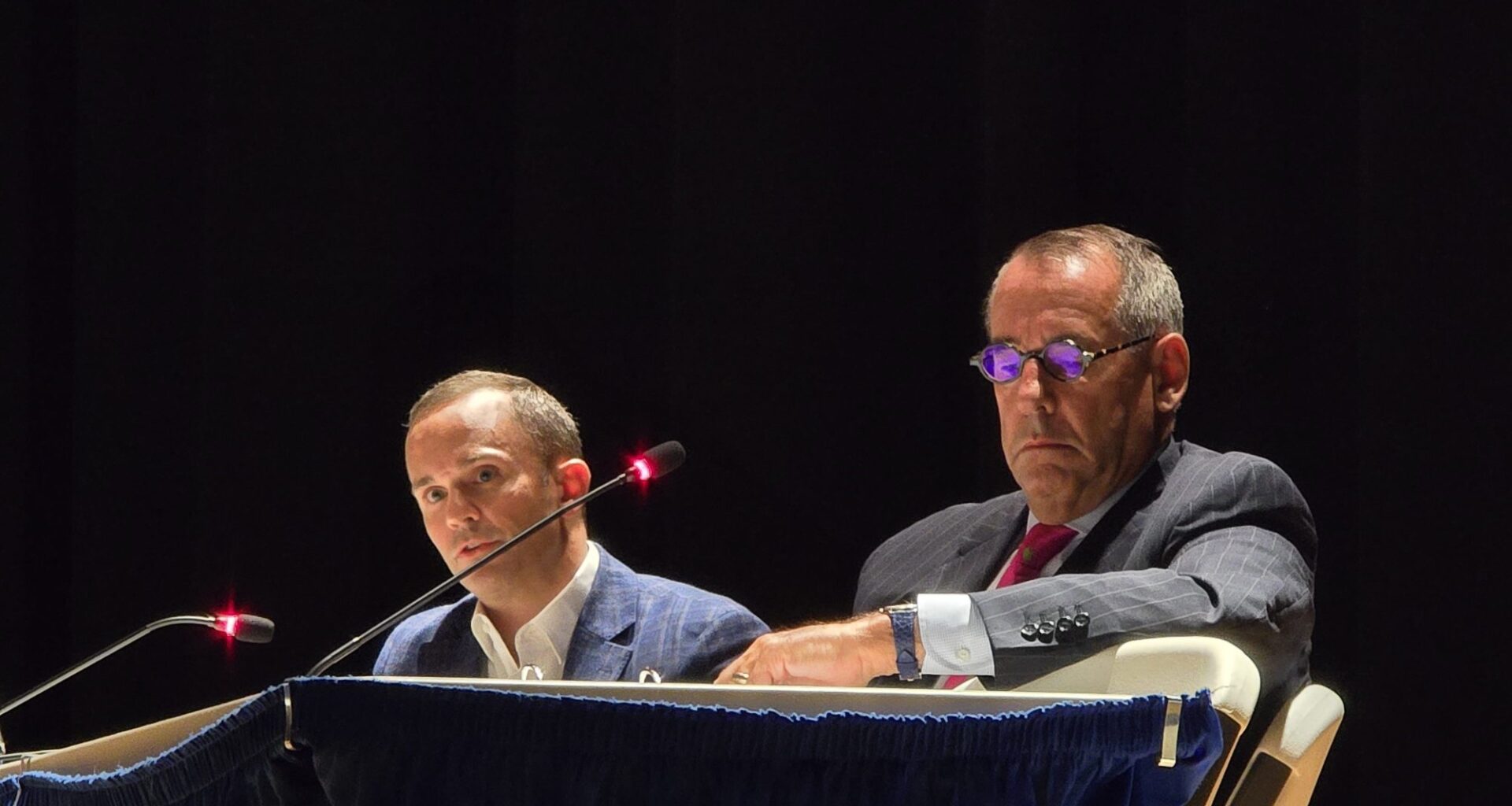
Archbald officials listen to testimony during a conditional use hearing for the Essential Energy LLC power plant at the Valley View High School auditorium in Archbald on Tuesday, Aug. 18, 2026. (FRANK WILKES LESNEFSKY / STAFF PHOTO)

KCI Technology’s technical lead of power generation, Andrew Markle, left, answers a question posed by Essential Energy attorney Frank Hoegen of Hoegen & Associates in Wilkes-Barre during a conditional use hearing at the Valley View High School auditorium in Archbald on Tuesday, Aug. 18, 2026. (FRANK WILKES LESNEFSKY / STAFF PHOTO)

A woman holds a “NO DATA CENTERS” sign during a conditional use hearing for the Essential Energy LLC power plant at the Valley View High School auditorium in Archbald on Tuesday, Aug. 18, 2026. (FRANK WILKES LESNEFSKY / STAFF PHOTO)
Show Caption
1 of 4
Archbald’s special counsel, attorney Brett C. Flower, cross-examines an Essential Energy LLC witness during a conditional use hearing at the Valley View High School auditorium in Archbald on Tuesday, Aug. 18, 2026. (FRANK WILKES LESNEFSKY / STAFF PHOTO)
Flower’s questioning underscored a prevailing question across data center hearings and related developments — how much information is enough to satisfy borough concerns over a project’s impacts on the community? Representatives for developers often cite an inability to refine their plans until after they receive conditional use approval from borough council. They contend the permitting and regulatory framework will mandate those protections, while borough officials and residents push for more information and guarantees to inform council’s eventual decision.
‘Can comply’
Deller repeatedly noted that the power plant is in the conceptual design phase.
“Regardless of who the operator is, regardless of what specific equipment is going to be selected, the same governing standards on safety and regulation and permitting requirements and constraints are going to apply to any and all users and/or equipment,” Deller said. “So if there’s something that deviates, they’ll have to still meet those same standards, regulations, permitting requirements.”
The governing laws and regulations are what protect public health and safety, Deller said in response to a question from Flower.
“At the conditional use phase, it’s our obligation to show that a facility of this nature can be designed, constructed and operated in a way that can comply with all the safety, public health and standards in all the different permitting processes, from a typical sense,” he said.
He acknowledged the inherent risks that come with a power generation facility, including fuel, combustion, exhaust and emissions.
“Those risks are mitigated to the levels required by the jurisdictions, whether that’s the local Archbald Borough ordinances or all the way up to the EPA,” Deller said.
Flower cited that the report pointed out the power plant’s proximity to schools, day cares, parks, residential neighborhoods and assisted-living facilities, and how the site must be designed to avoid a significant hazard to those properties. She questioned Deller on setbacks, asking him what is the smallest setback he has designed from a power plant’s turbine to an occupied structure, such as a home or business.
He said he didn’t know the exact distance off the top of his head.
“More than 500 feet (away from occupied structures)?” Flower asked.
“Probably,” Deller said.
“More than 1,000 feet?” Flower responded.
“Potentially,” he said.
‘There’s not an answer’
Karen Timmons, a cancer survivor who lives in the Highlands Archbald development less than a quarter-mile from the proposed power plant, continued the cross-examination on behalf of resident Meg Nudelman, who was out of the country. Timmons also cross-examined Deller last month.
Her questioning included the impacts on her neighbors on Foxtail Circle in the Highlands, many of whom are senior citizens with chronic health conditions, she said. She also asked Deller whether he considered the valley’s topography and how it can trap air pollution and noise.
Deller said he would let their air and emission expert speak to that. Nicole Wilson of engineering firm Earthres, who testified on Essential Energy’s air emissions on behalf of the developer during a hearing May 21, was not present Tuesday.
“It’s hard for me to think of another question because, basically, there’s not an answer anyway,” Timmons said.
At the May hearing, Wilson was asked whether they assessed how air emissions or noise would be affected by the valley.
“No, we didn’t do any air modeling, and typically that wouldn’t be required by the (Pennsylvania Department of Environmental Protection),” Wilson said at the time.
Valley View School District Solicitor Kyle Callejas inquired whether the safety report evaluated impacts on any Valley View school, including the intermediate school, which is about half a mile from the site. He asked whether the analysis included emergency response or evacuation considerations specific to any school building; if it evaluated construction, traffic, blasting or vibration impacts on schools; and whether Deller could identify where any natural gas pipelines would be located in relation to the intermediate school.
Deller deferred to subsequent reports and testimony, while acknowledging they have not determined where the natural gas pipeline would be located to fuel the power plant.
After Deller’s cross-examination, KCI Technology’s technical lead of power generation, Andrew Markle, spoke broadly about the operations and safety features designed into power plants. Markle touted his experience in the power generation industry both domestically and abroad, including overseeing 180 different natural gas units representing 5% of the entire United States’ electric grid, providing technical direction to the board of directors of the largest thermal power plant in Colombia, developing three 1,000-megawatt units in Turkey, and saying he “just worked on a plant for xAI,” Elon Musk’s artificial intelligence company.
Markle provided an overview of how a natural gas power plant like Essential Energy would operate and the safety features employed at the facilities. Essential Energy attorney Frank Hoegen of Hoegen & Associates in Wilkes-Barre guided Markle’s testimony through questions.
The power plant would be air-cooled and provide power to the grid, Markle said. The industry gives power plants a 30-year operating life based on the lifespan of their equipment, though they can be worked on indefinitely to continue, he said.
Markle contended he has seen power plants less than 100 feet from residences, saying, “We have the ability to change the design to meet the environment,” like putting the turbines on rubber mountings to reduce their sound.
He spoke about safety features including how the power plant would use piped-in natural gas, air pollution and the use of ammonia to reduce pollution, protections for electrical hazards, the use of a 200,000-gallon water tank for fire protection, building the facility to withstand weather hazards like wind and heavy snow, and backup and redundant systems.
Elicited through a question from Hoegen, Markle agreed the power plant can be constructed “so as not to create a significant hazard to public health and safety.”
“It’s been done hundreds of times around the United States,” he said.
The hearing concluded before cross-examination of Markle occurred. The next hearing will resume Sept. 29 at 5 p.m. at the Valley View High School auditorium, 1 Columbus Drive, Archbald.