
A developer radically changed plans for the $18 billion Project Gold data center campus amid concerns from residents of two North Pocono communities, scrapping talk of up to 1,000 backup generators and a possible nuclear reactor, eliminating an estimated 1 million gallon daily drain on local water, and reducing the number of data centers.
“In both Covington and Clifton townships, there was this strong sense that this was too dense,” said attorney Tony Maras, the principal and co-founder of developer Quantm Group LLC. “Even if it was permitted, there was a sense from the community that this was too much.”
Quantm Group filed a 4,000-plus-page conditional use application in Covington Twp. on Tuesday seeking approval to build just over 2.5 million square feet of data centers that would use 2.2 gigawatts of electricity along Interstate 380. The new application establishes Project Gold as the third-largest proposed data center campus in Lackawanna County based on building footprints, with the highest reported electricity demands of any proposal. Conversely, its water demands are exceedingly low, down from early estimates to just over 8,500 gallons per day.
The application depicts six one-story, 65-foot-tall data centers — four in Covington Twp. and two in Clifton Twp. — in addition to an up to 900-megawatt battery storage yard and two switchyards/substations, both of which PPL Electric Utilities would own.
The six buildings represent more than an 80% reduction in the number of data centers at the campus and a roughly 43% decrease in building footprints across the 1,000-acre site. However, each data center is significantly larger than the average building proposed in Lackawanna County. Proposed footprints have ranged from 130,000-plus-square-feet to just over 202,000 square feet, while Project Gold proposes four 388,500-square-foot data centers and two 475,006-square-foot data centers. Unlike Project Gold’s single-story facilities, locally proposed data centers are usually two stories.
The only larger individual data center proposed so far is the nearly 620,000-square-foot Project Boson in Archbald.
The campus falls into a data center and energy technology zoning district in Covington Twp. that conditionally allows the developments, subject to a hearing process culminating with township supervisors voting on the application. Zoning in Clifton Twp. is tied up in legal challenges.
Maras, who previously represented Project Gold under the limited liability company 1778 Rich Pike, said the campus has an end user who will be identified prior to the start of conditional use hearings in Covington Twp. He declined to identify the user Friday.
“Nondisclosure right now is not due to limitations of an NDA,” Maras said.
The end user is a publicly traded company, and to prevent speculation on stock values, Maras said he has been advised that he “cannot disclose the entity until a later date.”
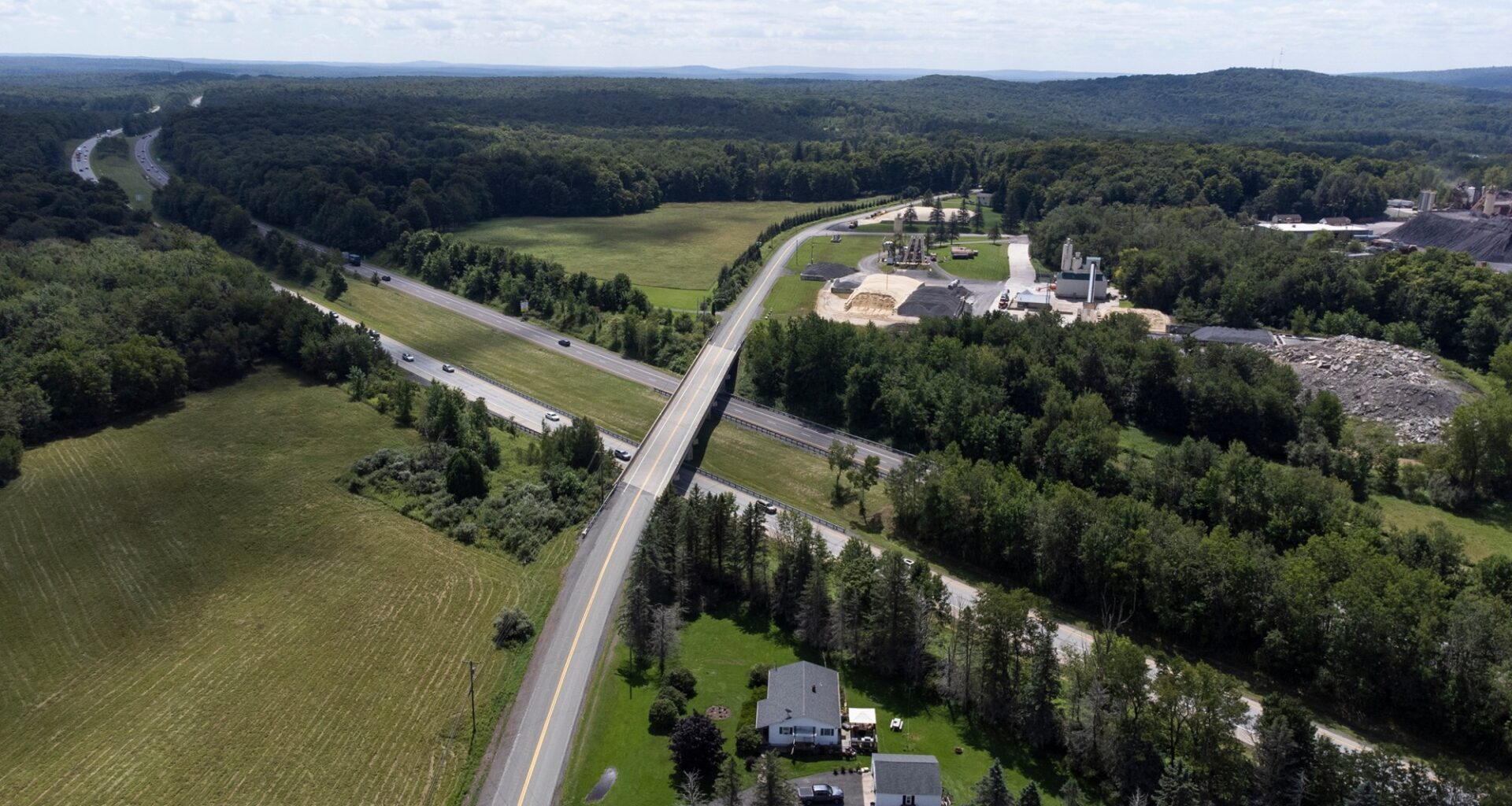
The entire site is 998.8 acres; about 564.1 acres fall in Covington Twp., with the remaining 434.7 acres in Clifton Twp., according to a project narrative. It is divided into two campuses split by Interstate 380.
The Northwest Campus begins near the Dorantown Road overpass at Interstate 380, continuing south on the west side of the interstate until just beyond the Clifton Twp. line. It encompasses all four Covington data centers and one Clifton data center. Crossing over Interstate 380 on the east and moving south, the Southeast Campus proposes a Clifton Twp. data center north of Clifton Beach Road, with a battery storage yard just south of the road.
Quantm Group, 120-124 E. Lancaster Ave., Suite 101, Ardmore, estimates it will be an $18 billion investment.
Changing plans
Project Gold’s new application is different from its original plans presented a year ago. Beyond changing the size and layout of its data centers, the project significantly changed its water use and cooling, the source of its electricity and its means of backup power in the event of an outage. The application also commits the project to Gov. Josh Shapiro’s Governor’s Responsible Infrastructure Development, or GRID, standards, which Shapiro strengthened via executive order Tuesday.
In addition to concerns from the community regarding the scale of the project, Maras attributed the redesign to the end user wanting a greener campus, new technology that allows more computing power per square foot, and work with PPL to invest in electric infrastructure. The developer will pay to bring more power to the site and create redundancy for the data centers and the grid, Maras said. Power lines will connect from the north and south using existing easements, allowing Project Gold to receive power during an outage, rather than rely on backup generators.
“If the entire northern segment went away, this facility can still run and operate. If the entire southern segment went away, the facility can still run and operate,” Maras said. “If the north and the south are gone, you have to think of some sort of cataclysmic event because the system is designed to be redundant.”
The project will tap into between 750 megawatts and 900 megawatts of grid-connected on-site battery storage owned and operated by PPL, he said. The batteries will allow PPL to store excess power on the grid generated from green energy sources like wind and solar farms, then later draw from the batteries to supplement the grid, he said.
The battery system also acts as a buffer between data centers and the grid, Maras said.
“The battery can respond instantly, and then also respond when the demand drops,” he said, explaining it helps to stabilize the grid.
The only generators on site — 18 “life safety backup generators” — will power things like emergency lighting and fire pumps, Maras said.
The earliest plans for Project Gold called for 35 data centers, each around 125,000 square feet, three stories and 120 feet tall. The concept plan reserved space for either a natural gas power plant or a small modular nuclear reactor. To power the data centers in an emergency, it would have relied on more than 800 backup generators, maxing out at up to 1,000, according to the application. Massive yards of diesel generators have emerged as a core concern surrounding data centers due to their noise and air pollution. Zero-emission battery storage still carries risks, including the difficulty of extinguishing battery fires.
As part of its community-benefits agreement, Maras said they would ensure local first responders were adequately prepared to address the batteries. He also said battery technology could evolve by the time the project would be ready to install them.
The original campus would have also used an open-loop/evaporative cooling system sustained by groundwater. Early estimates for 35 data centers exceeded 1 million gallons per day, Maras said.
Project Gold’s second iteration scaled back those plans to 13 two-story, 65-foot-tall data centers — plus administration and warehouse buildings — while removing plans for an on-site power plant and switching to a closed-loop cooling system that cycles water without evaporating it off, reducing the demand.
The plan now proposes six data centers offset with about 290 acres of open space and 100% grid-supplied electricity, with all upgrades funded by the developer. The campus would have on-site wells for potable water, humidification and fire suppression, amounting to about 8,512 gallons per day for the entire campus, equal to about 35 residential homes, according to Quantm.
The water for data center closed-loop cooling systems would be trucked in via tanker, supplemented by reusing treated wastewater from the Covington Twp. Sewer Authority’s treatment facility, Maras said.
Quantm Group is paying for improvements to the sewer treatment plant, Maras said.
The developer contended that data centers are an essential service in daily life and pointed to the tax revenue for North Pocono from the development.
“We have to find a way to develop these responsibly, and I think we’ve shown that we’re responsible,” Maras said. “We’re proud of that.”
Commissioner’s concerns
Democratic Lackawanna County Commissioner Bill Gaughan, who spearheaded efforts to conduct a countywide health and air-quality assessment of the impact of proposed data centers and power plants, said the downsized project didn’t allay his concerns.
“We shouldn’t be fooled into believing that because an enormous project becomes less enormous, that it suddenly becomes harmless,” Gaughan said. “They essentially started off asking the community in North Pocono to swallow an elephant, and now they’re cutting it up into a couple pieces, and they want us to call it a snack.”
He believes the change of plans represents the effect a community can have on development.
“The real story, I think, is not that the developer suddenly saw the light, as they’re saying, but that ordinary citizens up there stood up, demanded answers, and essentially forced a multibillion-dollar industry to change its plans,” Gaughan said. “I’m interested in permits, engineering studies, independent verification — trusting them is not a regulatory standard.”
The redesigned campus strengthens the need for scrutiny of proposals, Gaughan said. Removing plans for on-site power plants and high water demands shows scrutiny is warranted, he said, emphasizing, “I don’t think anybody should declare victory on this thing.”
“The public needs to keep the pressure up as they have been doing, force better answers, better plans,” he said. “It proves to me scrutiny is definitely justified on all of these things.”
How it compares
Project Gold’s earliest plans would have made it Lackawanna County’s largest proposed data center campus. The new proposal dropped it to third largest by building footprint at just over 2.5 million square feet of data centers.
The largest proposal in Lackawanna County remains the Wildcat Ridge Data Center Campus above Business Route 6 in Archbald. Wildcat Ridge seeks approval for 14 two-story data centers, each 80 feet tall with 202,340-square-foot footprints, according to its conditional use application from January. That amounts to about 2.83 million square feet of data centers.
The second largest would be Project Scott in Archbald at nearly 2.79 million square feet of data center footprints, proposed between Eynon Jermyn Road and Business Route 6. Project Scott consists of 18 two-story data centers; the buildings would have 154,850-square-foot footprints while rising to about 90 feet, according to a December conditional use application.
While Project Scott’s electricity demands are unclear, Wildcat Ridge had the highest reported electricity demands of any campus proposed in Lackawanna County, seeking to use 1.6 gigawatts, or 1,600 megawatts. Project Gold now trumps that with 2.2 gigawatts.
Wildcat Ridge requested to use a maximum of just over 3.3 million gallons of water per day from Pennsylvania American Water during the hottest summer weather, with a daily average of 598,000 gallons throughout the year.
Comparatively, Project Gold’s water demands represent some of the lowest reported needs in the county at 8,512 gallons per day.
Project Gold is the second data center campus in Lackawanna County to consider battery storage instead of generators, though it is the first to formally propose doing so. Last month, Mudiita Land Venture LLC, a Carbon County-based firm with a parent company in New Jersey, spent $2.4 million on 528.6 acres in Ransom Twp. south of Ransom Road and west of South Keyser Avenue. An affiliated, now-removed website for Mudiita Infra advertised a 930-plus acre hyperscale data center campus in Ransom Twp. with a 750-megawatt capacity and a battery storage yard.
Project Gold’s conditional use application cites Shapiro’s May 27 GRID standards that encouraged the use of zero-emission energy storage when possible. The new order does not reference battery storage.
A letter Tuesday from a PPL executive to Maras and Quantm Group confirmed the utility has the ability to provide 2.2 gigawatts for Project Gold’s peak demand. The document placed the onus on Quantm for funding.
“Our first priority is keeping the lights on. PPL Electric plans and invests carefully so the electric grid can support new, large customers like data centers while maintaining reliable service for homes and businesses across our communities,” wrote Joseph B. Lookup, PPL Electric’s vice president of transmission and distribution planning and asset management.
The existing transmission grid has the capacity to support the project, and with proposed upgrades, the new 2,200-megawatt load can be added in a safe, reliable system, Lookup wrote.
Large-load customers like data centers pay directly for the electrical upgrades solely dedicated to their utility service, preventing other customers from footing the bill, according to the letter.