
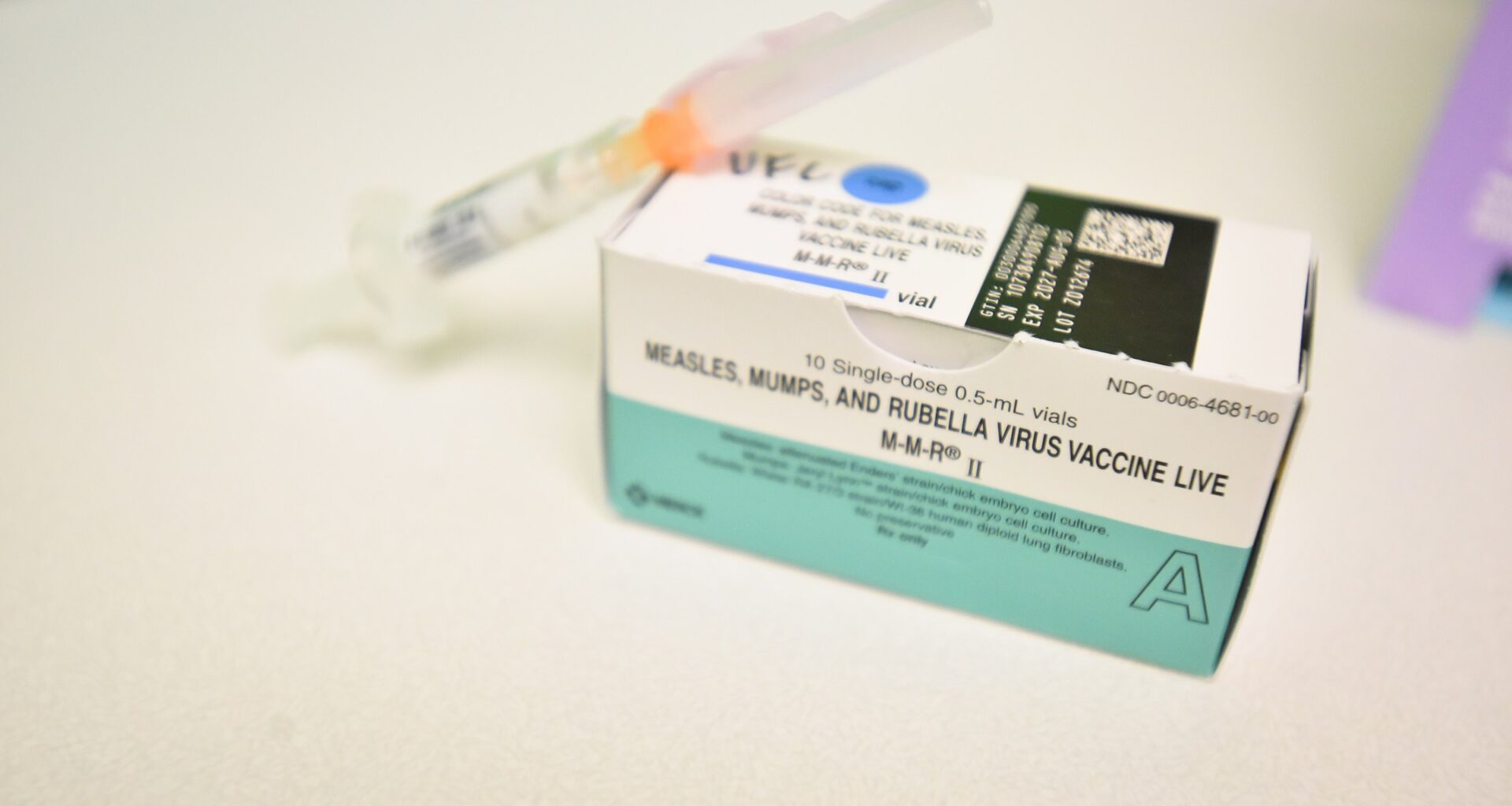
With parents and students preparing for school to start again as measles cases continue to climb in parts of Pennsylvania, kindergarten-level immunization data from last school year shows dozens of elementary schools in the state’s northeast region reported measles, mumps and rubella (MMR) vaccination rates under 95%.
That key immunization threshold is important as measles can “easily cross borders and cause outbreaks in any community where vaccination coverage rates are below 95%,” per the U.S. Centers for Disease Control and Prevention. The CDC recently released data showing vaccination coverage among kindergarteners in the United States dropping during the 2025-26 school year for measles and all other reported vaccines from the year prior, with American Academy of Pediatrics President Dr. Andrew Racine noting in a statement that “even a small decrease in vaccination rates can lead to more outbreaks of disease because community immunity requires over 95% of susceptible individuals to be immunized.”
The national data and local school vaccination statistics published by the state Department of Health come amid the worst year for measles in the U.S. since 1991 — 2025 was the second worst — with Pennsylvania contributing to the nationwide surge. While there’s still yet to be a confirmed measles case in Northeast Pennsylvania this year, the number of confirmed cases statewide hit 379 as of Friday after Pennsylvania recorded just 16 cases of the highly contagious viral respiratory disease last year.
State school-level data also shows MMR vaccination rates among kindergarteners having dropped at many Northeast Pennsylvania elementary schools compared to the 2018-19 school year, declines that coincide with rising levels of vaccine hesitancy nationwide.
The region
While rates at individual schools varied, county-level school vaccination summaries for both public and private schools show Lackawanna, Luzerne and Schuylkill counties all exceeded the 95% MMR vaccination threshold for kindergarteners during the 2025-26 school year.
Other more-rural counties in the region fell short, per the state Department of Health summaries.
DOH reports that 96.4% of 2,086 students enrolled in kindergarten in Lackawanna County had received at least two doses of the MMR vaccine. That was the case for 95.8% of 3,576 enrolled kindergarteners in Luzerne County and 95.8% of 1,370 enrolled kindergarteners in Schuylkill County.
Rates in other local counties were lower, particularly Wayne, where just 84.9% of enrolled kindergarteners had at least two MMR doses last school year. Pike County’s kindergarten rates were slightly higher at 86.4%, followed by Monroe, 90.2%, Susquehanna, 92.8%, and Wyoming, 94.2%.
Gary Decker, M.D., director of infection control services for Commonwealth Health’s hospitals in Lackawanna and Luzerne counties, said the MMR vaccine remains the best way to protect against measles and the 95% threshold for community immunity applies regardless of population size.
“Whichever population you’re measuring — whether it’s the country, a state, a county or an individual school district or an individual school within the district — it holds true that to provide herd immunity to the entire population you’re measuring … you have to achieve 95% immune success,” he said.
Individual schools
A number of local elementary schools fell short of that target for measles, even in the counties where the overall kindergarten vaccination rate exceeded it.
In Lackawanna County, for example, eight such schools were below the 95% MMR benchmark for kindergarteners last school year: Clarks Summit Elementary, 94%; Jefferson Elementary, 85.1%; Moscow Elementary, 91.9%; Newton Ransom Elementary, 91.7%; Old Forge Elementary, 94%; Our Lady of Peace School, 89.4%; Robert Morris Elementary, 94.1%; and South Abington Elementary, 93.9%.
All but two of those schools, Our Lady of Peace School and South Abington Elementary, were above 95% during the 2018-19 school year.
Jefferson Elementary accounted for the most precipitous drop between those two points, with its MMR vaccination rate falling from 98.2% to 85.1%. Only one of the aforementioned eight schools, South Abington Elementary, reported a higher rate last school year than during the 2018-19 school year, and that increase was nominal at just 0.1%.
In Luzerne County, state data shows seven schools below the 95% MMR benchmark for kindergarteners: Bear Creek Community Charter School, 94.7%; Cheder Menachem Inc., 61.3%; Cheder Menachem Schuyler Avenue, 75%; Freeland Elementary/Middle School, 90.6%; Good Shepherd Academy, 92.6%; Lyndwood Elementary School, 93.3%; and Rice Elementary School, 93.1%.
Data from the 2018-19 school year was available for four of those schools — Bear Creek Community, Freeland, Good Shepherd and Rice — all of which reported MMR rates above 95% at that time. For the purposes of this analysis, the newspaper compared Lyndwood’s rates last school year to those of Hanover Green Elementary School where Hanover Area School District students attended kindergarten during 2018-19 academic year, when the MMR rate there was 97.5%.
Cheder Menachem, a private Jewish school with locations in Wilkes-Barre and Kingston, reported relatively large percentages of students with religious exemptions to vaccine requirements at both sites last school year. Pennsylvania law allows students to forgo otherwise mandatory vaccines for medical or religious reasons or based on a strong moral or ethical conviction.
There were four schools in Schuylkill County with fewer than 95% of enrolled kindergarteners vaccination against measles for 2025-26: Blue Mountain Elementary East, 89%; Blue Mountain Elementary West, 87.3%; the Early Childhood Education Center in the Minersville Area School District, 88.2%; and Saint Clair Area Elementary/Middle School, 94.3%. All four reported MMR vaccination rates above 95% during the 2018-19 school year.
The state database for 2025-26 shows at least 22 other elementary schools across Monroe, Pike, Susquehanna, Wayne and Wyoming counties with kindergarten MMR vaccination rates below 95%, though it isn’t exhaustive. Among other caveats, the database doesn’t list data for schools with kindergarten enrollment under 20 students, which is the case for many smaller private schools, and wouldn’t include schools that didn’t submit an immunization report to the state health department for the 2025-26 school year.
To search the database, visit www.pa.gov/agencies/health.
Vaccine hesitancy
The yearslong trend of declining kindergarten vaccination rates isn’t unique to the region or state, and measles has become less uncommon in recent years amid those declines.
The nonprofit health policy research, polling and news organization KFF reported last year that continuing trends of declining vaccination rates for kindergarteners — and increasing rates of exemptions from school vaccination requirements, particularly non-medical exemptions — began during the COVID-19 pandemic and “appear to be related to increasing vaccine hesitancy, fueled in part by vaccine misinformation.”
“The past few years have seen more skepticism among the public about the safety and effectiveness of measles vaccines, a decline in trust of health authorities in general, and increasingly partisan views on vaccine requirements,” the 2025 KFF issue brief notes.
It also notes that 39 states, including Pennsylvania, had MMR vaccination rates below 95% for the 2024-25 school year, up from 28 states during the pre-pandemic 2019-20 school year.
Decker, the Commonwealth Health doctor, attributed declining vaccination rates in schools and more broadly to several different factors, including complacency among parents and members of the general public who may underestimate the risk of measles and other diseases because they haven’t encountered them before due to the success of vaccines. He also cited barriers to care that might prevent uninsured individuals, those without transportation and others from accessing vaccines, and vaccine hesitancy stemming from “pervasive” anti-vaccine narratives.
Decker pointed to an ultimately retracted 1998 study that he said “falsely linked MMR vaccine to causality with autism,” emphasizing that “it’s been disproven over and over that there’s any link” between the two and that large-scale studies have shown no such link.
“But, in any event, there are still those with an anti-vaccine sentiment that continue to perpetuate that message of misinformation through their narratives on social media,” he said. “So I think you have complacency, you have barriers to care and then you have the national sentiment of anti-vaccine, and unfortunately it’s been driven by mostly people who aren’t that knowledgeable, they’re not vaccine experts, they’re often conspiracy theorists and so forth.”
The prevalence of anti-vaccine narratives on the internet is making vaccine hesitancy more widespread, Decker contends.
“I think that prior to widely available information on the internet the vast majority of public-health decisions were driven between patient, parent and doctor or the healthcare system, and there was a significant amount of trust in the healthcare system,” he said. “And I think also there’s been erosion in trust in the healthcare system, which is due to a lot of things. It can be due to bad patient experience. It can be due to non-healthcare providers critical of the healthcare system. It can be driven by anti-insurance sentiments. There’s a lot of reasons that drive that, but I do think that a significant number of Americans now get their health information off the internet and they don’t directly discuss the pros and cons of any healthcare issue with their provider.”