
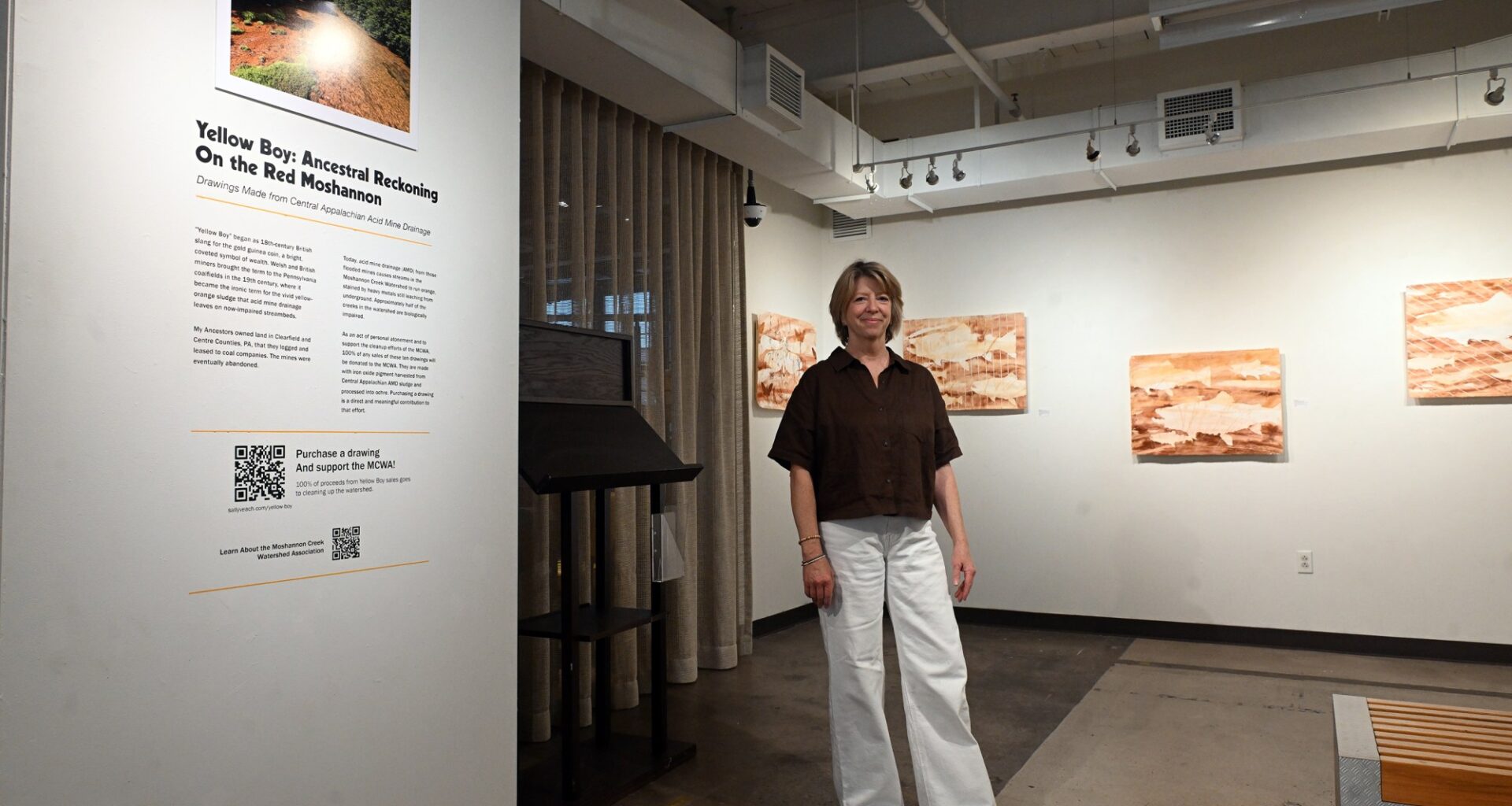
Sally Veach views her art as an act of atonement.
In the 19th century, her fourth great-uncle sold land in Centre and Clearfield counties to coal companies that mined underground until the seams played out in the mid-20th century.
The mines were abandoned, and the acid drainage from the flooded mines has leached into the water of the Moshannon Creek, turning it yellow.
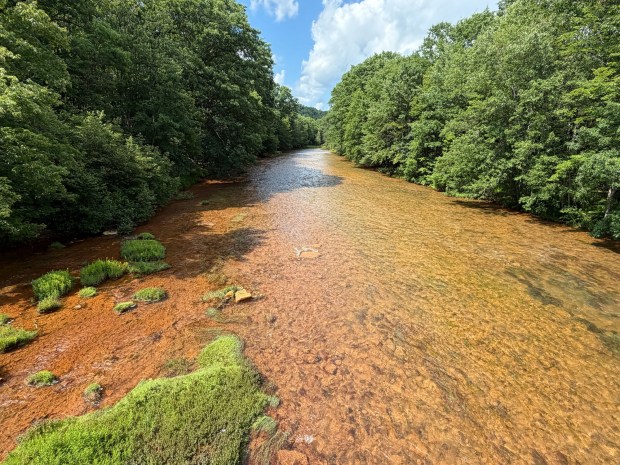 The Moshannon Creek between Centre and Clearfield counties in central Pennsylvania runs yellow with acid mine drainage from abandoned coal mines. (Courtesy of Sally Veach)
The Moshannon Creek Watershed Association was formed to try to mitigate the damage, Veach said as she put the finishing touches on her exhibit at the GoggleWorks Center for the Arts in Reading.
“They’re doing passive and active treatment to restore the watershed,” she said. “They’re getting grants to build the treatment plants, but they need day-to-day operational support. So I decided to do this personal project of atonement.”
The 10 drawings comprise the exhibit “Yellow Boy: Ancestral Reckoning on the Red Moshannon,” a part of her larger exhibit “Hubris and the Sublime,” which will open Aug. 21 with an artist’s reception from 6 to 8 p.m. at the GoggleWorks, 201 Washington St. The exhibit runs through Oct. 12.
Veach, who lives and works in the Shenandoah Valley of Virginia, created the drawings using iron oxide pigments derived from mine drainage in eastern Pennsylvania along with pieces of coal she picked up from land once owned by her ancestors.
She will donate 100% of the proceeds from the sale of the drawings to the watershed association.
“It all ties in with my overarching interest as an artist in the natural world and our place in it,” she said. “I don’t even like to say our place in it because what we do within the natural world and the fact that we’re part of nature, but also stand apart from nature, is very interesting to me.”
The title of this section of her exhibit is derived from the 18th century British and Welsh slang for the gold guinea coin, a term the immigrants brought to the mines in the 19th century, when it was used to refer to the waste sludge, Veach said.
Her drawings steeped in the ochre of the mines depict the shadows of what a healthy stream would look like with vibrant brook trout, stoneflies, mayflies and caddisflies.
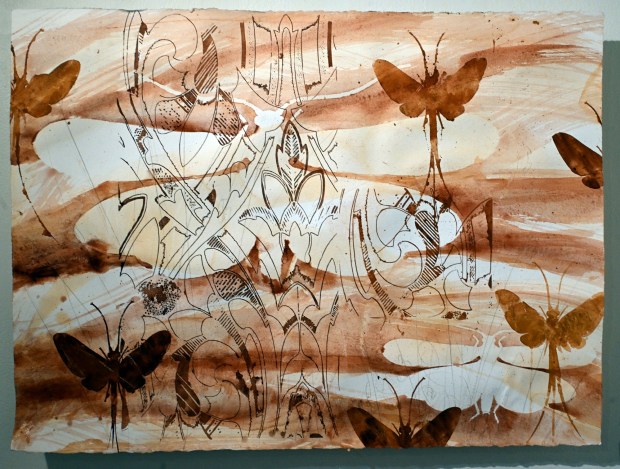 Sally Veach’s “Red Mo #9 /Gilded Age Stonefly” is a painting on display at the GoggleWorks that was created with pigments from acid mine drainage from abandoned coal mines. (BILL UHRICH/READING EAGLE)
Overlaid on the drawings are images from 19th century textile designs.
“These patterns all happened in the Gilded Age,” she said. “Like even Reading. I drive around Reading and think this is Gilded Age, and a time capsule. It’s amazing.”
Her drawings are done on handmade paper. The works were float mounted for the exhibit.
She sees her drawings much like those living time capsules, with the pigments and lines drawn with coal changing with the passage of time.
“It becomes a time-based piece as well,” Veach said. “It’s curious what will happen over the years.”
Although wishing to atone for the environmental damage that the coal mining reaped, she doesn’t judge her ancestor’s role in it.
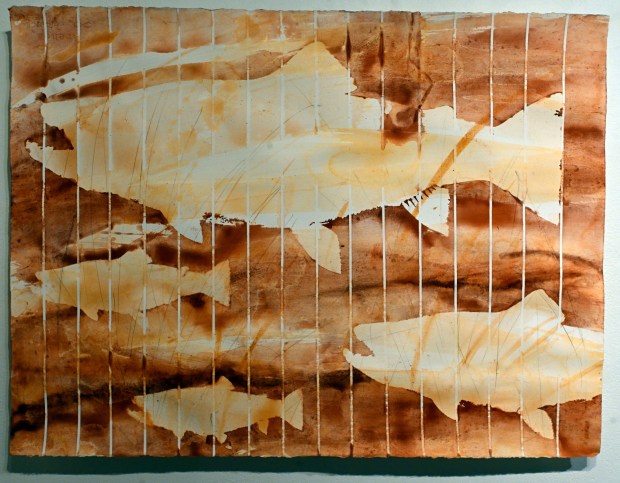 Sally Veach’s “Red Mo #1/Brook Trout” is a painting on display at the GoggleWorks that was created with pigments from acid mine drainage from abandoned coal mines. (BILL UHRICH/READING EAGLE)
Both the grandfathers of one of the watershed association’s members were coal miners, Veach said.
“He’s proud of them,” she said.
“He says the coal mining was like this. This much was good,” she said, extending her arms.
“This much is bad,” she said, narrowing the space. “That’s how he feels. They were able to come from eastern Europe and make a living.
“There are a lot of thoughts that keep swimming around.”
Like the brook trout and the mayflies and the stoneflies.
“They’re a nice symbol,” she said, “of maybe doing something good in the world.”