
Despite major advances that have made advanced lung cancer more treatable, fewer than half of older patients with the disease receive treatment — a gap experts say begins with late diagnoses and extends to barriers that persist even after cancer is found.
According to a study of 250,000 older adults ages 68 to 80 conducted from 2006 to 2021 and recently published in JAMA, only 46.8% of patients received systemic therapy for widespread non-small-cell lung cancer — the deadliest form of cancer in the United States. A modest 3% increase was seen over that timeline.
A full third never saw an oncologist.
That’s all despite numerous new drugs and therapies hitting the market over the same span that serve to enhance patients’ quality and length of life even after the cancer has become metastatic.
Dr. Ariel Lopez-Chavez of Gibsonia, medical oncologist and director of the Precision Medicine and Developmental Therapeutics Cancer Clinic at the AHN Cancer Institute, has been studying this problem since the early 2020s. He believes a low lung cancer screening rate is one key player in low treatment rates for the progressed disease.
“It’s probably under 10% of patients that are eligible for screening don’t get screened to begin with. That’s one of the reasons why people don’t get treatment. And they get diagnosed way too late, when it may be too late to act,” he said of the low-dose CT scan screening typically available to those who have a 20 pack-year smoking history and are ages 50 to 80.
According to the CDC, “a pack-year is smoking an average of one pack of cigarettes per day for one year. For example, a person could have a 20 pack-year history by smoking one pack a day for 20 years or two packs a day for 10 years.”
A full 40% of lung cancers have advanced to stage 4 by the time they’re diagnosed, according to a 2015 study. Around 40% of those studied passed away within three months of diagnosis.
“Without the screening, we don’t know until people start having symptoms,” said Lopez-Chavez. “And once they have symptoms, then it starts getting more complicated.”
But late diagnosis is only part of the problem.
Why people are not being treated — and what they
could be missing
In Lopez-Chavez’s mind, emotional factors like shame regarding smoking-induced lung cancer (80% per the CDC), fear of perceived treatment side effects and general fatalism, alongside more tangible factors like barriers to access and lack of knowledge about treatments, may all work against patients getting treatment.
Access to financial resources and transportation also played a role in the numbers. Treatment likelihood was lower among patients who were unmarried, lived in a rural area, or were Black or Hispanic.
“They may think that all cancers are just treated with heavy-duty type of chemotherapy. They may recall seeing a movie in which people did really poorly and they had a miserable experience while they were getting treatment. And they may think if they’re feeling bad right now because of the cancer, if they get treatment like that, they may just have a worse time and die in pain,” he said.
But cancer treatment is constantly evolving.
“In each generation, the treatment(s) get more effective and with less side effects,” said Lopez-Chavez. “It’s to the point that to some patients it’s just like having another chronic disease. They’re taking a pill and they’re having otherwise no symptoms or very minimal symptoms and being able to go to work, do all the regular activities without really noticeable (side effects) — very, very minimal.”
Over the past 20 years or so, the outlook for advanced lung cancer patients has improved with the advent of targeted therapies and other nonchemotherapy treatments.
“Targeted therapies are very unique because a lot of them are in the form of pills. There’s no chemo,” said Lopez-Chavez. “And some of them will have extraordinary effectiveness. People that otherwise would just die in six months without treatment, they can get survivals of more than five years by just taking a pill.”
Personal viability depends on biological factors that must be examined through a molecular test.
“I was really surprised to see that nationwide the testing rates are low. You would think that they would be closer to 100% if they
are that important, right? But they’re consistently under 40% or worse. Sometimes then you see analyses in which they’re 20%,” said Lopez-Chavez. “So it’s just, ‘How can that be?’ I think that’s one of the biggest problems that we have.”
He says around 50% of patients are eligible for targeted therapies. Some who are not eligible can still benefit from immunotherapies like Keytruda, which helps the body’s immune system fight off cancer.
“We have also seen amazing responses there as well — we’re talking about three, four, five and more than five years just with immunotherapy. Not getting a lot of side effects: not losing their hair, not vomiting — nothing,” he said. “We’re talking about good quality of life when we’re talking about targeted therapies, and even with immunotherapy, too.”
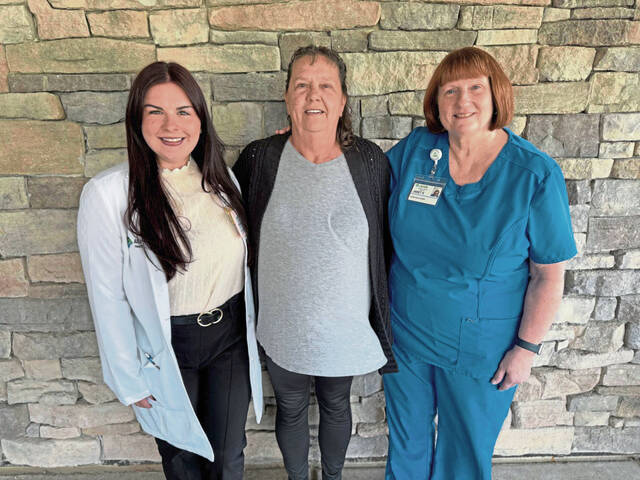
Diagnosed with advanced lung cancer in 2021 after pursuing treatment for what she believed to be kidney stones, 63-year-old Ellwood City resident Carol Shablensky is living proof of the treatment advancements.
She first received a year’s worth of chemo and radiation but has since enrolled in two different clinical trials providing access to experimental treatments through AHN’s year-old partnership with the national Tempus Time Trial program.
“I did not really think I was going to survive this long,” Shablensky said. “I figured a year or two at most, and it’s kind of shocking to have made it the five years.”
Lopez-Chavez champions the program’s linking of patients like Shablensky with treatments that are not yet FDA-approved.
“We have the availability to bring some of those newer therapies to the patients now,” said Lopez-Chavez. “In the old days, some of these trials would take months to open. We have sometimes very aggressive cancers that will grow really quickly, so a patient cannot be waiting months. Through this program, we have reduced the time that it takes us to open a trial to weeks.”
Shablensky takes two divarasib pills a day at home as part of a yearlong targeted therapy study that causes her side effects limited to nausea and constipation. She also underwent a yearlong immunotherapy treatment. One of her lung nodules being monitored by doctors has disappeared completely during the process, while the other has grown by a millimeter.
“We still walk the dog for half a mile every day. I’m still out in the pool every day. I’m still doing literally everything I used to do,” she said of the time she’s been able to spend with her husband Richard and their cane corso dog. “I love to cook. I still cook every day.”
Chemotherapy, too, has changed.
“We have some chemotherapies that are a newer generation of chemotherapies,” Lopez-Chavez said. “They get surprised sometimes, patients, because they come to me and think we’re going to use chemotherapy and they’re going to be in the back room vomiting all the time, lose their hair and everybody’s gonna know that they have cancer.”
“It’s nothing like it used to be,” Shablensky said of the treatment process as a whole, noting the worst thing that she’s experienced was losing her hair during chemo. “It is so much easier.”