
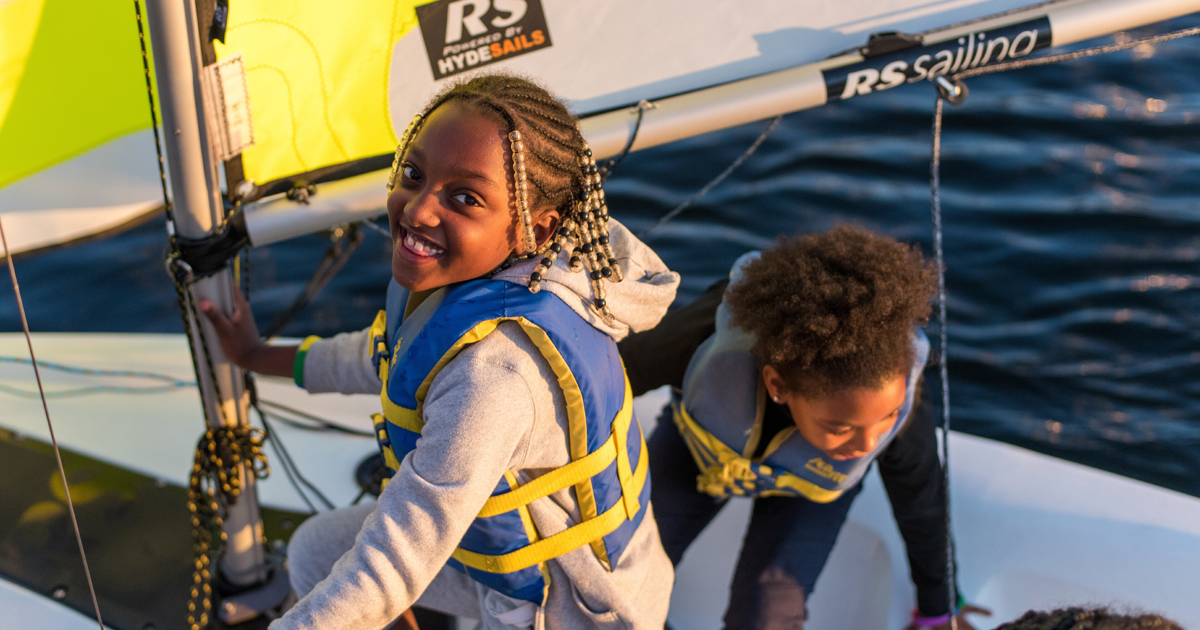
A middle school student steadies a rowing shell along the mighty Cuyahoga River. Another one checks wind direction before raising a sail. They aren’t thinking about fluid dynamics, force vectors or watershed science. Yet they’re experiencing all three.
“Take a child through a forest, and watch how they start thinking about the habitat around them,” says Mike Trebilcock, co-founder with his wife, Gina, of The Foundry. “Draw an analogy to the river and lake. When they open their eyes, they’re seeing a completely different environment.”
This philosophy took a major step forward in June with the opening of the Patrick S. Parker Community Sailing Center at Cleveland Metroparks’ East 55th Street Marina. It expands access to rowing, sailing and an array of STEM-centered programs.
“We believe the water is for everyone,” says Trebilcock.
And Lake Erie is the ultimate learning lab — it’s one of Northeast Ohio’s most dynamic classrooms. Across the region, educators, scientists and community organizations are bringing STEM to life through hands-on exploration and discovery.
“What we’re trying to get across is the natural resource, the cultural resource, the economic resource and the drinking water resource that Lake Erie is to us,” says Mary Rouse, director of outdoor experiences for Cleveland Metroparks.
Current Events
A fish flops in a metal bin as students drop to their knees for a closer look. One eagerly reaches for a scalpel. Another peers into a microscope at plankton no bigger than grains of pepper. Across the room, someone lets out a “Whoa!” while watching minuscule heartbeats inside the transparent organism.
This is Stone Laboratory on Gibraltar Island, and its programs transform Lake Erie into a hands-on STEM classroom.
Operated by Ohio State University in partnership with Ohio Sea Grant, the island field station welcomes about 2,700 students each spring and fall for immersive field experiences that take learning from textbooks to research vessels, laboratories and the lake itself.
Students spend time aboard research vessels collecting fish and plankton before bringing their discoveries back to the lab.
“We see lots of giggling, oohs-and-aahs and screaming,” says Chris Winslow, executive director of Ohio Sea Grant and Stone Lab. “It all happens.”
Some have never seen a fish up close, let alone dissected one.
“We learn about how to identify the body parts in different species, and they get a real look inside at what we pulled up from 25 feet below the boat,” he says.
As for those funny floaters dredged up from below, “If it’s something transparent that’s been eating algae, they’ll see a little green line through the organism as the algae moves through its stomach,” Winslow points out to students.
They witness a real speck of lake life at work.
“They realize the lake has a color to it,” Winslow continues. “When you put the water in a jar, that greenness, those are little plants growing in real time.”
For many, it’s their first trip onto the lake.
“Stone Lab is a life-changing inflection point in many of the students’ lives,” he says.
Those experiences help students understand the big and the small of the Great Lakes, Winslow points out. Together, they hold about 20% of the world’s surface freshwater, and the way we behave around our watersheds matters.
“What we do on the landscape and what runs off our parking lots goes into that lake and alters that ecosystem,” he says. “You can’t manage what you don’t measure. If we can get more kids and adults on the water and craving that information, we can do good things with these Great Lakes.”