
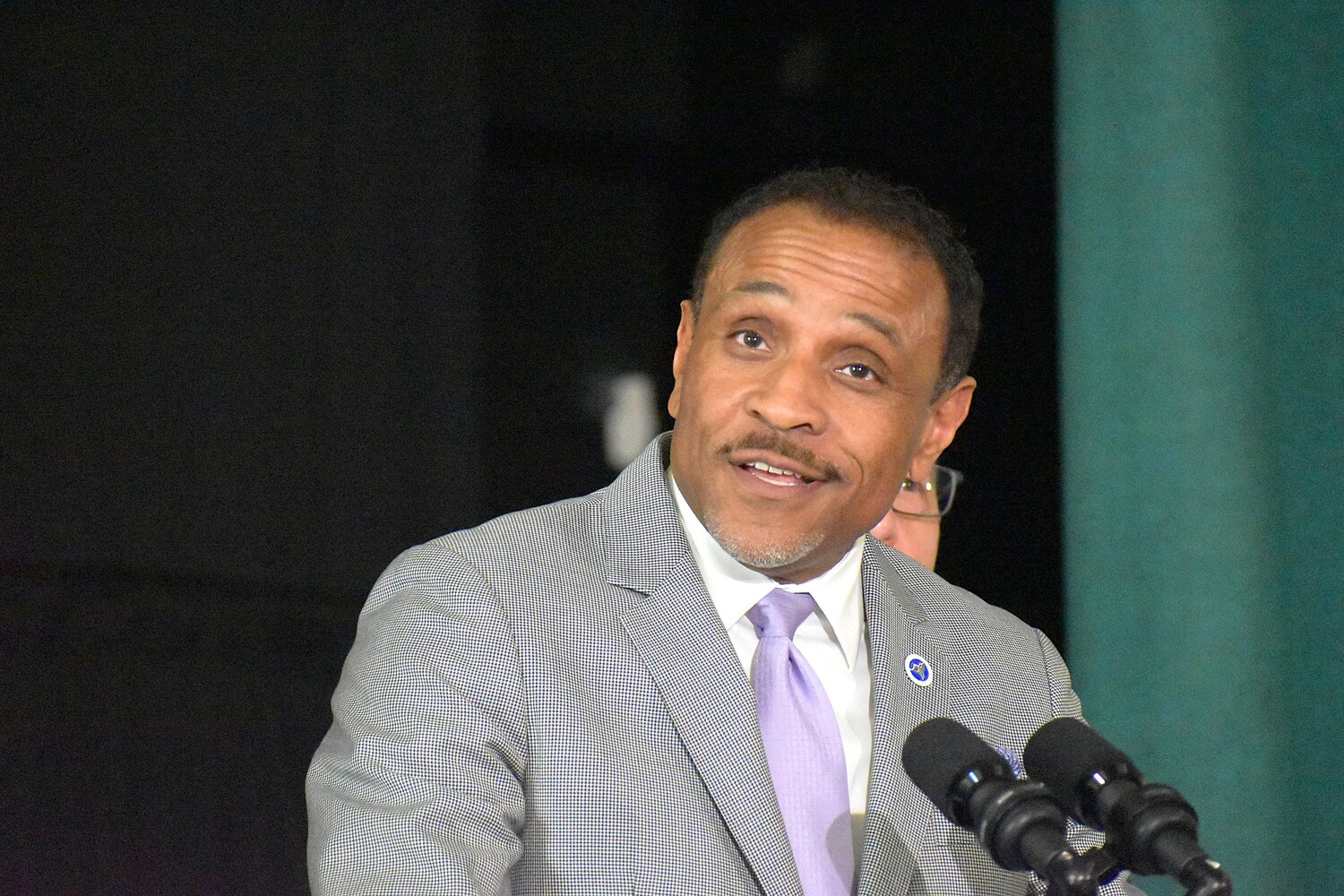
Philadelphia’s public school students returned to classrooms this week, and Superintendent Tony Watlington said the year is “off to a great start.”
Over the coming months, the School District of Philadelphia is going to focus on academic improvement, enhancing customer service and building stronger bonds with families, according to Watlington.
On the last point, the district is planning to launch a cellphone app where parents can monitor their child’s grades, lunch menu, extracurricular activities, he said. The school system also intends to hire community ambassadors to strengthen ties between schools and their neighborhoods.
Watlington sat down with Metro on Wednesday morning. The following conversation was edited for brevity and clarity.
As far as accelerating academic achievement, are you hoping to build on the progress that has been made or do something new?
We’re going to keep building on the progress, but we’re going to double down on how we support our teachers in delivering the reading curriculum. We’ve made a lot more progress in math than in reading, and so we’re going to make sure that our teachers are prepared to teach the science of reading.
We’re going to do what we need to do to encourage our kids to do more reading. We want to get our kids reading books from cover to cover, because our kids aren’t reading enough. We want to make sure that we’re giving our children access to reading materials that they’re highly interested in.
Gov. Josh Shapiro has proposed a “bell-to-bell” cellphone ban. Versions of it have passed the state House and Senate, though it has not been finalized. What are your thoughts on that and how the school district would implement it?
I commend Governor Shapiro for his interest in helping schools to be focused. I agree kids spend too much time on cellphones. I also think these cellphones can be a classroom library and provide lots of access to lots of things, and we need to teach kids how to appropriately use them and when not to use them. But I talk to principals all the time, and schools are working on this issue.
It’s interesting. Some parents want cellphone bans, and some parents absolutely want their kids to have their cellphones. But I commend our governor and people who are doing what they can to try to help us manage that issue.
Say I’m a parent whose child is going to a school that may be closing at the end of the year under the “Accelerating Opportunity” facilities plan. What should I expect this school year?
Parents should expect to be contacted by the school transitions office. We’re going to wrap our arms around every single one of our parents and students. We will provide whatever services and supports they need, whether it’s customized transportation, whether it’s tutoring, whether it’s some social and emotional and mental health resources. Whatever our families need, this office will be there to provide it.
We recognize that not everybody agrees with the vote and the decisions made by our Board of Education. I happen to think we’re on the right track. We have to address empty seats in the school district, and we have to address the fact that some schools are overcrowded (and) some schools are under-enrolled. We just can’t continue to kick this can down the road and do nothing. We just can’t do it. It’s not a good use of the taxpayers’ dollars.
That said, we want parents to be at the table helping us to figure out how this transition should look in every school community. It’s this whole notion of “nothing for us without us,” and I want our parents to know we are listening and we are paying attention to what they’re telling us.
How has the district been supporting families and students from Kensington High School who have been relocated to the former Meehan Middle School?
We were very transparent. When we found a problem with asbestos at Kensington High School, we very transparently made our parent community aware.
We’ve also shared with our families that we’re going to work as hard and as fast as we can to get the problem fixed. We hope it can be fixed by January, but we’re not guaranteeing any firm date because I’ve instructed the team to take as much time as we need to do this right and to do it well.
How are Kensington students getting to Meehan, which is some distance away? Are they having to take SEPTA?
We’ve increased the number of yellow school buses that pick children up right at Kensington High School. We would like for young people to be able to get on a school bus (and) be transported from Kensington High School to Austin Meehan Campus instead of having to take SEPTA transportation. I’m not saying there aren’t some who will do it, but we’re doing our best to try to limit that.
It’s been reported recently that there has been a lack of access to the PSSA and Keystone exam results from last year. Can you clarify that situation and its impact on the upcoming school selection process?
We typically get that data verified by August from the Pennsylvania Department of Education, so we can release it. This year, the Pennsylvania Department of Education informed us that it will take them more time, and so we won’t release it in August because we don’t have it. We expect it sometime later this fall, and once we get it, we will immediately release it to the public.
Because we don’t have the data for the school selection process, which requires young people to submit two consecutive years of test data, we’re looking at our options this week. And by next week, we will announce a decision about how to handle that in a way that focuses on the best interest of students and preserves the integrity of the school selection process.
There was a recent City Council hearing about algebra access. One thing that was brought up was that Masterman, the No. 3 ranked school in the country, requires algebra, even though not all kids have access to it in middle school. There are some people calling for Masterman to drop that requirement.
No, we won’t drop the requirement. The district will increase the percentage of middle grade students who have access to algebra instruction from 53% of our students across the city to 100% of students across the city over the next two years.
This is a perfect example of why we need to take our resources and use them differently. When we consolidate some of the schools (and) focus on modernizing 169 schools, we can take all of our resources, and we can have a bigger, deeper impact, including algebra for all middle grade students, more arts and music in the school district, and more high-quality career technical education programs in the city.
All of those things are possible when we better use our resources instead of spreading our resources so thin over a lot of schools, some of which have very few students in them.
MORE: Can Philly schools keep students off their phones?
Keywords
Superintendent Tony Watlington,
School District of Philadelphia,
cellphone ban,
school closures,
algebra