
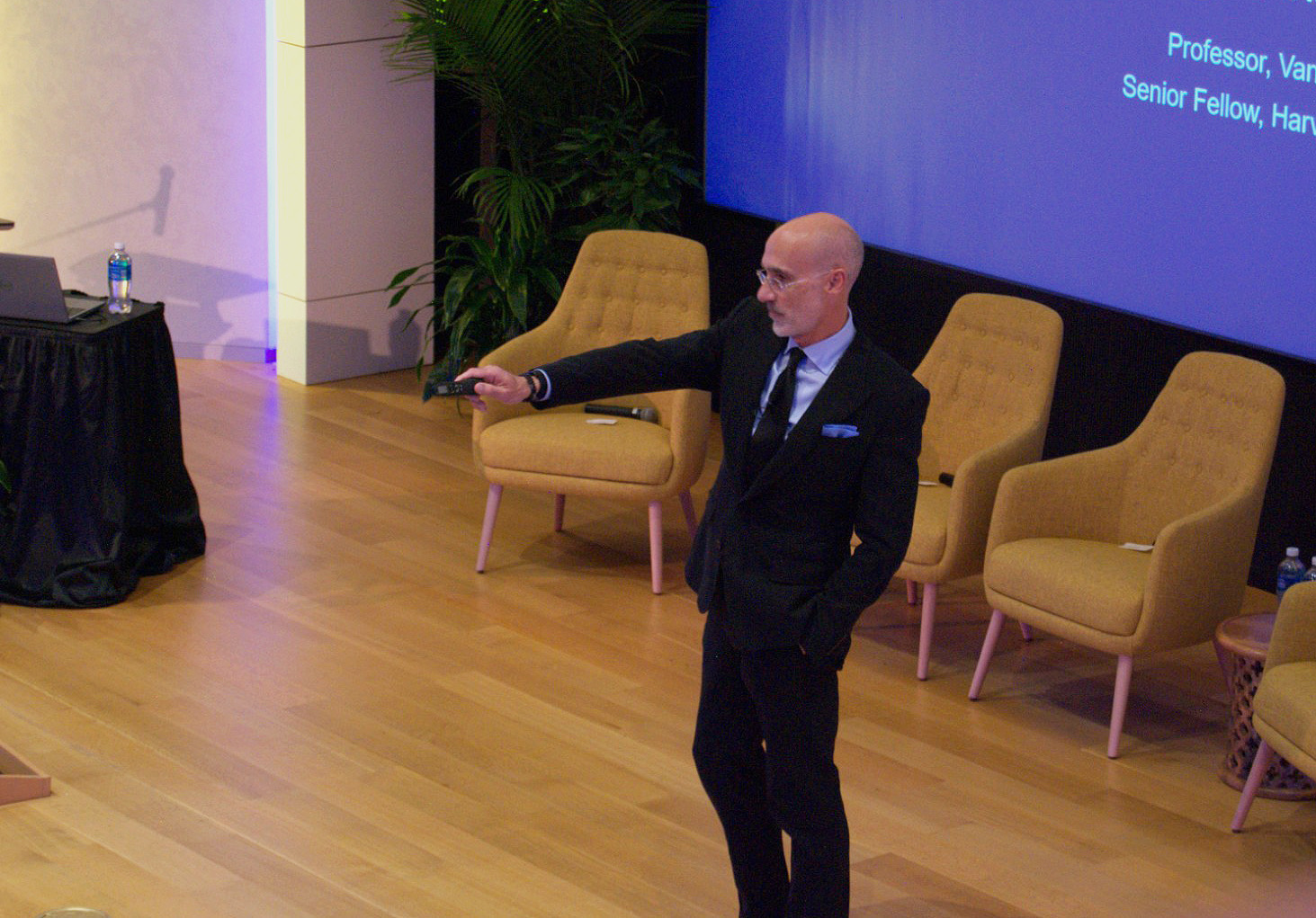
“Happiness is the business of life. Every single one of you is a startup entrepreneur, and you’re the founder of You Incorporated.”
That was best-selling author and former professor Arthur Brooks’ message to Pitt community members Tuesday evening. Speaking to a crowd of about 100 people in Alumni Hall, Brooks argued that young people are losing the ability to find meaning in their life, partially because of technology’s effect on mental health.
After his speech, Brooks spoke on a panel with Chancellor Joan Gabel, engineering associate professor David Sanchez School of Nursing professor Grant Martsolf.
Brooks said he has administered a survey to students for 30 years about life’s meaning. Since 2008, he has observed a decline in students feeling their life is meaningful.
“Today, 50% fail,” Brooks said. “Half of young adults today say that their life feels meaningless.”
Brooks said he believes the feeling of meaninglessness is a predictor of mental health issues in young adults, citing statistics showing that generalized anxiety and clinical depression have both significantly increased among young people since 2008.
“Loneliness, people not knowing [others] well, self harm, addiction, all up,” Brooks said
Brooks argued that a major catalyst for the spike in the lack of life meaning was the introduction of iPhones in 2007 and that having technology “in your pocket” has caused people to stop using the right hemisphere of their brain, which he said is used to answer “complex questions.” He explained that the right hemisphere of the brain is used creatively, while the left side follows a logical approach.
“It’s not that we don’t know the meaning of our life — we don’t even ask the questions, and that’s where we are today,” Brooks said.
Brooks argued that the ability to decipher life’s meaning can improve a person’s ability to understand their motivations in work.
“You need to have the why as well, and understand the why of your life, so you can understand the why of your work,” Brooks said.
To find life’s meaning, Brooks suggested using a three-step formula including using objects with abundance and gratitude, loving people and worshipping the divine, however a person understands that.
“Look for this, then you don’t have to figure out any of your life, but your life will figure out you,” Brooks said.
Attendee Phil Cicco, the assistant director for project management with the Office of Multidisciplinary Innovations, said he believes having the opportunity to come to events like this is good for the entirety of the University.
“I think folks tend to think of their jobs as a job, and it’s something that you just have to do, and you get a paycheck,” Cicco said. “But understanding that there’s a lot more that goes behind being happy with your job is important, and I think Pitt does that really well. Inviting Dr. Brooks here to talk about it only reinforces that.”
Hannah Harvey, a first-year politics and philosophy major, attended the event because she has been listening to Arthur Brooks’ podcast for a while and was happy that the university hosted the event.
“I felt very aligned with Pitt when I chose it, and they are showing up for me in a way that reinforces that,” Harvey said.
Harvey said she felt the event leaned toward focusing on faculty.
“Although students were welcomed, it wasn’t really geared towards students,” Harvey said. “[But] anyone can walk away with takeaways.”
Trey Henry, a first-year undeclared student, said he appreciates the university addressing issues of meaning among young adults.
“I think it’s awesome they’re making the effort. It’s definitely a problem that the data shows that, so it’s good they’re at least trying something,” Henry said.
Gabe Longenecker, a first year biochemistry major, said he felt the event was educational to him.
“The talk was comforting and eye-opening to the problems in the world,“ Longenecker said.
Longenecker said he would like to see more implementation of human flourishing tactics around the university.
“I think it would be very beneficial. It would help the whole Pitt community as a whole if it was integrated more into our learning,” Longenecker said.