
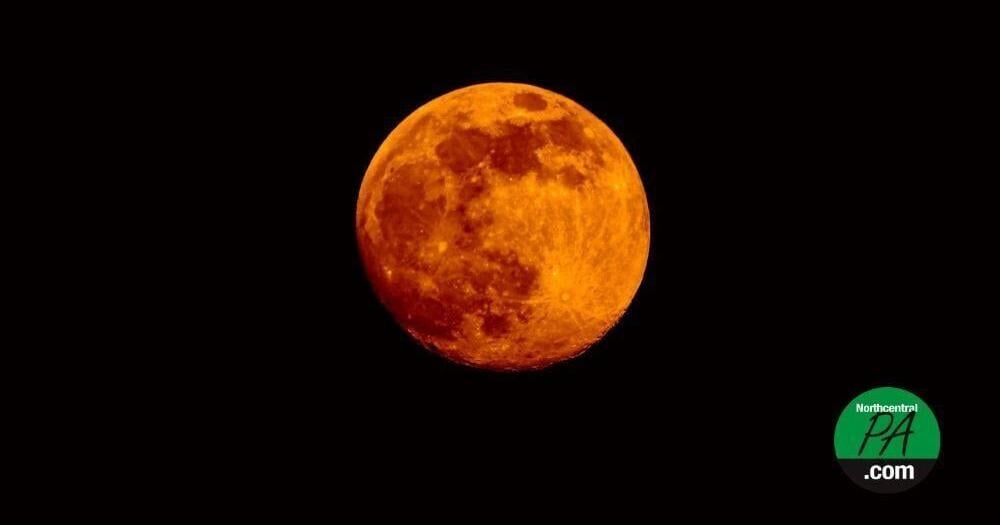

The red, yellow, orange, or brown color of a blood moon comes from long light wavelengths passing through earth’s atmosphere, similar to the mechanism of sunset coloration.
Luke Tinker
Williamsport, Pa. — If the weather cooperates, Pennsylvanians are in a prime position to view a 96.2% lunar eclipse, functionally very similar to a blood moon.
On Thursday night, into early Friday morning, the earth will pass between the sun and the moon, casting reddish or yellowish filtered light over the moon’s face.
The unusual color comes from earth’s atmosphere filtering sunset-colored wavelengths of light over the moon.
The eclipse starts at 9:24 p.m. with an hour-long penumbral phase, which will only slightly dim the moon with the earth’s outer shadow. The real action starts at 10:34 p.m. as earth begins casting a dark shadow (umbra) over its celestial neighbor. The peak time to watch the eclipse will be 12:13 a.m. on Friday morning, when 96% of the moon will be covered in shadow and the eerie-colored light filtering past the earth.
During the peak of the eclipse, most of the moon will appear red, orange, or yellow, with just a tiny sliver of silver along one edge.
As the planet and its beloved natural satellite trundle along their orbits, the shadow and red color will recede and vanish almost entirely by 1:52 a.m. The penumbral phase, which only dims the moon slightly, will linger until just past 3 a.m.
After this event, eclipses will be few, far between, or relatively unimpressive until 2029, when there will be a partial —approximately 50% — solar eclipse in January and another full blood moon will grace the skies of Pa. in June.