
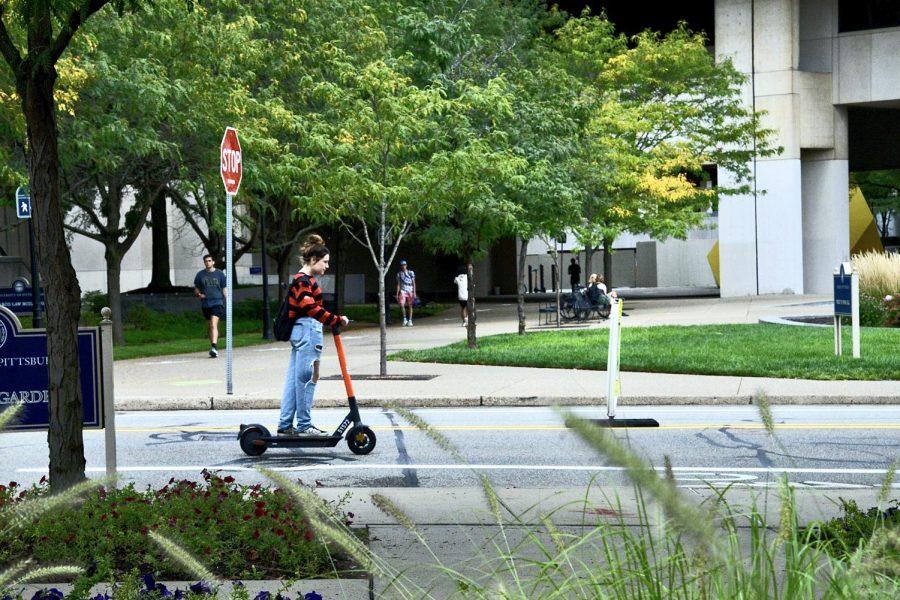
Students will be seeing less electric scooters on campus this semester.
Pitt banned electric scooters from being parked or stored on University property starting Aug. 1, addressing concerns about lithium ion-battery fire hazards and unsafe roadways and walkways. Pitt students are commending the new policy.
Caroline Eleoterio, a junior applied psychology major, supports Pitt’s decision to ban scooters from being stored in Pitt facilities.
“I was happy about the ban because I never thought the scooters were very safe, considering how fast they go and how often riders would have to dodge around pedestrians,” Eleoterio said.
Most e-scooters right now can reach a top speed of 20 miles per hour. Some high-performance scooter models can reach over 50 miles per hour. While the Pennsylvania Department of Transportation does not officially track e-scooter safety statistics, a 2026 report by the U.S. Consumer Product Safety Commission estimated approximately 380,000 emergency room visits associated with e-scooters between 2017 and 2024.
Eleoterio recounted hearing a story about a rider crashing into a pole while riding an e-scooter.
“I think this ban will make campus safer both for people who would have ridden scooters and pedestrians,” Eleoterio said.
Pitt is enforcing the rule with possible impounds, alongside a $100 fine for a first offense and $200 for the second offense. Repeat violations can be referred to Student Conduct, according to the policy.
E-scooters are not legal anywhere in Pennsylvania. They are considered motor vehicles in the Pennsylvania Vehicle Code, so they must be titled, registered and pass safety inspection. Most scooters don’t have the equipment to meet these standards.
Kodi Dobrowolski, a graduate student studying K-4 education, believes that the ban will have a positive impact on pedestrian safety.
“I was happy about [the ban] because people would just zip around on them,” Dobrowolski said. “When I was in my freshman year, I saw an athlete almost hit an old lady.”
Isabele Wilson, a sophomore undeclared student, said she was not surprised when learning about the new e-scooter guidelines, especially after reading a news story about Pitt students charged with reckless bike driving.
“I feel like it’s hard to hear them until they’re already past you, so I feel like you can get run over,” Wilson said.
Ryan Little, a senior electrical engineering major, has used electric scooter rental services in the past, but has noticed safety issues concerning use on Pitt’s campus.
“I would witness scooter safety issues almost every time I was on a sidewalk in Oakland,” Little said. “They almost hit people going full speed on sidewalks and almost get hit by cars when they ignore basic traffic laws and common sense.”
Little believes that it is unrealistic to operate e-scooters safely on busy Oakland streets, though they can sometimes be efficient.
“The scooter riders make up such a small portion of the community but impact so many when they blast down the sidewalk and clog bike racks,” Little said.
Little believes that there are better, more sustainable options for students trying to get to class.
“I personally ride a bicycle to class each day,” Little said. “I can safely ride at the speed of traffic without endangering myself or pedestrians.”
Katie Tobin, a senior rehabilitation science student, believes that e-scooters are unsafe in general.
“Can people with electric scooters have more manners and not run into pedestrians? The amount of electric scooters who try to rear me off the road is ridiculous,” Tobin said.
Samantha Anderson, a junior pharmacy student, also has concerns about safety with e-scooters and pedestrians.
“I know there have been concerns in the past of students walking on the sidewalks, worried that they’re going to get run into,” Anderson said. “I’ve experienced it myself, trying to share [the sidewalk] with scooters.”
Undeclared first-year student Josh Alvarado rides e-scooters, but opts for biking on campus after seeing riders operate e-scooters recklessly on the sidewalk.
“I honestly think [the restrictions] are a good thing just because the people that do ride the scooters have no respect for people who walk on the sidewalk,” Alvarado said. “It’s never on the street, it’s always on the sidewalk.”
However, first-year biology major Serena Rodgers uses an e-scooter to get around on campus, and said she would feel safer riding back to her dorm at night on an e-scooter instead of walking.
“I was honestly really irritated and annoyed because I feel like they could have given us a better warning,” Rodgers said. “We [could’ve] started preparing months before.”