
Much of Northeastern Pennsylvania has already ushered in the new school year. But are there enough teachers to welcome students back to the classroom?
The organization PA Needs Teachers — a coalition led by the advocacy groups Teacher Plus and the National Center on Education and the Economy — published a report earlier this month examining trends in Pennsylvania’s education workforce. The report depicts a severe teacher shortage, with the number of new teacher certifications issued plummeting and teacher attrition rates rising over the last decade.
Using statistics from the state Department of Education and a Pennsylvania State University analysis, the report examines this teacher shortage by county — and finds the shortage is having a particularly acute impact on Northeastern Pennsylvania.
PA Needs Teachers co-lead Emily Sagor said this eroding supply of teachers hurt school districts as they try to meet their unique needs. She noted that a shortage may grow class sizes, force teachers to lead additional classes, and have teachers assume extra administrative duties.
“When you have open positions that stresses the whole community, because education is an ecosystem,” Sagor said. “When we don’t have all of the people that we need for that ecosystem to run in a healthy way, it becomes very difficult for the individuals within it.”
This shortage of teachers could have a particularly deleterious effect on students. Sagor said failing to recruit educators who can develop experience in a school and familiarity with its students. The effect of a teacher shortage can worsen across students’ time in school, creating a deficit that widens year after year.
“We know that the number-one in-school factor that determines how successful a student is going to be is their educator,” Sagor said. “So, when we have a revolving door of educators, students don’t have the consistency that they deserve to lead to the strong outcomes that they’re capable of.”
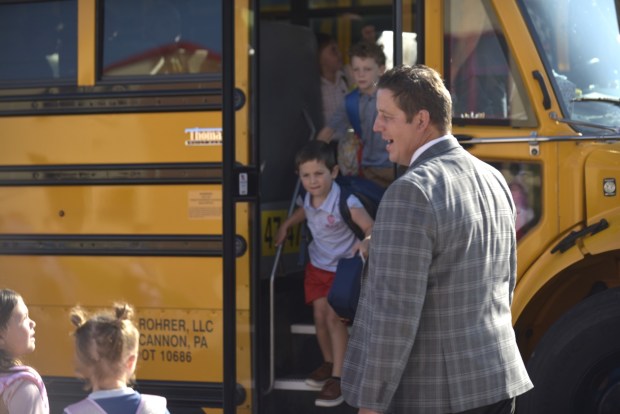 North Pocono students are welcomed to Moscow Elementary School for the first day of school Monday, Aug. 24, 2026. (CHAD SEBRING/STAFF PHOTO)
NEPA’s teaching needs
Given these effects on teachers and students, schools in Lackawanna, Luzerne, and Schuylkill counties have some cause for alarm.
The PA Needs Teacher report found Lackawanna County schools were short 106 qualified teachers creating a “high” shortage level. One-hundred sixteen teacher certifications were issued in 2024, marking a 31% decline in certifications from a decade ago and rendering the county’s total teacher supply “very low.”
This fall in teacher supply has corresponded with a fall in teacher qualifications. Ten percent of Lackawanna County teachers are now “novice teachers,” with 6% on emergency teaching permits, earning the county a teacher-qualification ranking of “low.”
Circumstances are similar in Luzerne County. The report determined Luzerne County has a shortage of 179 qualified teachers and has a “high” shortage level. The 144 teacher certifications issued in 2024 mark a 33% decline over the last decade, with overall teacher supply given a designation of “very low.”
As was the case in Lackawanna County, a full 10% of Luzerne County teachers were deemed “novice teachers,” with 6% on emergency permits, earning a marking qualification rating of “low.”
Schuylkill County, meanwhile, issued zero teacher certifications in 2024 and also had a “very low” supply level. Thirteen percent of Schuylkill County teachers were novices, 8% were on emergency-certification plans, earning it a “low” teacher qualification rating as well.
The teaching shortage in these counties comes alongside an alarming lack of diversity. Ninety-nine percent of teachers in Lackawanna, Luzerne, and Schuylkill counties are white, despite having populations where students of color account for 25%, 32%, and 21% of the student population, respectively.
Sagor said the economic obstacles to launching a teaching career, such as the high cost of certification and low starting pay, is exacerbated for teachers of color owing to economic inequality.
“We know (financial barriers) disproportionately impact future educators of color and folks from low-income backgrounds,” Sagor said. “And this can be one of the factors leading to a lack of diversity in the profession.”
PA’s progress
Despite these negative trends, PA Needs Teachers maintains that there are reasons to be optimistic.
Sagor noted there had been progress in directing more state investment towards teacher development with a bevy of new educator-support programs.
In the 2024-25 school year, the Pennsylvania Higher Education Assistance Agency launched the state’s Student Teacher Support Program to subsidize student-teacher assignments. Under this program, student teachers can collect a $10,000 stipend and mentors to student teachers can collect stipends as large as $2,500, with stipends awarded on a first come, first serve basis. The General Assembly increased funding for this program by a third in its 2026-27 state budget, allocating it a sum of $40 million.
Sagor said the stipend provided critical support to student teachers, reducing outside financial stress as they work in student-teaching positions, which are typically unpaid.
“This allows them to really focus on student teaching and learning what it means to be an excellent educator and being able to get that mentorship from other teachers,” Sagor said. “Something you often hear from folks who aren’t able to receive the stipend…(is that) they are having to have other jobs outside of student teaching just to sustain themselves.”
Sagor also cited the Grow PA Scholarship Grant Program — an initiative through which the PHEAA offers subsidies to college students pursuing careers in high-demand fields, including education. The Grow PA program offers these eligible students grants of $5,000 per year for a maximum of four years; and in exchange, students pledge to live and work in Pennsylvania in an in-demand field for a number of years equivalent to the number of years they received the grant. (Students who fail to satisfy the in-state residency and work requirement are compelled to repay all the grant money they received.)
“It’s a great way to, one, give people a financial incentive to enter the educator workforce on the personal, individual side,” Sagor said. “And on the collective side, as a state, it gives us assurances that these students will stay in Pennsylvania.”
Sagor urged state officials to commit to “sustained investment” in these programs, providing a guaranteed resource to high school and college students interested in becoming teachers.
“I do think sustained investments in the educator workforce…are going to be what helps us to continue to recruit educators,” Sagor said. “Having the legislature commit to these investments year over year…if that’s something we can start guaranteeing…I do think that will start to trickle down, leading to us having more educators.”
Success at Scranton
These programs have proven especially beneficial to Scranton, said Holly Meade, a member of PA Needs Teachers and a Scranton special education teacher who has taught in the district for around 20 years.
Meade said there was an approximately four-year stretch in which Scranton dealt with a teacher shortage and had a “huge struggle to find new talent.” She said she has recently noticed a reversal of fortunes at Scranton schools with teacher-support initiatives like the student-teacher stipends and the Grow Pa grants — helping to rejuvenate the district’s workforce.
“Really, they’ve done a lot in the last four years,” Meade said. “I really feel like we are on the upswing.”
Meade said she was further encouraged by a development earlier this month. On Aug. 6, state Secretary of Education Carrie Rowe announced that Pennsylvania had joined the Interstate Teacher Mobility Compact, an agreement that makes it easier for teachers moving to Pennsylvania from out of state to earn their Pennsylvanian teacher certification.
“Having that reciprocity between states is enormous,” Meade said. “That was a big thing that we’ve been pushing for…that will make it so much easier for people to continue in the profession….”
Meade said Scranton also benefits from the Aspiring Educator Pathway Program — an initiative that allows high school students to explore careers in education. She said the Scranton AEPP club has visited East Stroudsburg University and Marywood University and has helped open up new pathways or students.
“It’s really been wonderful for our students,” Meade said. “We’re really encouraging our sophomore, junior, and senior high students to be teachers.”
Scranton is pairing these efforts to make its faculty more representative of its students — seeking to diversify a faculty that six years ago had only five non-white teachers. Meade said the district was now working to expand its recruitment efforts, sending representatives to career fairs across the region.
“I have noticed a huge difference,” Meade said. “It really benefits the students, it benefits the culture of the school, and it helps everyone to feel more included and that’s what really education is about.”
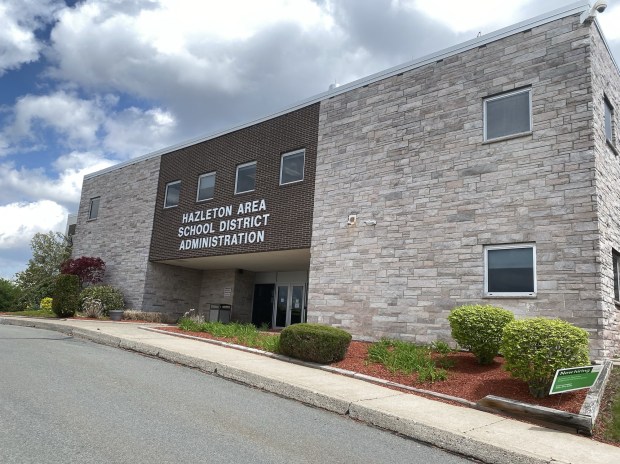 Hazleton Area School District Administration on Friday May 2, 2025.(John Haeger / Staff Photographer)
Helping Hazleton
For Hazleton Area — a rapidly growing school district that is now the sixth largest in the commonwealth with around 14,000 students — recruiting more teachers and paraprofessionals is crucial. Dr. Robert Childs, a member of the Hazleton Area Board of Education, has introduced his own “grow your own” plan to add to the school district’s workforce.
The plan, which has yet to win approval from the full school board, would have Hazleton Area pay for staff members who have completed two years of post-graduate studies, to complete two more years of study to earn their teaching degrees, while they also work as student teachers and full-time paraprofessionals in the district. In exchange, these new educators would agree to teach in Hazleton Area schools for three years. Childs said his goal would be adding 50 new teachers and paraprofessionals to Hazleton a year. He projected that the program would cost the district between $3 million and $5 million annually, though final cost would be subject to particular arrangements Hazleton Area negotiates with area colleges, as well as other factors.
“At the end of two years, you have a new bilingual teacher teaching for three years in the district,” Childs said.
This proposal would place a special emphasis on diversifying the Hazleton Area faculty, so it better reflects the diversity of the students they teach. Seventy percent of Hazleton Area students are Hispanic, according to a review of the district earlier this year, with around 29% being students who do not speak English as their first language. In contrast Childs said, less than 5% of Hazleton Area staff and faculty are bilingual and relatively few are Hispanic.
Childs maintains this has led to significant inequality in the district, leaving Hispanic students without sufficient language support and putting them at an academic disadvantage that he hopes his proposal could help address.
“You’re talking about they have to learn math, science, and at the same time, they have to learn the English language. And it isn’t working,” Childs said. “So, there’s a terrible disproportion between the student-body makeup and the educational-staff makeup.”
A ‘fantastic job’
Sagor said there were other reforms she hoped state officials would consider. One program she suggested was allowing schools to implement “strategic staffing” models, trying out different faculty arrangements that best suit their students’ needs, making the profession “less stressful and less isolating.”
“There’s a whole world that we can create within our schools…that leverages the expertise of the educators in the space and gives them opportunities to lead,” Sagor said.
Meade said teachers themselves can help grow schools’ workforce in the long run. She said it was important for teachers to inspire students who show an aptitude for teaching to pursue a career in education.
“Teachers who love teaching know what a fantastic job it is,” Meade said. “And we’re just trying to get more people to realize how much they would love it too.”