
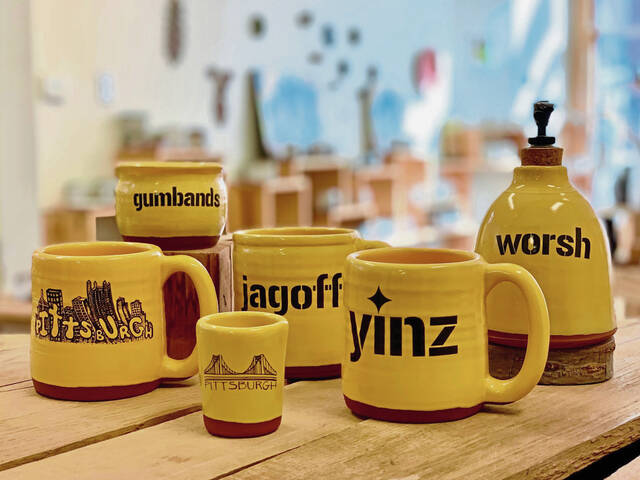
Many proud Southwestern Pennsylvanians carry the label of “Yinzer,” wearing their flattened “ou” sounds and their use of words like “sweeper” and “jaggerbush” like a badge of honor. But is the region’s singular accent and dialect disappearing?
From hot dog stands and coffee shops to festivals and merchandise lines, terms including “yinz” and “dahntahn” have been codified and commodified for younger generations of Pittsburghers. However, those same younger people are often not carrying the same linguistic markers as their locally born parents and grandparens within their everyday speech.
While the words and sounds that make a Pittsburgher’s voice instantly recognizable have been evolving since Scots-Irish settlers staked their claim in the region before the Revolutionary War, linguists can point to a few reasons as to why this and many regional dialects are “flattening out.”
So should we worry about preserving Pittsburghese? Well, it’s complicated.
Talking history
When it comes to the unusual words and syntax we use, much of that is owed to the Scots-Irish settlers who crossed the Appalachian Mountains and settled in Western Pennsylvania in the 18th century, back when the area was considered the western frontier.
Dr. Scott Kiesling, professor of linguistics at the University of Pittsburgh, said those who came during the industrial boom of the late 19th and early 20th centuries had some impact on our accent.
“We had huge amounts of migration from non-English-speaking places coming in and mixing up in different places,” he said.
Because of Pittsburgh’s geographic position, the accent has remained surprisingly insular and similar for a long period of time.
But those early Scots-Irish influences have remained strong, as the already-assimilated group is seen as carrying the most “prestige” to new immigrant groups.
“The prestige tilts the scale,” said Dr. Betsy Sneller, associate professor of linguistics at Michigan State University. “If your kids are going to school and it’s 30% outsiders, those 30% outsiders are going to acquire the local dialect.”
Sneller said that much of the evolution in regional dialects comes from out-groups being deferential to in-groups.
Our dialect — or the unique words that we use — mostly comes from those early settler influences, including the way that we drop “to be” out of certain contexts, saying “the car needs washed” instead of “the car needs to be washed.”
The Pittsburgh accent is characterized by several markers, including monophthongization.
“It’s just a fancy way of saying that we take a vowel that has two parts, like ‘ow,’ and we make it have just one part, like ‘ah,’ ” said Dr. Dan Villarreal, assistant professor of linguistics at the University of Pittsburgh. “There’s also things like the classic ‘eel’ forming into ‘ill,’ like ‘Stillers.’”
Villarreal also talked about what linguists call “O-fronting,” where locals say the vowel sound in words like “go” and “hoagie” in the front of their mouth.
“That’s something that’s present in a number of places, not just Pittsburgh. You see that in Baltimore, you see that in Philly,” he said.
Causes of change
Linguists want to assure us that accents don’t disappear; they’re simply in a constant process of evolution.
If we are to look at the traditional Pittsburgh accent as fading, there are a few possible reasons. The first is technology’s influence, especially with social media video platforms such as TikTok hogging young people’s time.
“Social media is very different because you don’t only receive, you put out,” Kiesling said. “It’s that interaction that has an effect.”
Pittsburgh isn’t alone in being affected by this regional dialect flattening. Kiesling said there is lots of data on how a dialect reversal is underway in northern Michigan and upstate New York.
Another factor is our industrial history. After the sputtering of Pittsburgh’s longtime industrial boom, our population massively declined starting in the 1970s, and those carrying the Yinzer accent spread throughout the world.
Then, as the city became known for higher education, healthcare and technology, younger white-collar transplants began to flood the city in recent years.
While you may hear fewer of the accent and dialect markers among those younger professionals in the city, experts say younger people working in the trades and in smaller suburban communities may keep the accent more; socioeconomics play a large part in regional dialects.
“The working class are the people who have the most local dialect that would be different from the ones next to them,” said Dr. Dennis R. Preston, professor of linguistics at the University of Kentucky. He added that as people gain more monetary wealth, their speech tends to blend more together with that of other wealthier people across the country.
Profession and education also play into the way we speak.
“A lot of folks who go into the trades didn’t go to college, and college is another place where you get a lot of dialect mixing,” Sneller said.
She also pointed to the accent as a way to signal your belonging to a certain group; if people with strong accents go to a place where that accent is noticeable, they’re more likely to change it. Or, having a strong accent can signal to neighbors or those with which you share something in common that you do belong.
“It’s a really powerful way to both intentionally signal and unintentionally signal your group belonging,” she added.
But if nothing else, the tradition of our accent is kept alive by our unique pride in it. The linguistics experts said few places in the country are as enthusiastic about their words and syntax, a trend that started in the 1980s and became even more pronounced over the past few years.
Kiesling, who is a native of Indiana who has lived in the city for more than two decades, said he’s fascinated by how “yinz” has become a kind of shorthand for the Pittsburgher identity.
“It’s just this little word that you can add to anything and make it mean Pittsburgh,” he said.