
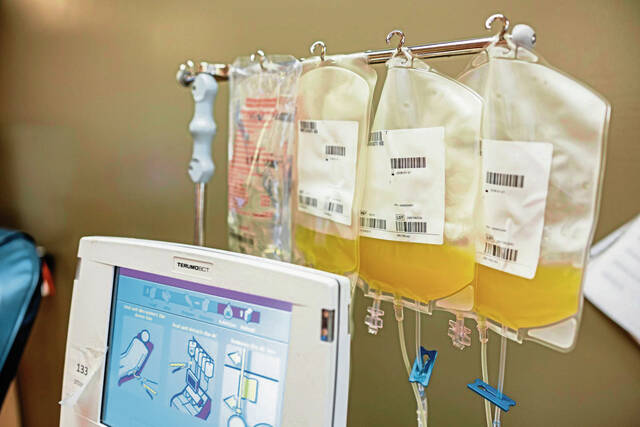
Local researchers say a change in how blood platelets are stored could triple or even quadruple the U.S. supply available to treat life-threatening bleeding.
Recently, study author Dr. Philip Spinella and his team published research in JAMA showing platelets stored cold for up to 21 days could soon become a viable option for treatment of bleeding injuries at hospitals and on the front lines of war — if the FDA finds his Defense Health Agency-funded work adequate to extend its existing 14-day regulation.
“This could equate to saving 30, 40, 60,000 lives per year in the U.S.,” said Spinella, a University of Pittsburgh professor of surgery and critical care medicine and the co-director of its Trauma and Transfusion Medicine Research Center.
Currently, platelet units are stored predominantly at room temperature for just five to seven days before bacterial risk begins to develop. If left unused, they’re discarded. Since the 1970s, blood banks and hospitals have stored the vast majority of their supply in this way because, while they have a shorter shelf life, room-temperature-stored platelet units encourage longer-term, in-body survivability than cold-stored platelets. That notion makes room-temperature platelets better suited for prophylactic applications such as treating blood disorders and cancers, where the cells’ survival duration is key.
Prophylactic uses account for more than 65% of platelet transfusions.
For decades, that prevailing line of thought, combined with the rigid economics of early blood banking, deemphasized the larger scope of platelet units that could potentially be kept viable through longer-lasting cold storage to treat bleeding injuries, which a USC Annenberg Center for Health Journalism study said kill around 31,000 people in the U.S. a year. For bleeding injuries in otherwise healthy people, platelet survival duration is far less important a factor, making cold storage the more efficient option.
“The (medical) community (in the 1970s) said, ‘Maybe we need a dual inventory,’ and the blood bankers all basically said in unison, we can’t handle a dual inventory. We can only handle one temperature that we store platelets,” said Spinella.
The study randomly tested refrigerated platelets in 1,000 pediatric and adult patients with bleeding injuries from 2021 to 2025. No drop-off in efficacy was observed with the increased duration. It also reiterated several more recent preclinical studies that reexamined the issue over the years that contended cold-stored platelets actually are more effective than their room-temperature counterparts in treating bleeding injuries.
“We’ve known (about cold-storage’s use in bleeding injuries) since 1973,” said Spinella. “But we had to repeat the trial to show that at the very least storing them cold after 21 days would at the very least be non-inferior to a room-temperature stored platelet.”
Pitt says the FDA is mulling a revision of platelet-storage recommendations.
“We have very little doubt that the FDA will license the 21-day, but it will take time for them to officially then license it,” said Spinella. “I would hope within 12 months, we’ll have them licensed — but that’s a guess. It’s about the speed of the FDA.”
Vitalant blood bank’s chief medical and scientific officer Dr. Ralph R. Vassallo said only about 1% of the blood service firm’s supply is comprised of cold-storage platelets, which generally is kept for 14 days before disposal. He said that’s a practice largely mirrored across major blood banks and hospitals. He also said blood bank leaders are ready to embrace a shift that will allow them to help meet the pressure of an aging donor base.
“The FDA has essentially stated that (cold-stored platelets) should only be used when warm-stored platelets are not available, and we think that this study is going to help them recognize that this is an alternative — not something to be used only when you don’t have other platelets available,” said Vassallo.
Under current storage practices, according to research in Hematology, 2.5 million platelet units are collected in the U.S. annually, with 10 to 20% wasted at a cost of $300 million to hospitals.
“Most of the ‘Oh my gosh, we don’t have a platelet on the shelf when we need it’ (moments), it’s because someone’s bleeding,” said Vassallo. “It’s not because a cancer patient comes in for their scheduled transfusion. So it’s exactly the product (hospitals) need.”
Such a change would shift the platelet paradigm.
“If you’re a small community hospital in Altoona, and you buy platelets and, on Day 17, and you just haven’t had a patient come in that needs them — they could then be transferred to Pittsburgh, where they would be used the next day or two,” Spinella said. “That’s how red cell inventory is managed. And now with the 21-day product, we can take the same strategy and have probably close to zero wasted platelets with the 21-day mark.”
Often, Spinella said, rural hospitals cannot afford to keep platelets on hand.
“It takes two days to do the infectious disease testing,” said Spinella. “So it’s really effectively three to five days. It’s only three days on a shelf. And if nobody uses it in three days, now they’ve wasted a product that costs anywhere between $600 to $700 a unit.”
Lack of availability of platelets exposes patients to extra risk.
“If you come in with severe bleeding for any reason — your tractor turns over on your farm and you amputate your legs, you’re not getting platelets from Altoona and you might die as a result. The helicopters and ambulances don’t have platelets on them because they can’t afford to stock their vehicles with platelets.”
If approved, Vassallo said, each blood bank and hospital would be left to determine what storage breakdown works best for them on an individual basis.