

The Reading Housing Authority is weighing whether to impose work requirements or limits on how long some residents can remain in public housing under a proposed federal rule giving local housing authorities that choice.
The U.S. Department of Housing and Urban Development proposal would allow housing authorities to adopt work requirements, time limits, both or neither for certain residents.
Older adults, people with disabilities and other qualifying households would be exempt.
Before deciding whether those changes make sense in Reading, the authority recently brought housing advocates, social service providers, local officials and other community stakeholders together at the Oakbrook Neighborhood Resource Center to discuss the proposal.
Stacey Keppen, authority president and CEO, stressed that the authority has not made a decision.
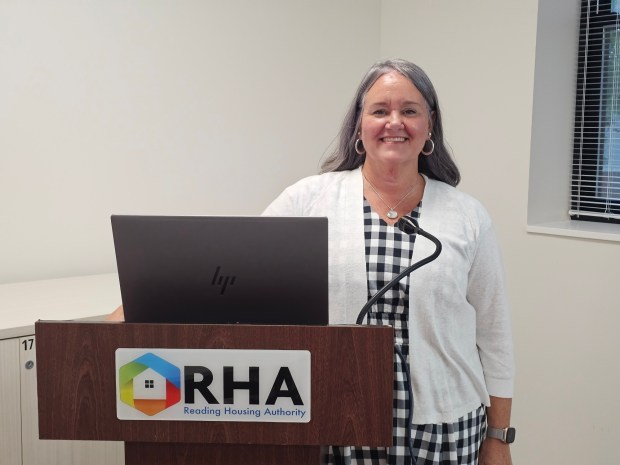 Reading Housing Authority President and CEO Stacey Keppen speaks at a recent conference that brought housing advocates, social service providers, local officials and others together at the Oakbrook Neighborhood Resource Center to discuss a HUD proposal that would allow housing authorities to adopt work requirements, time limits, both or neither for certain residents. (MICHELLE LYNCH/READINGEAGLE)
“We have not concluded yea. We have not concluded nay. We have not landed anything,” she said. “Your input is going to be really helpful as we go back to our board and say this is what we think.”
HUD proposed the rule, titled “Establishing Flexibility for Implementation of Work Requirements and Term Limits,” earlier this year.
The authority is considering the issue as it prepares its annual plan and wants feedback before deciding whether to include such a significant change, Keppen said.
At the center of the debate, she said, is a familiar problem: Demand for affordable housing far exceeds supply.
The authority operates 1,610 public housing units in eight communities, according to its website. The units are nearly always occupied, and only 120 households left public housing in 2025, Keppen said.
When the authority opened its waiting list for four days in 2023, it received 2,296 applications.
Under HUD’s proposal, the authority could require certain residents to work or participate in qualifying activities for up to 40 hours a week. The requirement could not be a condition of admission but could be imposed for continued occupancy.
The authority also could limit how long nonexempt households receive public housing assistance. The limit could not be shorter than two years, though the authority could set a longer period or impose no limit.
The authority would have discretion to determine required hours and establish exemptions and hardship provisions. Work requirements also would have to be accompanied by supportive services such as employment assistance, child care, transportation, education and job training.
Reactions
The possibilities drew differing opinions from those attending the session at Oakbrook on Aug. 20.
 City Councilman Jaime Baez Jr., whose family relied on public assistance when he was growing up, said he supports placing some responsibility on people who are able to work. (MICHELLE LYNCH/READING EAGLE)
City Councilman Jaime Baez Jr., whose family relied on public assistance when he was growing up, said he supports placing some responsibility on people who are able to work.
A requirement would not necessarily need to be 40 hours a week, he said.
“I can work, I can contribute to society,” he said. “That is where my belief comes from.”
Baez also said a sufficiently long time limit could give residents an opportunity to earn a degree, find work and prepare to leave public housing, eventually making units available to others.
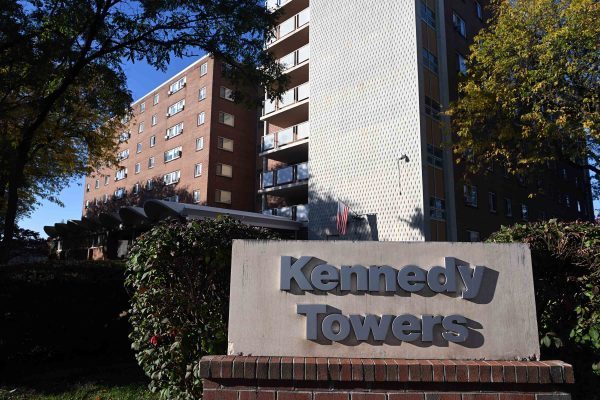 The Reading Housing Authority operates 1,610 public housing units in eight communities, including Kennedy Towers. Officials said the units are nearly always occupied, and only 120 households left public housing in 2025. (BILL UHRICH/READING EAGLE)
Others were more wary, particularly of time limits.
Riley Monahan, who oversees a rapid rehousing program for Mary’s Shelter serving homeless young adults, said forcing families out after a set period could increase youth homelessness.
“It’s hard to focus on school when you’re a homeless teenager,” she said. “You’re in fight or flight at that point.”
Monahan said work requirements could be beneficial when someone in a household is able to work but would need to account for circumstances such as full-time caregivers of children with disabilities.
Elise McCauley, acting director of the Berks Coalition to End Homelessness, questioned whether the policies can succeed when wages and affordable housing remain inadequate.
She said many of those experiencing homelessness have income, such as child support, social security or social security disability, or are among the working poor who have been priced out of housing. They are not people who are just taking advantage of the system, she said.
McCauley also raised concerns about enforcing the requirements without additional federal funding.
“Until we have enough affordable housing and enough jobs that pay enough, I don’t think it’s fair to say we’re going to do a work requirement, we’re going to do time limits,” she said. “Where are these people supposed to go? We don’t have a good answer.”
Jane Koelble, who has a background in social work and housing, raised a similar concern.
Residents need a job that pays a living wage and housing they can afford on that wage, she said.
Participants also discussed whether education, job training, treatment and volunteer work should count toward a work requirement and whether exemptions should extend to people applying for disability benefits, those with temporary medical conditions and caregivers.
The authority plans to use the feedback as it develops its annual plan.