
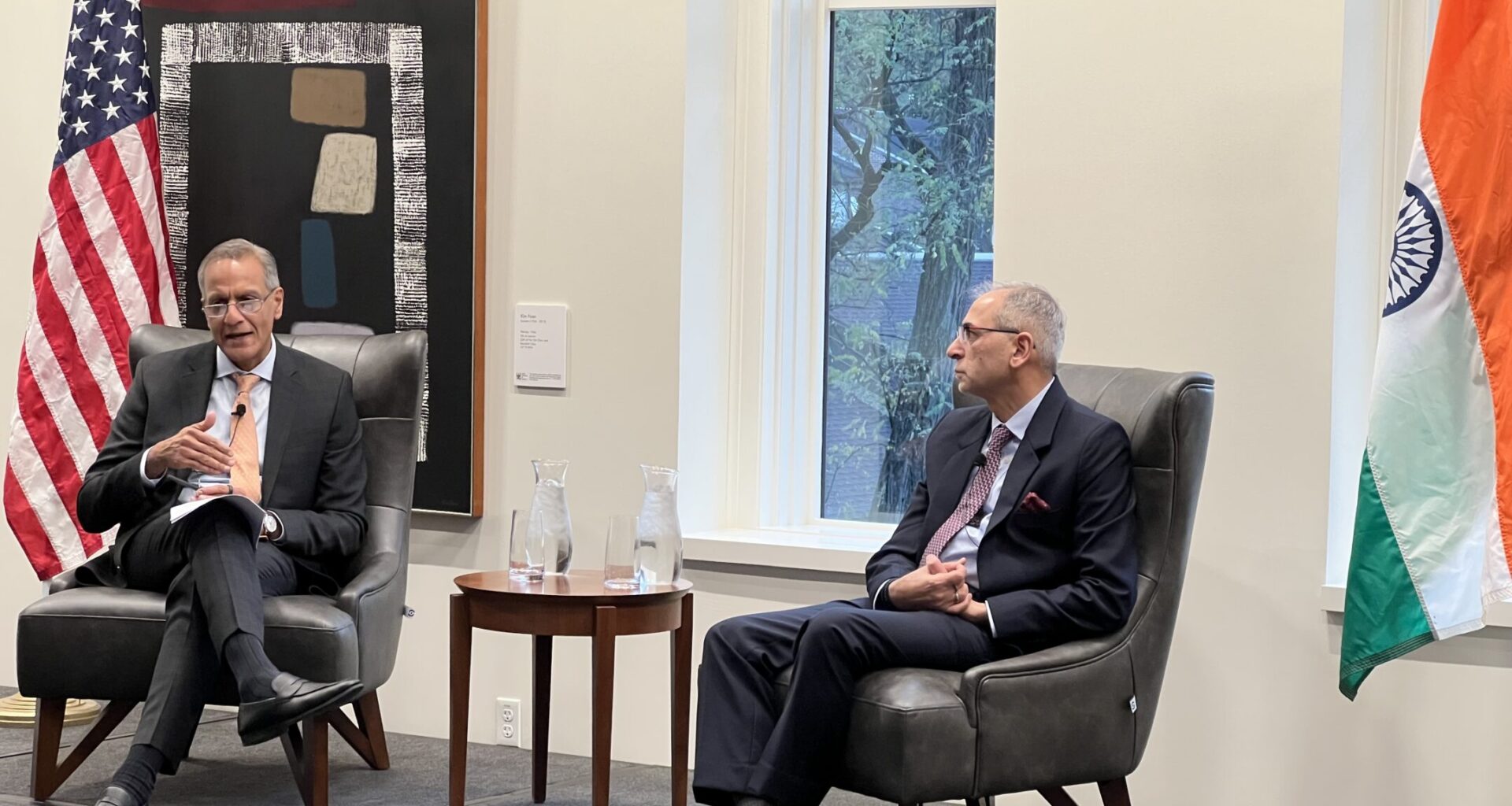
Vinay Kwatra, the current ambassador of India to the United States, spoke in a fireside chat Wednesday night, marking the first time an Indian ambassador has visited Lehigh.
The conversation, facilitated by Richard Verma, ‘90, the former U.S. ambassador to India and the inaugural president’s distinguished fellow, focused on how relations between the country and the U.S. have strengthened with time.
Kwatra has served as the 29th ambassador of India since he took office in 2024. Prior to this position, he was India’s ambassador to Nepal and France. Most recently, he worked as a joint secretary in the Prime Minister’s office.
Verma said there are roughly 5 million Americans of Indian descent who have integrated themselves into the entire spectrum of U.S. society, from the hospitality industry to the medical field.
It’s this population, Kwatra said, that partially allows for the continued growth of the India-U.S. relationship because of the value competition.
Kwatra said in 2000 when President Bill Clinton was in office, there was nearly no defense cooperation between India and the U.S., emphasizing the growth of the countries’ relationship over the last 25 years.
He also said foundational agreements are essential steps a country can take toward concrete cooperation.
One example is the Indo-US LEMOA, which is a Logistics Exchange Memorandum of Agreement, according to the U.S. Department of State. Through this trade cooperation, Kwatra said both countries provide each other with access to military facilities for purposes such as refueling.
LEMOA is one of four foundation agreements in sectors of security and communications between the U.S. and India that have all since been signed and implemented.
Kwatra said the two countries are even now talking about adopting new foundation agreements in more emerging domains, such as the underwater or space spheres.
“You will not agree to signing any foundation agreements unless there is that degree of understanding of each other and each other’s perspective,” Kwatra said. “And defense and security is one space where (the) transformation is complete.”
One recent transformation, specifically in the last 10 months, is the oil and gas trade between the U.S. and India, which Kwatra said has grown very heavily. Specifically, he said Indian imports of U.S. oil products have increased 60-70% from last year. He partially attributed this to President Trump’s administration, which focuses on the energy sector.
According to the National Bureau of Asian Research, India imports about 85% of oil and gas for its energy needs. For this reason, Kwatra said the country considers energy trade a political pillar of its relationship with the U.S.
From the energy sector to the security sector, Kwatra said that very strong engagement between India and the U.S. exists in almost every human economic aspect.
Verma then discussed an address given by India’s Prime Minister Narendra Modi in 2016.
“One of the things (the prime minister) said to members of Congress was, ‘I am pleased to report to you that the U.S. and India have overcome the hesitations of history,’” Verma said.
Kwatra said he believed this speech was the turning point that sparked major discussions between the countries.
He said from 2016 until the present day, the countries have not just discussed, but cooperated to form agreements. If similar propositions were brought to the table in 2013, however, he said it’s likely not a single word would have been exchanged.
Kwatra said another valuable relationship between the U.S. and India is their trade agreement. While he said India is intensely engaged with the U.S. administration to find a mutually beneficial trade understanding, India currently has a $200 billion trade volume.
He said India hopes to scale that number to $500 billion by 2030.
“The commercial and business machinery is deeply plugged into that trade relationship,” Kwatra said. “It’s extremely critical because those stakeholders in the relationship are one of the key drivers.”
Avneet Kaur, ‘28, closed out the discussion by offering her thanks on behalf of the Lehigh community to Kwatra, specifically for sharing about the trajectory of relations between the countries. She also extended her gratitude on behalf of Lehigh’s Indian students.
“Beyond your formal role, we see you as a powerful symbol,” Kaur said. “Thank you for skillfully representing our country and for enabling the environment that allows Indian students to pursue their education and take advantage of unparalleled opportunities here in the U.S.”