
Erie’s fight over its mineral rights has entered a new phase. If it seems complex, it is.
The town has kept its mineral rights, SM Energy has redrawn the Draco drilling plan around Erie’s unleased minerals, and town officials are now considering how much leverage they still have over the project and what they should do if another offer arrives.
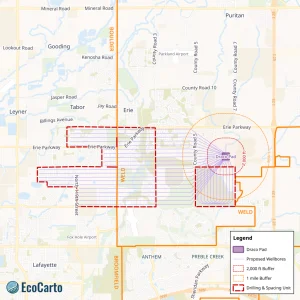
The amended/proposed Draco Drilling and Spacing Unit (DSU)
These latest changes came in a matter of days. SM Energy terminated its agreement to buy Erie’s mineral rights Aug. 19. The Erie Town Council repealed the ordinance authorizing the sale Aug. 25, ending a referendum that had gathered nearly 2,000 signatures. Then SM Energy offered to lease the same minerals, but the offer expired Aug. 28 before council could consider it. At the same time, its subsidiary, Extraction Oil & Gas, moved forward with a new plan for Draco.
The Sept. 1 council meeting showed that the town’s options are now different from the ones it had when the original deal was before council.
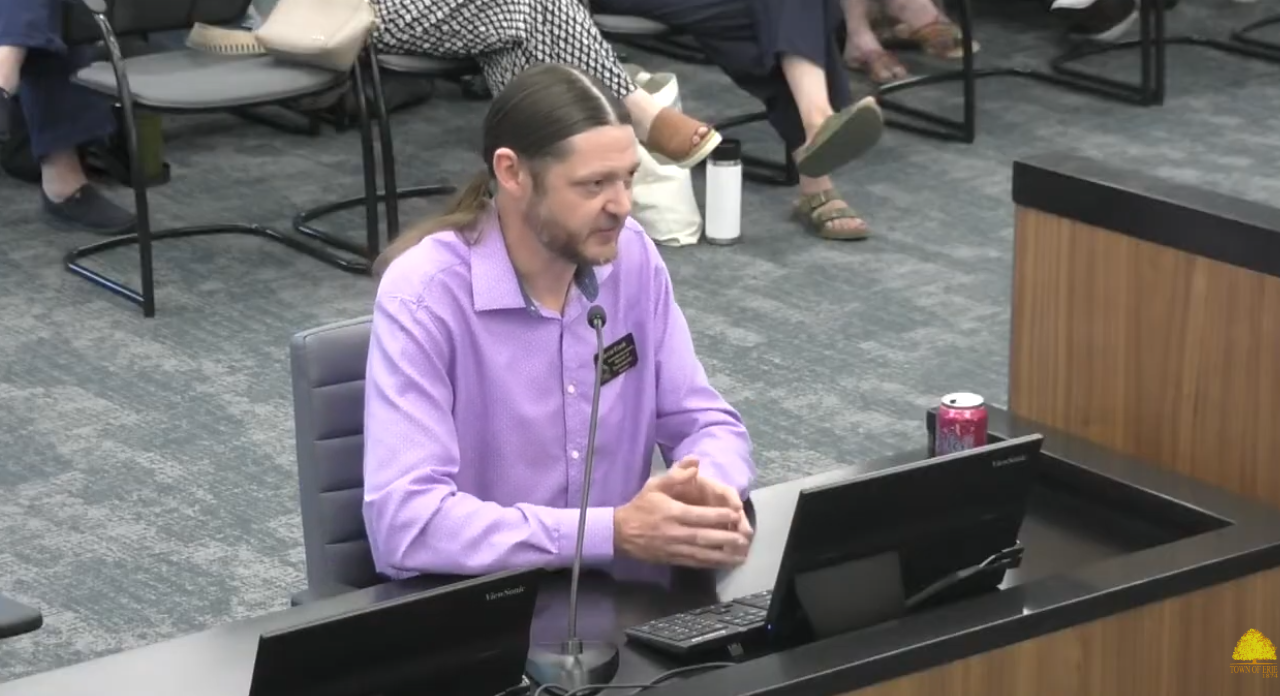
Extraction withdrew the spacing and pooling applications tied to the previous Draco process, ending the ECMC proceedings that had been scheduled for Sept. 24 and Oct. 21. The company filed a new application to change the area where the wells could be drilled, but the state had not yet assigned the case a number. Town Environmental Services Director David Frank said Erie will review the filing and seek to participate once the new docket is established.
The biggest change is where SM Energy can drill. Frank showed council a map marking the town-owned minerals that have not been leased in orange. The new drilling area stops short of those minerals. The revised plan still calls for 26 horizontal wells from the existing Draco Pad, with 20 extending west and six extending south.
“The focus is really at this stage on those unleased minerals, which this new spacing unit excludes,” Frank said. “So there are no plans to produce those minerals.”
Erie still owns some minerals within the new drilling area, but those minerals are already leased. That means the companies already have the right to develop them and do not need to force-pool them. That leaves Erie with a role in the ECMC process, but a less direct fight over its unleased minerals than it had before the new map was filed.
“We’re exploring every possible path,” Frank said.
 One of those paths is challenging or reasserting Erie’s ownership of disputed minerals. Frank said the town and an outside consultant have spent hundreds of hours reviewing property records in Boulder and Weld counties. He described the search as “pretty darn exhaustive” and said one half-quarter section remains disputed because of the timing of older documents.
The question is complicated by how mineral rights were conveyed decades ago. During the meeting, town officials discussed a 2024 Colorado Supreme Court decision involving mineral rights beneath a public right of way. The court ruled that mineral rights beneath a road can sometimes belong to the owners of the neighboring land, extending to the road’s center, unless property records show otherwise.
For Erie, that means determining what the town owns can require tracing old deeds and other property records rather than simply looking at who owns the land today. Frank said Erie had agreed under the now-void SM Energy deal not to pursue some disputed claims, but the town can assert them again now that the agreement is gone.
That does not necessarily mean Erie can stop drilling there. Frank said the disputed area appears to have an existing lease dating to 1982. In that case, the fight could be over who receives the royalties rather than whether the minerals can be produced.
The council also explored whether Erie has rights beyond the minerals themselves. Extraction’s revised plan sends six wells toward the Front Range Landfill, where Erie owns surface property. Frank said the mineral rights under those parcels were severed before the town acquired the land, but Erie does own the surface. He said Erie clearly controls the underground space beneath town-owned land for carbon storage, but whether it controls that space for other uses is less certain.
Town Attorney Breena Meng said the town has used different forms of agreements for underground crossings in the past. “If that is something that council is interested in, that would be something that the council would need to decide and vote on,” Meng said. Whether such an agreement could give Erie leverage over the revised Draco plan remains an open question and will require additional legal and title research.
Frank said the town may have less opportunity to weigh in if no one challenges the new drilling applications. In that case, state regulators could approve them without holding a full hearing. Once an application is filed, Meng said, council members and staff also cannot privately lobby ECMC commissioners about it; discussions must occur through a public commission or hearing process.
The town also has to decide what it will do if another operator makes an offer for its minerals. Staff asked council to choose among several approaches: bring every offer to council, give staff parameters for negotiating, reject future offers or establish another policy.
Council members said future offers should come before the full council in a public meeting. Baer went further, saying she would support requiring voter approval for a sale or lease of town mineral rights.
“I would actually support policy that rejects leasing or selling town property without going to the voters on a specific offer,” Baer said. “I also think that we are operating on the town’s timeline, not SM’s timeline. So we are able to take our time and make those decisions.”
Town Attorney Breena Meng said the terms of a lease offer could be analyzed confidentially before a public meeting, but once an offer is placed on the agenda, the offer itself and the council’s discussion would be public. She said legal strategy related to ECMC proceedings could remain confidential when it falls under attorney-client privilege, while anything the town formally files with ECMC is public.
That distinction could matter after what happened with SM Energy’s latest offer. Extraction offered Erie $12,000 per mineral acre for 112.97 acres, a $1.36 million signing bonus and a 20% royalty. The offer expired Aug. 28 after the town told the company that council approval was required and could not be obtained within the deadline.
In regards to receiving that offer, Mayor Andrew Moore said, “So it was Wednesday when that came in. I didn’t see it until Friday. Why it was sent to me, I don’t know. I’ve never gotten an email from SM Energy directly. But then I forwarded it on, I think it was Friday morning when I saw it.”
At nearly the same time, Extraction was pursuing a second route. Its ECMC filing says the unleased local-government minerals were preventing the project from meeting its existing timeline and that the drilling and spacing unit therefore needed to be changed to exclude them. The new plan keeps the 26 wells but changes the underground area in which the wells can produce.
Erie now owns the same minerals it did before the sale, but SM Energy has redrawn the project to avoid those the town has not leased.
The town also has to decide what to do about the legacy wells that were part of the original agreement. Without the SM Energy deal, Erie no longer has the company’s promised plugging commitments. Staff told council it could seek state action under Rule 211, which allows a local government or landowner to ask the ECMC to require a well to be plugged when the evidence meets the rule’s standard.
But Frank cautioned that Rule 211 is not an easy path. He said previous cases have set a high bar and that the town should focus on its strongest candidates rather than filing weak cases simply to force the issue.
“We could look at them individually and make some sort of assessment of how successful those might be in a Rule 211 hearing,” Frank said. “But I’m pretty skeptical of how successful we might be.”
Staff said Erie could inventory low-producing wells, identify the strongest candidates and continue negotiating with SM Energy about voluntary plugging. Frank said the town could prioritize wells within the new drilling unit or along the path to it. Many of the wells were left behind by Crestone, a predecessor of Extraction Oil & Gas.
The town is also facing a potential legal challenge. Erie has received a notice of claim from two mineral-rights companies seeking $17 million under a potential takings claim, a legal theory involving whether government action has improperly affected private property rights. Town Attorney Breena Meng said a notice of claim is not a lawsuit but a required step before a governmental entity can be sued. “A notice of claim is not a lawsuit. It is a precursor to one,” Meng said, explaining that state law requires a person or company pursuing a claim against a governmental entity to file the notice within specific deadlines and with specific information. Baer said she was surprised the claim was raised publicly and suggested it could be a tactic to scare residents.
Colorado law expressly gives Erie authority to refuse development of its own unleased municipal minerals. Meanwhile, these private mineral-rights companies are asserting that Erie’s actions have affected their property rights enough to support a $17 million takings claim. If the claim develops into a lawsuit, it could leave the courts to determine where the town’s statutory protections end and the companies’ private property rights begin.
Emily Brecht, Erie mineral rights referendum organizer
For residents who pushed the referendum, the choices now are as important as the outcome they sought. Emily Brecht, who helped organize the petition, told council that future mineral discussions should remain public and that residents should not have to repeat the referendum effort simply to get information.
“Any consideration to sell or lease town minerals should be held openly if at all,” Brecht said. “And if there is a decision to be made, put it to a public vote. The referendum is proof that the public wants to participate in those discussions.”
Residents also urged Erie to assert every mineral interest it believes it owns. Steve Drew called for Erie to formally claim all the minerals it believes it owns, including disputed rights beneath open space, town property and roads. Frank said the town’s title work will continue, while council members asked for clearer public information about what Erie owns, what is leased and what remains unleased.
The Sept. 1 meeting also produced a more concrete answer about how Erie will handle another lease offer. Council members said they want future offers brought to the full council rather than rejected by staff before council can weigh the benefits and risks. If an operator sets a short deadline, town officials said a special meeting could be called.
Moore acknowledged that the town may not be able to stop Draco, but said Erie still needs to determine how much influence it can exert. “Because now I’m mad, right? We’re not getting anything. So how are we going to stop this thing?” Moore said as the council turned to what role it should play before the ECMC.
For now, Erie can weigh in on the state review, claim additional minerals it believes it owns, investigate other rights tied to town property, push for old wells to be plugged and decide how much say residents should have in any future mineral deal.
None of those options comes with a simple way to stop Draco. But the recent changes have shown that Erie’s decisions about its minerals can affect the project’s path. Extraction has already redrawn the drilling units around the town’s unleased interests, and Frank said the company could redesign the units again if Erie eventually agreed to allow those minerals to be produced.
“Perhaps if the town entered into an agreement to allow our minerals to be produced, we’d see this DSU redesigned again,” Frank said.
The next step is another round of state regulatory proceedings, and the town does not yet know how much influence it will have once those proceedings begin.
Erie still cannot simply stop Draco, and the project still calls for 26 wells. But Erie has proven that it can impact the path of the Draco Pad, and there are still more options to consider.
Previous coverage of Erie’s Mineral Rights.
In today’s corporate world, finding true, honest journalism is getting harder, and that includes local news, too. From corporate takeovers to the nonprofit industry, finding reporters willing to ask the hard questions seems like a thing of the past.
Which is why Yellow Scene remains fiercely independent and never, ever accepts quid pro quo. We are only beholden to our readers, not funders.
The truth is, we really cannot do this without you. If you value our journalism, become a sustaining supporter for $8 a month. Your support keeps honest reporting alive and gets the hard copy delivered to your home.