
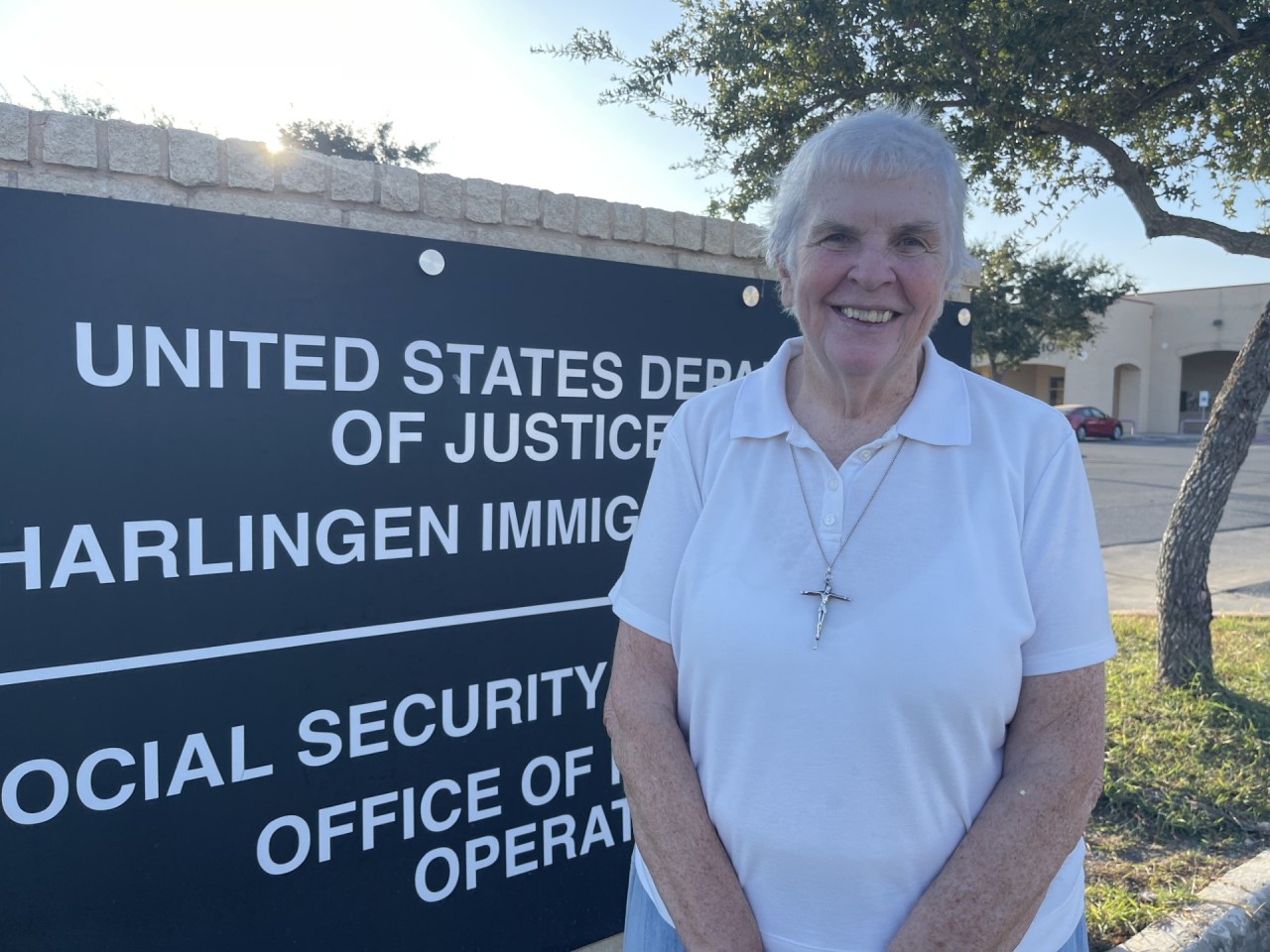
HARLINGEN, Texas (Border Report) — A Catholic nun from Philadelphia every week attends federal immigration court in this border town to pray and give comfort to immigrants, many of whom are facing deportation from the United States.
Sister Rose Patrice Kuhn, of the Sisters, Servants of the Immaculate Heart of Mary order has been living in the Rio Grande Valley since 2022.
For the past year, she’s been attending federal court hearings every Wednesday in Harlingen, Texas, to pray and give moral support to those in immigration proceedings and their families.
“It is a way to support the migrants, the immigrants who have their appointment with immigration, to let them know that they’re not alone. There are many people that are praying for them. I tell them that I’m one of hundreds of sisters that are praying for them every single day. And all those sisters can come here to Harlingen to the immigration court. But I’m here in their name and they are praying,” Kuhn said Wednesday as she allowed Border Report to shadow her.
She chose Wednesdays because that’s the day that most unaccompanied migrant children have their hearings. But that day has changed as of late.
There weren’t any children who went before immigration judges here on Wednesday, so Kuhn used the morning to talk to anyone else with whom she came in contact.
The 78-year-old nun used to work in Chile. She speaks Spanish and used to teach high school.
She says she has a special affinity for the youth. She says those who came to the United States alone are brave and deserve respect and love.
“Teenagers are very dear to my heart. So I am grateful to be able to accompany them in whatever way I can,” she said.
On Tuesday, she is scheduled to help a 12-year-old girl who came to the border without an adult and is scheduled to go before a judge at the Harlingen immigration court.
“I tell them that they are very valiant,” Kuhn said. “And I just think they’re really good people, and they would be a great gift for our country if they are allowed to reunite with relatives in the United States, uncles or cousins. They don’t have to be parents.”
But for the past few months she said she is seeing more and more children go before immigration judges and announce that they are self-deporting back to their home countries.
She estimates that “at least a third of them right now are asking to self-deport,” she told Border Report.
On Wednesday there were only adult cases.
Border Report sat through 11 cases in one courtroom where the judge was on video camera from Laredo, Texas.
There was a translator and headphones for the defendants. But in 10 of the 11 cases on Wednesday, the immigrants asked for a cancellation of their order of removal in order to self-deport. That means they’d rather leave on their own than be sent by the United States, possibly to a third country that is not their homeland.
The Department of Homeland Security is using the CBP Home Mobile App to incentivize the voluntary self-departure of those in the country illegally. Those who use the app “will receive cost-free travel, a $3,000 exit bonus, and forgiveness of any failure to depart fines. Illegal aliens requesting assistance will have a timely departure arranged for them,” the agency says on its website.
Border Report Live: Operation Rotten Apple nets 2,200 in New York
In the cases heard Wednesday by Border Report, every case was given a return hearing date. Most must return in October.
Kuhn says those who agree to self-deport get about three months to self deport and must be gone by a deadline time.
Kuhn says she is now also seeing a trend for immigration judges to use the word “asylum” to mean the person is free to go to a third country, not back to their homeland.
“The judge will say, you will probably be given asylum, but the asylum will be to Ecuador. Or the asylum will be to Uganda. And they say, but I don’t know anybody in Ecuador. And the judge has said, ‘my hands are tied,’” Kuhn said. “So there are the people that have suffered in their country and then they come and they’re told, ‘Yes, you have been suffering and you’re suffering a lot. But at this time, we’re not going to allow you to stay here. We’re going to send you to a third country.’”
She says she sat in on a case where a judge ordered the mother to her homeland of El Salvador but ruled that her three children must be sent to Mexico where they had been born but never lived.
“That was unbelievable!” she said.
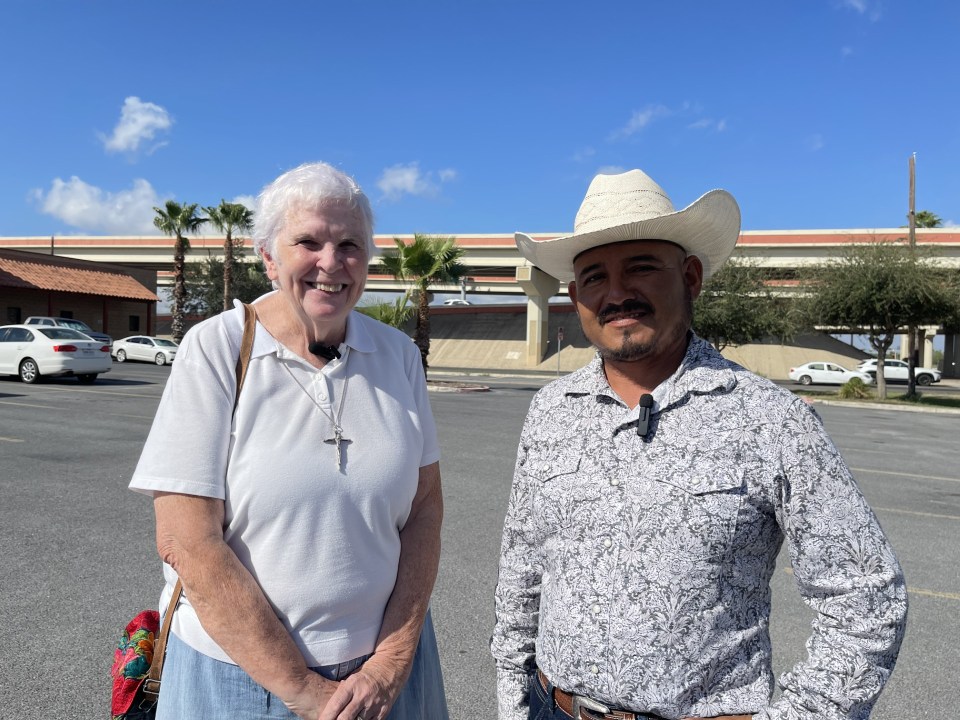 Sister Rose Kuhn talks with Israel Guevara Gonzalez, 47, a rancher from Rio Grande City, Texas, who had an immigration court hearing on Sept. 2, 2026, in Harlingen, Texas. Gonzalez is facing deportaiton back to Mexico. (Sandra Sanchez/Border Report)
On Wednesday, the only defendant not to agree to self deport in this particular courtroom was Israel Guevara Gonzalez, a 47-year-old rancher who lives in Rio Grande City, Texas, about 75 miles west of the courthouse.
Immigration Judge Courtney Chua Stevens, who was in Laredo, told Gonzalez via video camera that he had been found “removable” by the court and asked whether he was seeking a cancellation of removal, like the other cases.
Gonzalez was the last case and without a lawyer present it was obvious he didn’t understand what was going on.
He told Kuhn afterwards that he had hired two different lawyers and paid thousands of dollars but lately was told his case is hopeless and cannot find anyone to represent him.
His three children are U.S. citizens, including his youngest daughter, 17-year-old Esmeralda.
Stevens was very patient with him and told him he can continue his case but would need to provide the court with documents about his daughter and letters from anyone else attesting to his work and contributions in the United States.
He has an Oct. 5 return court date.
Gonzalez came to South Texas in 2002 from Ciudad Victoria in the Mexican state of Tamaulipas. He says he hasn’t seen his mother since he left, but if he is deported he will likely go live with her.
He told Border Report he doesn’t expect to be able to stay in the United States into the new year.
He admitted it was a sad and tough day but he touched Kuhn’s hand and thanked her for being there. He looked back at her just before he went before the judge. And as he testified, Kuhn held tight to her turquois rosary beads and had her eyes shut and was praying.
“Es un gran dia para mi (It was a great day),” Gonzalez said in the parking lot afterwards. He even called Kuhn his “angel.”
“This was all in the plan of God that we met today,” she replied back.
Sandra Sanchez can be reached at SSanchez@BorderReport.com.