
By MARTY LEVINE
Editor’s note: “Lasting Lessons” presents stories from faculty and staff about an educational moment that made the most impact on their lives — as a student or an instructor, inside a classroom or out, here at Pitt or elsewhere, formal or impromptu, between friends or even at a bad moment — something that challenged or changed them. Look for more Lasting Lessons in future editions of the University Times.
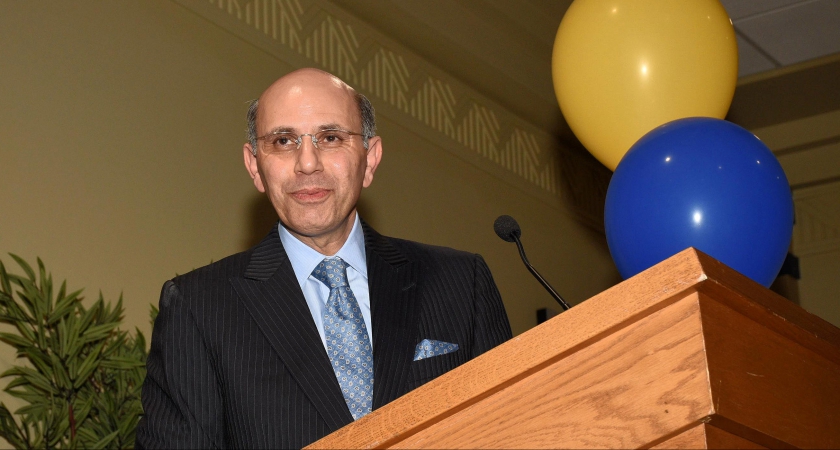
Arash Mahboobin, associate chair for undergraduate education, associate professor, Department of Bioengineering, Swanson School of Engineering
From Iran to the University of Illinois to Pitt, single moments have provided indelible lessons Arash Mahboobin is still using today.
Mahboobin, who grew up in Iran, often feels as if he came from “education royalty” there — his parents are physicians and his grandfather was a mathematician, for whom Mahboobin had worked as an assistant in his teen years.
But in his freshman year at Azad University in Tehran in 1994, Mahboobin experienced the inadvertent effects of someone who treated education with less respect — his instructor in an engineering class on circuitry, in his second semester of a biomedical engineering program, which was a first of its kind for the area.
“During our very first lecture, the instructor — who we later discovered was actually a teaching assistant — asked if anyone was familiar with a specific software program” — PSpice, which simulated circuit building and testing.
“It’s what I do here in all the labs I teach,” Mahboobin said of today’s classrooms — using simulations that lead to hands-on experiences. “It’s a very powerful tool from an education perspective and from a research perspective.”
But no one in his freshman class knew how PSpice worked. The instructor “called us ‘idiots’ and challenged us to learn the software on our own and present a project using it,” Mahboobin said.
He and his fellow students panicked, Mahboobin said — then headed to buy pirated copies of the software from a local bookstore, which was their only choice in those years. Lacking manuals — with no Internet yet to consult — Mahboobin teamed with his English tutor, who happened to be a working electrical engineer. Together, they figured out how the software worked and Mahboobin showed the class.
At first, he presented only his results. “I’m thinking, the instructor is an expert,” Mahboobin recalled. But the instructor said, “‘No, no, no, start from the beginning. That’s when I realized he also didn’t know anything about the software. He was actually having us do the leg work for him.”
Later, Mahboobin was asked to present a workshop for his classmates — “a deeply rewarding experience that ignited my love for collaborative learning and education.”
As a master’s degree student at the University of Illinois–Urbana-Champaign’s business school in 2000, Mahboobin was now a TA himself. Teaming with another TA to teach a summer session for MBA students, Mahboobin presented the material while the other TA handled the mouse and keyboard.
He decided to experiment on subject matter he knew from his earlier schooling in Iran — principles for running software. “We were always told as teaching assistants, you had to be very diplomatic, intentional. I think I tapped into all of that. Perhaps I was also entertaining in my delivery of content.
“It was fantastic,” he remembers. “Two hours went by. Everyone followed. No one was confused. The result was a standing ovation. I was a foreign student. I had learned this in a different system. But I was able to ignite learning in the students.
“This moment solidified my belief that teaching is not just about delivering information — it’s about creating connection and inspiration.
“I remember my own experiences as a student and how faculty and mentors were influential, so now I am giving that back in this role,” he concluded. “I want to ignite in them the love of lifelong learning — to add a bit of spice here and there.”
Rose E. Constantino, associate professor in the School of Nursing’s Department of Health and Community Systems
“I felt alone,” recalls Rose Constantino, when she joined the first class of a new psychiatric mental health nursing master’s degree here at Pitt in 1969.
She had come to the U.S. from the Philippines in 1965 and spent her first two years in Baltimore before moving to Pittsburgh to teach mental health nursing to the staff at Montefiore Hospital. There, she said, “They told me, ‘If you really want to teach in higher education, you have to have your master’s.’”
The faculty at Pitt, she said, “they had a vision for me. They were able to let me know that I belonged to the program at Pitt. It gave me a better look at myself, trying to pattern relationships with people. They are the ones who helped me develop a vision of belonging and relevance. They used the words ‘empathy’ and ‘resilience.’
“That would really make me feel that I had something in me that I could help the program” — and help her field. Among this first class of seven students, she said, two graduated, and both stayed here. Constantino ended up studying resilience as a psychological coping mechanism in both of her Pitt degrees, and has continued to focus on the idea since she was hired as an instructor in 1971.
“It’s kind of complex,” she said — what makes us delay coping or grow stronger from a stressor. What makes us resist change or more easily adapt? How is resilience acquired?
She studies the delay in our resilience: “Right now you may not have the will to deal with a stressor, but later you may have a purpose for it.”
Resilience, she says, “is like money. You can keep it, but then you spend it” recovering from a stressor. “But we don’t really know how to recover it once we spend it. That’s my goal now. That changed my life — looking at it biologically, physically.”
It is, of course, established now that our resilience affects our physical immunity to disease and even our longevity. She believes our individual capacity for resilience at any moment ought to be treated by nurses as the sixth vital sign to be measured regularly, alongside body temperature, pulse, respiration, blood pressure and pain level.
“I am now thinking that we can do a questionnaire for resilience, a short questionnaire. But that’s only psychological, it is not biological.” The main measure of resilience involves factors in our blood. She hopes an easier test might be developed and deployed; why not a saliva test, she said “I think it can tell us a lot more — if we can do something to replenish it.”
She hopes also that nurses can be more often coached about resilience. “Maybe teach the nurses how to replenish resilience by teaching themselves how to develop a good relationship with patients.”
And she wants to encourage all her students to feel the same sense of belonging that she felt here, so many years ago: “There are students who come to me and say, ‘I don’t belong. The professor doesn’t answer my question. She doesn’t realize I am there in class.’
“It’s amazing how you can be in touch with students wherever they are” now, she added. “So it’s really up to the faculty and staff to be in touch with them all the time.”
Marty Levine is a staff writer for the University Times. Reach him at martyl@pitt.edu or 412-758-4859.
Have a story idea or news to share? Share it with the University Times.
Follow the University Times on Twitter and Facebook.