
Kent George was at an aviation industry conference in Montreal on the morning of Sept. 11, 2001, when he heard the news: Two passenger planes had crashed into the World Trade Center’s twin towers, and a third struck the Pentagon. Chaos reigned as it became clear the crashes were part of a coordinated terrorist attack.
George, the executive director of Pittsburgh International Airport at the time, tracked down a rental car. On his flip phone, he got through to his deputy, the late Bradley Penrod.
They had to make rapid decisions. Penrod had evacuated Pittsburgh International’s control tower when a fourth hijacked plane — United Airlines Flight 93 — appeared to be heading toward it.
The two men shared a tense moment before Penrod received word that the flight had gone down in rural Somerset County at 10:02 a.m.
“We didn’t know what the plane was doing,” George said.
George sped home with the phone to his ear. By the time he arrived in Pittsburgh after nightfall, its batteries were dead.
On a day when a catastrophic air security breach led to terrorists claiming the lives of thousands of civilians and emergency responders, Pittsburghers came together to safely ferry stranded passengers from the airport to nearby
hotels.
Now, 25 years on, George remembers the teamwork.
The airport built a temporary road about 100 yards long to “consolidate” the arrival and departure lanes and reduce the area that needed monitoring. “The airlines, the police, the local folks all worked tremendously well, hand in hand, on how to coordinate,” George said.
The 9/11 attacks fundamentally changed the nation’s passenger airline experience, prompting a slew of security restrictions that mostly remain in place in airports across the country a quarter-century later.
And, on a local scale, the attacks contributed to Pittsburgh International losing its largest airline, triggering a chain of events that culminated in the new terminal that opened last year.
Ramping up security
Customers who returned to Pittsburgh International in the weeks and months following the attacks encountered an airport on edge.
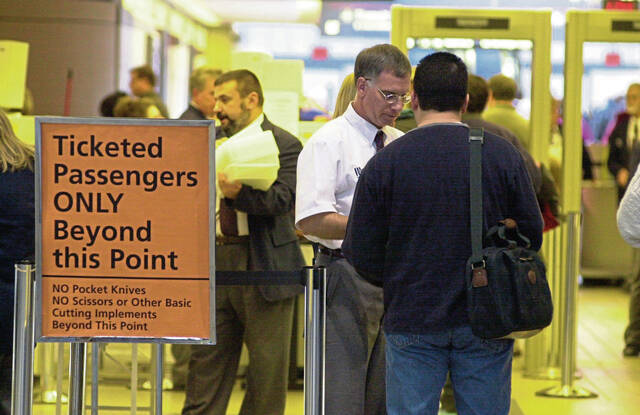
Before 9/11, Pittsburgh International had its own metal detectors, but airlines handled security screenings, George said. That changed after the attack. In late November 2001, the federal government created the Transportation Security Administration to take on those functions.
TSA agents patrolled the airport with bomb-sniffing dogs. They installed a second layer of security featuring hand-held metal detectors and carry-on screenings for flights traveling to high-risk cities like Washington, D.C., former TSA spokesman David Castelveter said.
“D.C. was a lot of business travelers going in and out of the city, so it had a financial impact as well,” he said. In reaction to the increased security, “people just decided, ‘I’ll drive instead of flying.’ ”
The TSA guarded the gates and questioned passengers at random, even testing the contents of their soda cups, Castelveter said. A later rule on liquids, which remains in place, limited passengers to containers of no more than 3.4 ounces in their carry-ons to reduce the risk of smuggled explosive components.
Passengers initially cooperated with the TSA after the attacks. But many grew impatient after months passed and the extra security became more of an inconvenience than a counter to an active threat, Castelveter said.
It didn’t help that some of the agency’s early technology was faulty. Castelveter said one machine, known as “The Puffer,” blew bursts of air onto flyers to detect traces of explosives like nitroglycerin and TNT. But it contaminated samples with false-positive particles — and frazzled people’s hair in the process.
“There were almost draconian measures in place that really offended and insulted travelers,” Castelveter said. “They ended up sending those machines into storage.”
Many of the security measures remained in place for years, though, affecting both passengers and workers.
The fall of the Airmall
In the era before 9/11, the airport’s airside terminal — the space after security — operated like a shopping mall open to the public, whether they had a plane ticket or not. Called the Airmall, it boasted more than 100 retail and dining brands in the 1990s. Some operated exclusive locations in Pittsburgh, like the women’s shoe store Nine West.
Under new rules after the attacks, only ticketed passengers were allowed in the airside terminal. Friends and family could no longer meet passengers at their gates or see them off. The pool of potential customers for the Airmall was drastically slashed, leading to its decline.
At the old airport, the landside terminal — the space before security — was ill-equipped to accommodate friends and family meeting or sending off passengers, said Bryan Dietz, Pittsburgh International’s senior vice president of air service and commercial development.
Mike Purpura was part of the opening team for the TGI Fridays in the airport’s airside terminal and was its assistant general manager during 9/11. One day after the emergency evacuation, he returned to a “ghost town,” with many of the restaurant’s 80 or so employees afraid to return to work.
Purpura cobbled together a temporary staff from regional TGI Fridays locations. Employees’ security badges had become much more restrictive. There were mandatory knife inspections in the kitchen after each shift.
Initially, security officials wouldn’t allow dinner knives, causing major problems for sit-down restaurants, Purpura said.
“We served New York strips, and somebody would be mad a lot of the time because you couldn’t serve a steak knife with it,” he said.
The dinner knives eventually returned. But some of the restaurant’s memorabilia that doubled as potential weaponry was gone for good, like a wall-mounted baseball bat autographed by Pirates players, Purpura said.
Effects on US Airways
Sept. 11, 2001, marked the beginning of the end for Pittsburgh International’s largest airline, US Airways, which operated a hub for connecting flights at the old terminal.
Castelveter served as US Airways’ spokesman at the time. He was watching smoke billow out of the Pentagon from the airline’s nearby headquarters when he heard the startling news that Flight 93 crashed in Stonycreek Township, fewer than 100 miles from Pittsburgh International.
It took several days for US Airways’ planes to fly out of Pittsburgh again. Air traffic was suspended nationwide until Sept. 14.
The airline’s international flights to destinations like London, Paris and Frankfurt, Germany, were snarled because the planes serving them were stuck in Canada after making emergency landings, Castelveter said. US Airways did not have extra wide-body aircraft capable of international flights at the time to shoulder the load, he said.
Disruptions in D.C. continued for weeks longer, further harming US Airways. It had the largest airline presence at Ronald Reagan Washington National Airport, which didn’t reopen for commercial traffic until Oct. 4, 2001.
The events of 9/11 had an immediate and “pretty significant” financial impact on the airline, which, like most of its peers, was operating on thin margins, Castelveter said.
“Nobody knew if there was going to be another attack involving an airplane. People were just afraid to fly, and they didn’t for quite some time,” he said.
And US Airways was already in trouble in Pittsburgh: Executives were locking horns with Allegheny County leaders over landing fees and other charges.
The additional security measures post-9/11 exacerbated an industrywide shift away from US Airways’ hub-and-spoke model toward an “origin and destination” model prioritizing flights connecting large cities, the airport’s Dietz said.
A big part of Pittsburgh International’s early appeal was that it provided connecting flights to smaller but relatively close-by cities like Johnstown and Oil City. But the lengthy new security process made it more attractive for some customers to drive, Dietz said.
The federal government had been propping up airlines by subsidizing fixed expenses like aircraft leases and payroll. That arrangement, while temporary, gave airlines room to declare bankruptcy to renegotiate debts, labor contracts and leases, Dietz said.
Facing a revenue shortfall, US Airways declared bankruptcy in both 2002 and 2004, abandoning Pittsburgh International as a hub soon afterward.
George, although disappointed by the “very little notice” the airline gave, bridged the gap by adding low-cost carriers like Southwest and JetBlue. He left Pittsburgh in 2007 to run the airport in Fort Lauderdale, Fla., and later retired in the state.
Taking flight again
Pittsburgh International has reinvented itself as an origin-and-destination airport. It has grown from seven airlines to 15 and from 36 direct flights to 64 since current airport leader Christina Cassotis began her tenure in 2015, according to airport spokesman Bob Kerlik.
Pittsburgh’s spacious $1.7 billion landside terminal opened in November. It allows the airport to serve more arriving and departing passengers versus primarily connecting flights, Dietz said. The new terminal has 12 security lanes compared to its predecessor’s seven, plus pre-security concessions and several outdoor terraces for meeters and greeters.
“We didn’t want the infrastructure to limit air service growth because we still had a building that was serving a different business purpose,” Dietz said.
Purpura left Pittsburgh International a few years after 9/11. But he eventually returned to manage the airport’s Primanti Bros. location, where he still works. The knife policy has continued, although physical inspections are less frequent and restaurants track their knife inventory using a log, he said.
Purpura complimented security for responding to vendors’ feedback by performing their occasional physical inspections early in the morning, when most restaurants are not as busy. Still, he expected most of the changes caused by 9/11 to remain in place.
“It’s evolved a little bit over the years, but pretty much all of the standards that they put in place after 9/11, they’ve stuck to in some form or fashion,” he said.
Pittsburgh International tried access to the airside terminal’s shopping and dining for non-flyers with a “myPITpass” in 2017. But the airport suspended the program during the covid-19 pandemic and it remained on pause during the landside terminal project, Dietz said.
Executives are evaluating how to reintroduce the pass now that the new terminal has been open for nearly a year and they have had time to observe how customers interact with it, he said.
In the interim, the airport has made a concerted effort to regrow its airside retail and dining roster, introducing more than a dozen businesses such as Mineo’s Pizza House, Shake Shack and menswear outlet Hammer Made.
The airport’s revamped parking setup opened alongside the landside terminal with thousands of additional spaces, making it easier for shoppers to access retail and dining if the Airmall concept returned, Dietz said.
His goal is to create “a future-proof building,” no matter what happens.
“As the industry changes, Pittsburgh is going to be ready,” Dietz said.
The TSA has started to roll back some of its 9/11-era restrictions, including the policy requiring passengers to remove their shoes at security checkpoints, which it phased out in July 2025.
However, Castelveter thinks the security measures will always stick around in some form — just upgraded to be as efficient and accurate as possible.
For example, the TSA’s state-of-the-art CT scanners in Pittsburgh produce 3-D images of carry-on contents, and 16 Credential Authentication Technology (CAT-2) units compare travelers’ real-time photos with their IDs. The agency confiscated 42 firearms in 2024, 88% of which were loaded.
“They’ve come light years from where they were on 9/11,” Castelveter said. “I think that helps all of us as travelers have some confidence that you’re going to get on an airplane and it’s going to be safe.”