
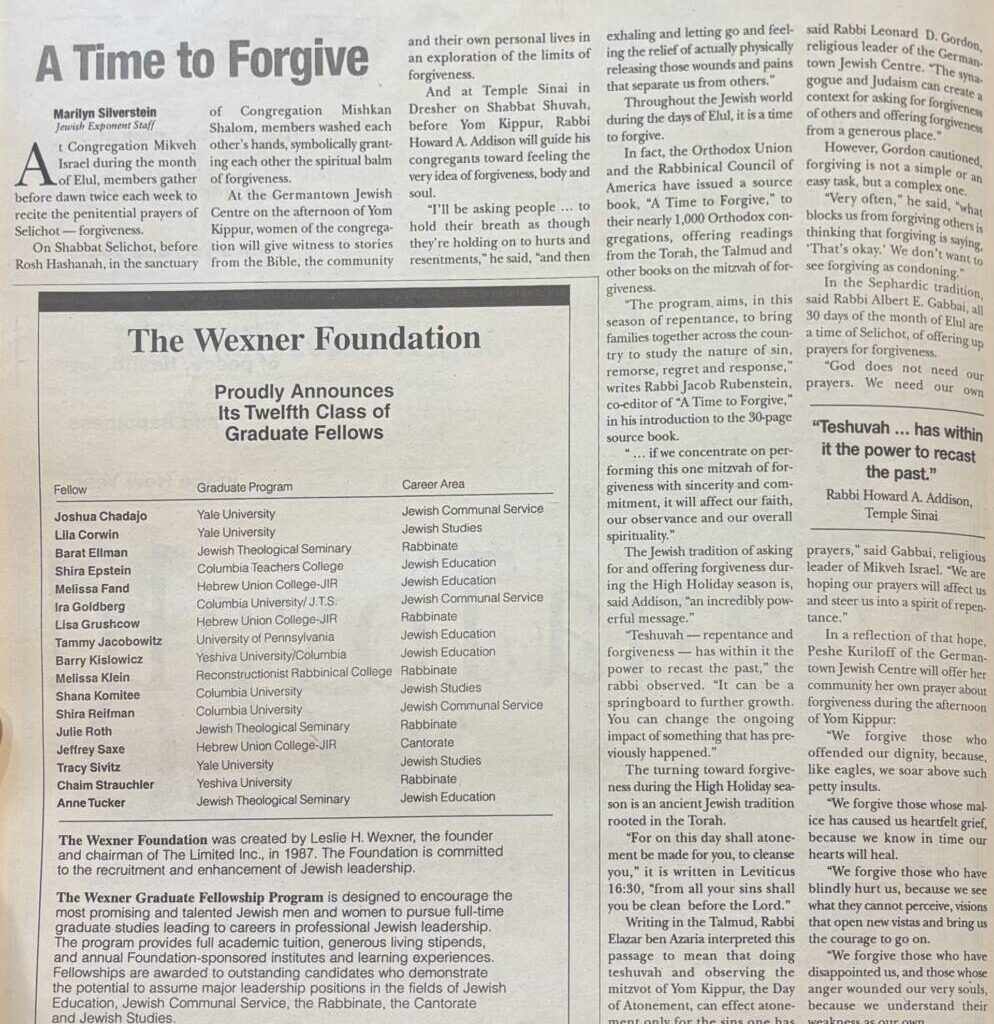
 Courtesy of Jewish Exponent Archives
As we look forward to the new year, we also reflect on our past.
Looking back at the history of Jewish Philadelphians, we find them, too, reflecting for their own Rosh Hashanah — and practicing forgiveness.
“At Congregation Mikveh Israel during the month of Elul, members gather before dawn twice each week to recite the penitential prayers of Selichot — forgiveness,” wrote Jewish Exponent staff writer Marilyn Silverstein in a Sept. 9, 1999, article titled “A Time to Forgive.”
Silverstein noted synagogues in Philadelphia encouraging their congregants to reflect and forgive for Rosh Hashanah 5760.
“On Shabbat Selichot, before Rosh Hashanah, in the sanctuary of Congregation Mishkan Shalom, members washed each other’s hands, symbolically granting each other the spiritual balm of forgiveness,” Silverstein wrote. “At the Germantown Jewish Centre on the afternoon of Yom Kippur, women of the congregation will give witness to stories from the Bible, the community and their own personal lives in an exploration of the limits of forgiveness.”
That year, Temple Sinai in Dresher, Congregation Mikveh Israel, Congregation Mishkan Shalom and Germantown Jewish Centre encouraged their congregants to focus on letting go and forgiving.
But it wasn’t a coincidence. Silverstein wrote that throughout the Jewish world, Elul is considered a time of forgiveness. That year in particular, the Orthodox Union and the Rabbinical Council of America issued a sourcebook, “A Time to Forgive,” to many Orthodox synagogues.
“The program aims, in this season of repentance, to bring families together across the country to study the nature of sin, remorse, regret and response,” Silverstein wrote, quoting Rabbi Jacob Rubenstein, co-editor of “A Time to Forgive.”
Silverstein explained it was believed that forgiveness in Elul and atonement of their sins during Yom Kippur were different, distinct processes. “Yom Kippur, the day of atonement, can [affect] atonement only for the sins one has committed against God. But if one has offended another person, even if only verbally, one must beg that person’s forgiveness directly.”
mresnicow@midatlanticmedia.com