
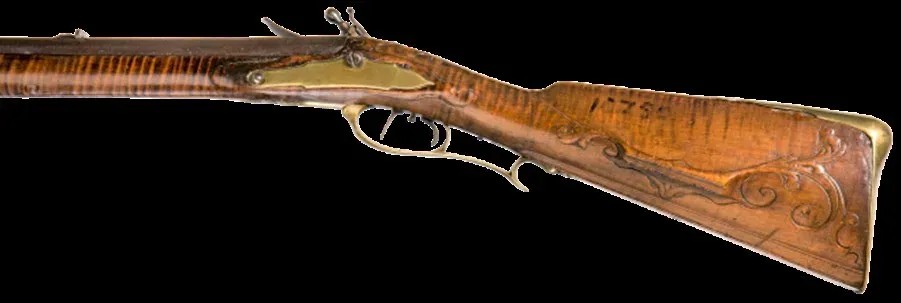
Pennsburg exhibit brings together 20 historic firearms, including privately held and newly discovered examples, to explore a distinctly Pennsylvania craft tradition
Some have spent generations in private collections. Several have never before been publicly displayed. Three were only recently discovered and had not previously been recorded.
Together, 20 early Pennsylvania longrifles are offering visitors to the Schwenkfelder Library & Heritage Center a rare look at the craftsmanship, immigrant influences and regional styles that helped transform a European firearm tradition into a distinctly American art form.
“Southeastern Pennsylvania Longrifles – The Early Years” remains on display through Oct. 18 at the Heritage Center, 105 Seminary St. in Pennsburg.
Organized in collaboration with the Kentucky Rifle Foundation, the exhibition focuses on early rifles connected to southeastern Pennsylvania and the gunmaking traditions that developed around places including Bethlehem, Reading and Lancaster.
Guest curator Harry Nowak assembled the exhibition from museum and private collections, bringing together examples selected to illustrate how gunsmiths adapted European traditions while developing identifiable Pennsylvania regional styles.
Among the firearms are three newly discovered early rifles that had not previously been documented, according to the Heritage Center.
Many others are on loan from private collections and have seldom, if ever, been available for public viewing.
The result, organizers said, is a collection that may be difficult to assemble again.
From European rifle to American longrifle
The Pennsylvania longrifle emerged during the 18th century as immigrant gunsmiths adapted European firearms to life in North America.
German and Swiss gunsmiths arriving in Pennsylvania brought knowledge of rifled barrels, in which spiral grooves caused a projectile to spin and improved its accuracy.
But European hunting rifles were generally shorter and heavier than the long, slender firearm that eventually developed in the colonies.
Pennsylvania gunsmiths altered that basic design for hunters and settlers who might travel considerable distances and needed an accurate firearm while conserving supplies of lead and gunpowder.
The resulting American longrifle generally featured a longer barrel and smaller bore than its European predecessors. Its rifled barrel provided greater accuracy than the smoothbore muskets commonly used during the period.
The design became so closely associated with Pennsylvania that it was originally widely known as the Pennsylvania rifle.
It later became popularly known as the “Kentucky rifle,” particularly as the firearm moved west with settlers and gained fame on the frontier. Despite the later name, historians trace much of the longrifle’s early development to 18th-century Pennsylvania.
Firearm and folk art
The rifles were utilitarian objects, but many were also highly decorative works of craftsmanship.
Gunsmiths carved elaborate designs into maple stocks and incorporated engraved brass and silver fittings, patch boxes and other decorative elements.
Baroque and Rococo motifs popular in European art found their way onto Pennsylvania rifles and continued to influence gunsmiths long after those styles had begun to fade elsewhere.
The Metropolitan Museum of Art has described the American longrifle tradition as one in which gunsmiths turned an everyday tool into an object of folk art, with regional schools developing recognizable approaches to stock shape, carving, engraving and metalwork.
Those local variations are a major focus of the Pennsburg exhibition.
Rifles produced around Lancaster, Reading, Bethlehem and other southeastern Pennsylvania communities often carried traits that knowledgeable collectors can use to identify where a firearm was likely made, even when the gunsmith never signed it.
The Kentucky Rifle Foundation maintains records of more than 1,000 known Pennsylvania riflemakers, including hundreds associated with Lancaster County and dozens tied to Berks, Northampton, Lehigh, Dauphin and Lebanon counties.
Moravian gunsmiths helped shape the tradition
The Lehigh Valley became one important center of early rifle production.
Andreas Albrecht, a German-born gunsmith who arrived in America in 1750, served as master gunsmith at the Moravian community of Christian’s Spring near present-day Nazareth.
The Kentucky Rifle Foundation considers Albrecht one of the patriarchs of Pennsylvania gunmaking. He later moved to Lititz in Lancaster County, taking techniques and stylistic influences with him.
Another prominent Christian’s Spring gunsmith, Johann Christian Oerter, took over his master’s gun shop there in 1766 at only 19 years old.
Although Oerter died at 29, the Metropolitan Museum of Art credits him with having considerable influence on the early stylistic development of the American longrifle.
Those connections between gunsmiths, apprentices and communities helped spread techniques while also producing distinct regional schools.
Lancaster became one of the most prolific centers of Pennsylvania rifle production, while other traditions emerged around Reading, the Lehigh Valley, York, Lebanon and Dauphin counties.
Later makers continued to develop those styles.
John P. Beck, who worked in the Lebanon area beginning in the 1770s, became known for rifles featuring elaborate Rococo scrollwork and engraving. Jacob Kuntz, who grew up in the Lehigh Valley before moving to Philadelphia, became one of the best-known artistic longrifle makers of the early 19th century.
More than a hunting gun
Longrifles also became entwined with the military history of early America.
Pennsylvania gunsmiths produced firearms for colonial defense and the Revolutionary War, while skilled riflemen became known for using the weapon’s accuracy at distances beyond the effective range of typical smoothbore muskets.
Some Pennsylvania makers supplied arms to Committees of Safety during the Revolution.
Yet the rifle’s everyday role was at least as important as its military one.
For settlers, hunters and farmers, firearms were tools used to obtain food, protect livestock and travel through areas where manufactured goods and ammunition could be difficult to replace.
That practical necessity helped drive the longrifle’s evolution toward greater accuracy and more efficient use of lead and powder.
At the same time, the carving, engraving and regional flourishes applied by individual craftsmen turned those practical tools into objects carrying the artistic identity of the communities that produced them.
Exhibit continues through October
The Schwenkfelder exhibition opened in July and is being presented with support from the Institute of Museum and Library Services, the Kentucky Rifle Foundation and private donors.
An Aug. 22 symposium brought together specialists to discuss the Caspar Wistar papers, German immigrant culture in southeastern Pennsylvania, Baroque and Rococo decoration and regional longrifle construction and design.
The Heritage Center will offer another related program Oct. 3 focusing on the Pennsylvania longrifle’s role in frontier life. The family-oriented workshop is intended to introduce visitors to how the firearm fit into everyday life during the period.
“Southeastern Pennsylvania Longrifles – The Early Years” can be viewed through Oct. 18 at the Schwenkfelder Library & Heritage Center, 105 Seminary St., Pennsburg.
The Heritage Center is open free of charge from 10 a.m. to 4 p.m. Tuesday through Saturday and 1 to 4 p.m. Sunday.