
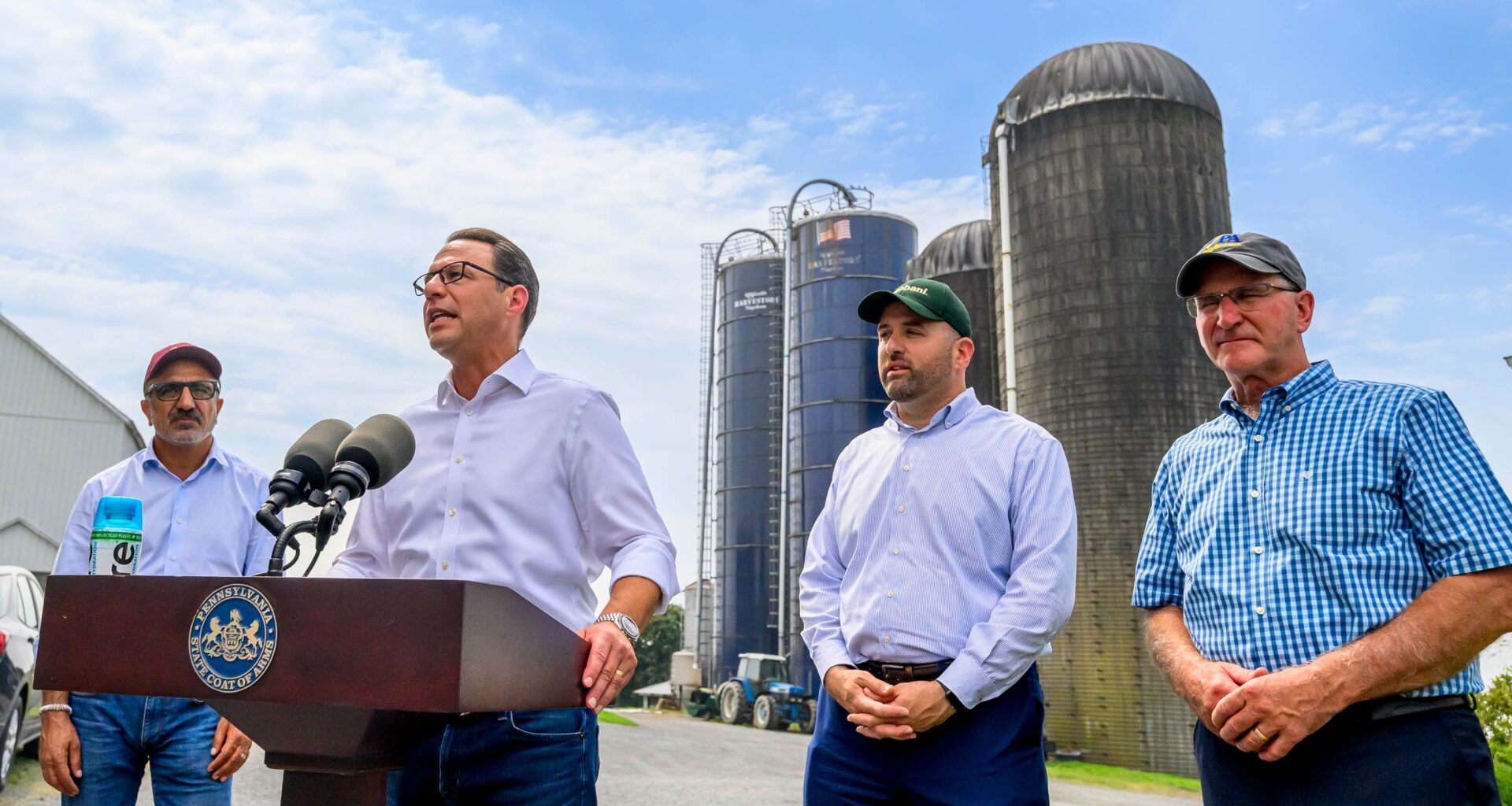
It was appropriate that Chobani’s big announcement came at a dairy farm, about 10 miles from the manufacturing plant it was going to take over.
The yogurt maker said this month that it will invest $1.2 billion and create 900 jobs at a shuttered beverage facility in Upper Macungie Township. However, the news conference wasn’t in the plant’s parking lot; it was at Crystal Spring Farm, a 350-acre dairy and crop farm in North Whitehall Township.
“Every cow in our herd is born and raised right here on our farm, and we grow all of our own feed,” said Jacob Sell, a fifth-generation farmer at Crystal Spring. “We believe that exceptional care for our animals results in exceptional milk.”
That’s part of the reason Chobani founder and CEO Hamdi Ulukaya finally picked the Lehigh Valley after a courting process from state and regional officials that lasted several months. It is the largest private agricultural investment in state history.
It’s expected that the cows at places like Crystal Spring, along with thousands of others in the Valley and across the state will be producing milk for Chobani yogurt and the company’s other dairy products. Gov. Josh Shapiro, who joined Ulukaya and other state and local officials at the announcement, said the facility is expected to process more than 3 billion pounds of Pennsylvania milk annually, which is approximately 30% of the milk currently produced by Pennsylvania’s 4,360 dairy farms.
For Paul Hartman, a retired Lancaster County dairy farmer, chair of the Pennsylvania Farm Bureau’s State Dairy Committee and a member of the state farm bureau’s board of directors, the news brought excitement to an industry that produces 9.7 billion pounds of milk annually from 461,000 cows, but has been either stagnant or in a steady decline of about a billion pounds over the past 20 years.
“It’s been decades since we’ve had any type of growth in Pennsylvania,” said Hartman, who still works on the family farm in northern Lancaster County. “This is huge. It’s nice for a change to hear about growth, because it has been at least a decade now since our local processor was telling us, ‘we don’t need any more milk.’ “
Hartman estimated that ramped-up production will require 120,000 additional cows with roughly 240,000 additional acres of forage to feed them.
According to the Center for Dairy Excellence, Pennsylvania ranks eighth in milk production nationally, generating about $11.1 billion annually in revenue and supporting more than 46,000 jobs. The average herd size is around 100 and 93% of dairy farms are family owned.
Ralph Hahn, whose family has farmed in Plainfield Township since 1930, wishes a deal such as Chobani had come sooner. He’s skeptical about some farmers moving back toward dairy after years of downsizing that includes smaller herds, land lost to development and younger people not getting into the vocation.
“I think overall for the dairy industry, it’s going to be a good thing,” Hahn, who has a herd of 85 cows and is part of a dairy co-op with a handful of other farms in the region. “It helps, but as far as local farmers here in the Lehigh Valley, I think they’re 50 years too late.”
Choices to make
Dairy farmers have some choices to make in the near future, said Becca Weir, an assistant professor of agricultural economics at Penn State University.
“Chobani said they won’t begin production until 2027 and that isn’t going to be the year that they hit that 3-billion-pound mark,” she said. “It’s going to be a bit of a ramp-up, so you take baby steps to get up to full production. I think that we have time to shift things around to match supply and demand.”
Weir said that rather than a guaranteed surge in herd sizes, farmers will weigh individual choices based on farm transition plans, capital, age and existing capacity. They will also consider such factors as the costs of transporting the milk and whether Chobani will offer a better deal than a regional dairy.
“One thing that I do think might be favorable from this is if this plant is closer, that essentially cuts some of their hauling charges depending on what those fixed and variable charges are for hauling their milk to the plant,” Weir said.
However, whether to expand herds is a decision each individual farmer has to make, and it’s not necessarily an easy one.
“I would be very hesitant to say that this is going to directly cause them to increase their herd size,” Weir said. “I think there are a number of factors at play, such as if a five-year plan is to transfer the farm, for example.”
Factors that are making expansion attractive to companies such as Chobani, Weir said, have been recent updates to dietary guidelines from the federal government that endorses a full-fat diet.
“We’ve seen a lot of push on the protein side,” she said.
Beyond farms, the plant could have ripple effects on grocery stores, entertainment and service sectors in the Lehigh Valley.
“The one place where I do think that we’re going to see a lot is in terms of community impacts,” Weir said, “900 jobs is not trivial by any means.”
“The impact of this investment will extend far beyond the walls of the new facility,” Pennsylvania State Grange President Matt Espenshade said. “When our dairy farms are strong, the benefits are felt by local businesses, schools, community organizations and families throughout rural Pennsylvania. This investment will provide an important economic boost while helping preserve Pennsylvania’s agricultural heritage for future generations.”
Morning Call reporter Evan Jones can be reached at ejones@mcall.com.