
By John Katrina
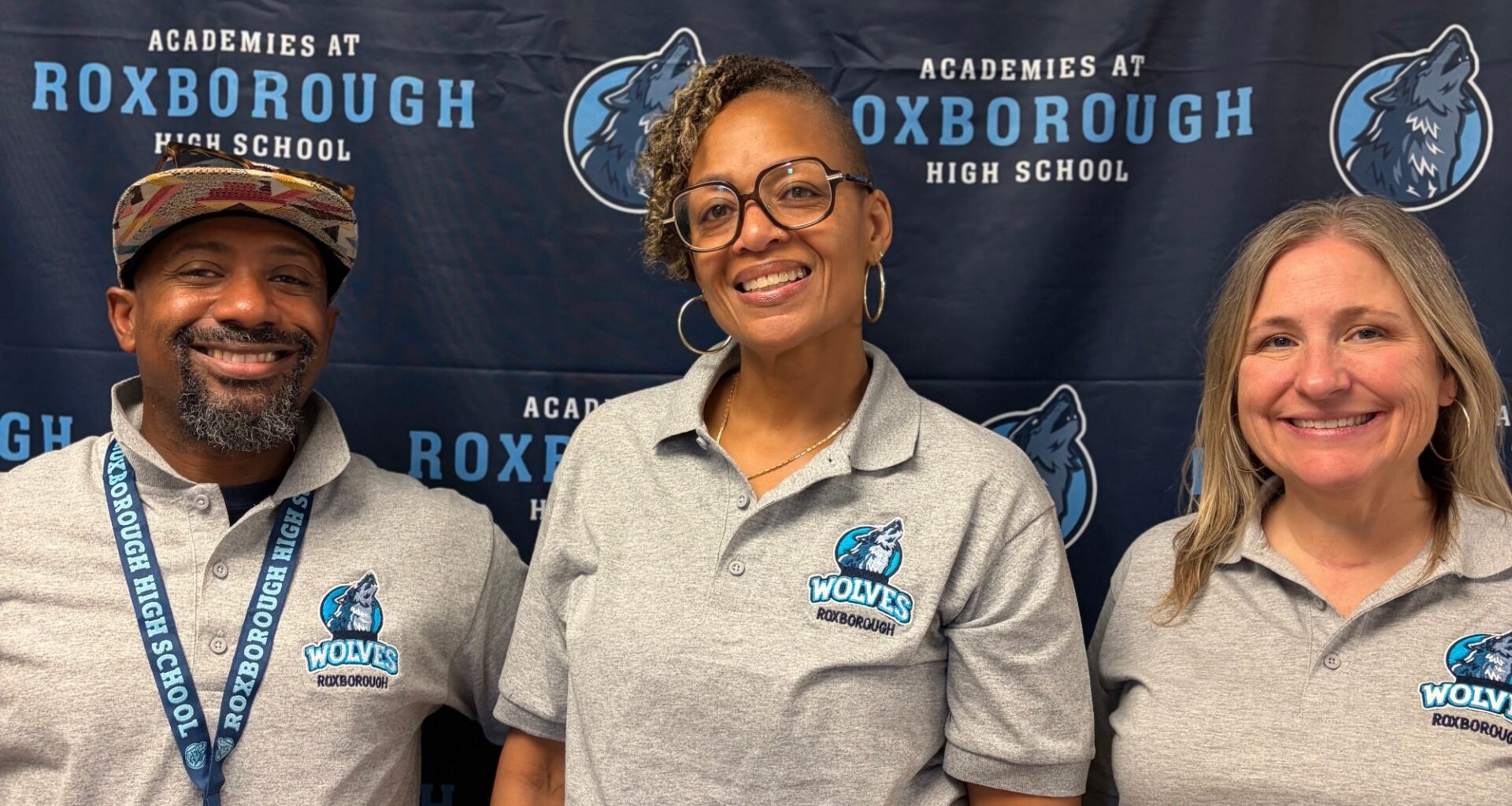
Roxborough High School Principal Kristin Williams-Smalley, weaves methodically through the bustling grounds of her domain like the visionary matriarch, gesticulating with firm but fair authority to a loyal brood.
She heads an indefatigable team committed to teaching leadership and graduating leaders — all invested in ready, eager coordination.
This energy was patently apparent at the Freshman Orientation for the Class of 2030, that was held in late August at the entrance to the one hundred four year old, brownish-gray speckled brick edifice that symbolizes the past, present, and future of Roxborough … and, possibly, even beyond our beloved sliver of the city.
The event featured Student Ambassadors — graduates of one of the handful of special mentoring programs, Strong Point Strategy, elegantly donned in navy blue Roxborough High School blazers, greeting and guiding attendees, already displaying budding characteristics of forward-thinking managers, directors, and C-suite members.
As I roamed through the row of “Wolves” blue cloth covered tables, I spied the likes of Army Colonels, teachers, Assistant Principals, Ph.D.’s, and consultants, all gathered with a solitary purpose under Smalley’s aegis — cultivate future leaders, here in the city of our origin, and the neighborhood we call home — starting with freshman — hands-on, right here, right now.
Strong Point Strategy, whose graduates served as those charismatic hosts, founded by Roxborough resident, Sharon McCollick, came to the fore as particularly emblematic of this bold vision.
But to appreciate the magnitude and depth of the transformative mission and work at RHS, we must first understand the state of public education in The United States, and the circuitous path that brought McCollick to her starring role locally.
Her journey encapsulates the landscape and challenges of our most fundamental duty as adult citizens — raising and educating our successors.
To say that public education and its funding is complex, confusing, tedious, or exhausting would be an understatement.
Even as a degreed teacher, I checked out and decided to just “do what’s best for me” years ago.
Every time I heard the words “school budget” or “school funding” I just wanted to shut it off … because it always seemed to go from bad to worse and never seemed to offer any good news — maybe, until now.
Looking as far back as the Civil Rights act of 1964, which desegregated public education and attempted to move us toward a more meritocratic balance of talent and brains, we see a fledgling nation in stormy, turbulent air, seeking smoother, clearer skies.
But those good intentions have faltered, and some might argue, not only remain unrealized, but worsened, and have even become the epicenter of injustice, and dysfunction in this great experiment.
Because all of the human-caused atrocities on the globe can be traced back to a failure to educate, well … ourselves, to be capable of manifesting this highest known intelligence in the universe to its full potential.
Even author John Steinbeck recognized that “thinking,” perhaps the core skill of education, is the key to that elusive peace many have forsaken.
“All warfare is a symptom of man’s failure as a thinking animal” he penned nearly seven decades ago.
Education is that important — because it unleashes the ultimate intelligence and, if lucky, character of every child that constitutes the body of us.
There is no way to truth, economic balance, justice, and peace, without commensurately rarified schooling.
It is with this calibration to reality, and vision to a better one, that we look at our current state of affairs, and the intrepid team working to improve them at 6498 Ridge Avenue.
When viewed from the outside, against unhuman data, test scores, and our time-hewn comfort configurations, most of us just shrug our shoulders and chalk up the seemingly insurmountable wall that stands between us now, and us at our best, to immutable, forever — flawed “human nature.”
But human nature in 2026 is not the human nature of 100,000 BC, or even 1860 CE, so maybe we, need to look at “us” and our contribution to the problems from which we so conveniently absolve ourselves with a lazy, rote refrain.
We’ve moved out of the barbarism of our origins, economies built on physical enslavement, absolute rule of kings and queens, and the clumsily, albeit brilliantly established union that promises each of us unalienable rights to life, liberty, and the pursuit of happiness.
Unfathomable rights of only 250 years ago, stand today as unfathomable to NOT exist.
This reversal is the argument against immutable “human nature,” and a testament that it, and thus, we, are evolving.
In that spirit, the tremendous responsibility that freedom requires, necessitates the most evolved education system in human history.
This is where we struggle.
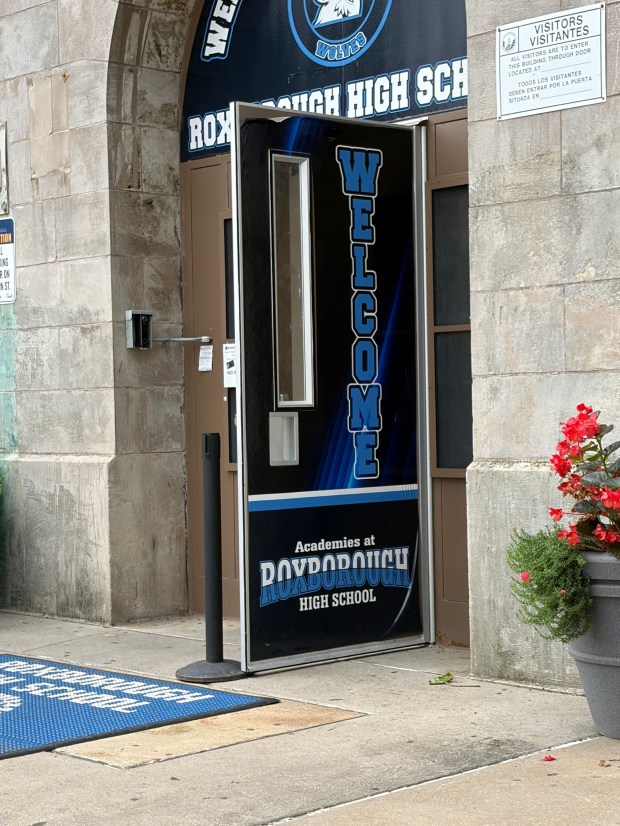 That first doorway of your freshman year hits different. (Photo courtesy of John Katrina)
Our public school system was forged during the industrial revolution and consolidated as power concentrated against our very constitutional design … it concentrated in government, in commerce, in media, and even in entertainment.
Stifled education is part of a larger trend of the commoditization of everything.
The shrinking of main street to wall street’s expansion, is not only a culture-wide tide and a permutation of history’s repeated tendency for power and wealth to fall into fewer and fewer hands, but a procession of dehumanization.
And the net result is a less educated, weaker citizen, and a less educated, stronger ruler.
It’s as if we’ve disconnected from one another and become senescent pods of consumption, rather than the original “e pluribus unum” body of us.
All of the attempts to improve education against this trend with national policy since 1964 — the 2008 No Child Left Behind Act, with its Common Core, and its successor, the 2015 Every Student Succeeds Act, with their rigid harness to testing, and low-touch processes, have arguably failed to deliver us to the promised land, if not increased the cost of education while reducing its efficacy, whether we find some redeeming qualities in them or not.
Public education is more expensive than ever, surpassing even inflation, with less students enrolled, and test scores lower.
Civic engagement is down, trust in government and media are at all time lows, and in 2023, US Surgeon General Vivak Murthy declared that we are in a “loneliness epidemic.”
The common thread being the confluence of power concentration, a sedentary citizenry, isolation, individualism, and the misuse of technology that makes everything, not just education, more transactional, less human, and less edified.
And our tendency is to seek some deus ex machina in the form of a person or policy to save us from the dysfunction and reinvigorate us as citizens to feel a power we lost — the power to imagine, to dream, and to make our dreams a reality.
This might be a long-winded way of saying reclaim the “pursuit of happiness,” or its more colloquial sibling, “the American dream,” but either way, it can only happen with effective education.
Enter Sharon McCollick and her story, that started in a humble corner of the Holme Circle section of Philadelphia in the 60’s.
Her parents, themselves the descendants of immigrants and children of divorce.
Her father exited when she was five. Her mother went to work at two fulltime jobs to keep seven children out of homelessness, and in the process was never home.
She remembers her brother working a paper route, not for his own spending money, but to help support the family.
When she went to catholic school at St. Katherine of Siena, she was more focused on survival than ABCs.
Frequently couch surfing and scrounging to survive from one day to the next, looking for a path to a better situation.
All the while, she remained a champion for the underprivileged and unjustly treated.
McCollick recalled an incident in third grade when a problematic student was locked in a closet as punishment for misbehaving.
“We (the other students) banded together and locked the nun out of the classroom, to free the kid’’ she said as if it happened only yesterday.
By fourth grade, her family moved a few miles north, just outside Philadelphia, to Bensalem, where she entered St. Charles Borromeo School.
“Things began stabilizing a bit, but mom was still preoccupied with two full-time jobs.”
McCollick was able to focus on that escape path a bit more now, and what she lacked in parental presence, was redoubled in ambition.
The palpable determination she exuded was sensed by her teachers, many of whom became mentors.
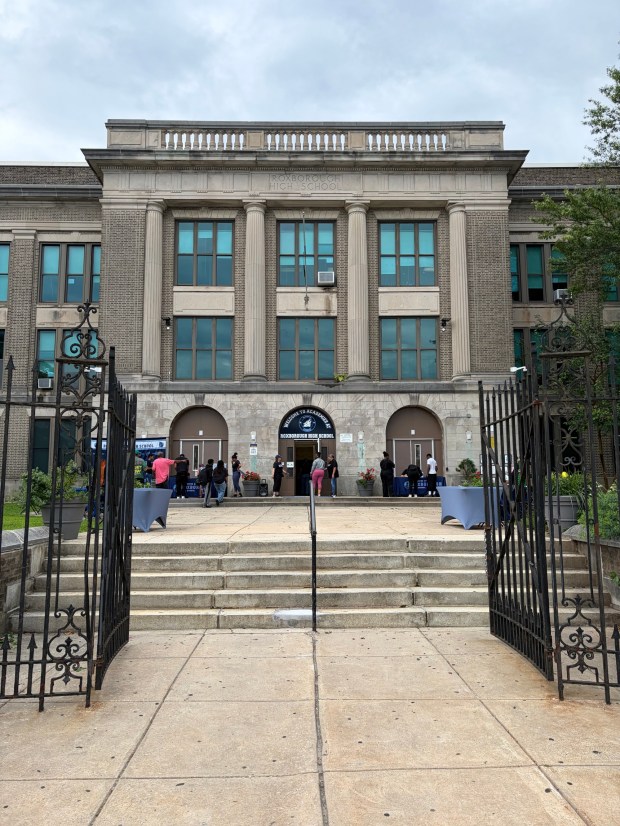 Roxborough High School gets ready for the 102nd class to pass through these doors. (Photo courtesy of John Katrina)
“When family doesn’t provide privilege, you rely on others” she said matter-of-factly as we spoke over her bountiful display of Strong Point Strategy swag, charts, and learning tools.
She suggested I try an exercise from her program in which I thought of a situation that caused me to feel frustrated, and we worked through some ways of taking steps to understand what went wrong, what I could do better and how to communicate with the individual to reconcile.
She moved through it with ease, and my confidence was already growing. Is leadership contagious?
We were frequently interrupted by inquisitive students who wanted to know more about the program, which told me word was spreading and SPS was growing; and the cycle of mentors begetting mentors was happening poetically in real time.
When she began at Bensalem High, her unstable home life had put her behind in math, but she needed income.
“I took a job at a pizza shop waiting tables … it was like work-study before there was work-study.”
I asked about the schedule to understand more deeply a day in the life she lived vis-à-vis her current and prospective mentees.
“Ha, well that was just non-stop … ride my bike home from work at 11:30 p.m., homework from midnight until about 1 a.m., or until I fell asleep.”
I took a moment to fathom a 15 year old female riding a bike for 30 minutes in the dark every night … so driven to succeed, that risk was more friend than foe.
Yes, times were a bit different, but it reminded me that poverty and safety are often at odds, then, and now.
“My teachers let me sleep sometimes for a couple periods. I was taking two math courses to catch up, practicing gymnastics after school (somehow managing to become the team captain), then off to work,” she relates, almost as if it’s a normal schedule and workload.
Gymnastics was more affordable than dancing, and a second choice.
One of her early lessons in how money affects dreams. And whatever affects dreams affects the quality of us as humans.
And it was that second choice of gymnastics that blossomed into her first enterprise.
As a teen, she recalls one of those mentors, Mr. Cianna, challenging her to get 4,000 signatures to petition for starting a gymnastics teaching charity.
She spent close to a year going from school to school, and eventually got the signatures and funding through Cianna.
Adding the running of a non-profit to the aforementioned schedule, she never took her eyes off of the holy grail — college.
And her mentors knew that was the plan.
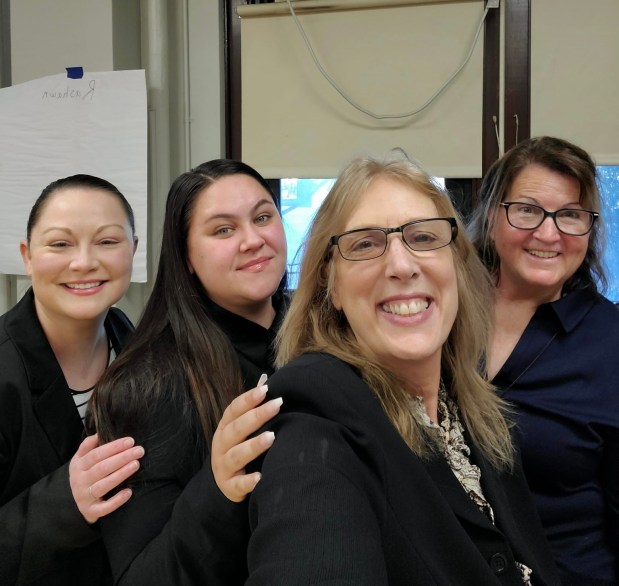 The Strong Point Strategy, LLC Team, left to right: Jenny Jenks, Lead Instructor; Brianna Obst, Student Aide and Liaison; Sharon McCollick, Program Director; and Sharon Fitzgerald, Program Developer. (Photo courtesy of John Katrina)
Help with applications, letters of recommendation, and covering tuition for her, if and only if, she studied math and computer science. At least one of those mentors had some laser accurate job opportunity prognostication in the late 70’s.
She matriculated at Lockhaven University and the pattern of unstoppable work, more mentors, and ambition continued.
Studying by day and working in the cafeteria as well as the college catering service at night, she made a special connection which caught the eye of the faculty and staff at the university, including the president.
This ultimately led to more letters of recommendation and a selection as one of the few to study abroad at Trent Polytechnic in Nottingham, England.
The multiple mentor or “village” approach worked.
It all added up to her first professional job at Colonial Penn Life Insurance as a 23 year old programmer.
This might be the end of a rags to riches story for many — college degree, prestigious international study, and professional job achieved.
But it was just the beginning for Sharon McCollick — she was upping the ante to making an impact on the world that had her scrounging for survival money for the first two decades of life.
While working for a software company in Lansdale, she wrote a letter to Andy Grove, CEO at a young company named Intel.
In it, she offered to help the emerging chip maker “go digital,” mostly with examples of her work.
It resulted in a pitch to top executives replete with a box of samples of her work that they all loved.
Still in her twenties, she became one of the youngest female tech executives in the country.
“I was running a $30 million dollar division; I was so young!”
But the pressures of the early 80’s male-dominated tech culture, traveling the country daily, and a new marriage took its toll.
In 1992, she made a hard decision to resign and focus on raising her child.
I didn’t get to ask if this was motivated by her upbringing and wanting to be present, because she knew the pain of not having a parent present.
McCollick wouldn’t sit for long before taking the lemons of early 90’s tech and making lemonade.
“I was written up for wearing a yellow man-tailored business suit” she explains. “That led to my desire to make a line of professional attire for women.”
As a new designer, she closed a $5 million deal with JC Penny. She lined up venture capital right here in Philly.
The Wall Street Journal interviewed her for getting the “largest working capital loan for a woman” at the time.
And in dramatic Hollywood fashion, inexplicably, the investors pulled out.
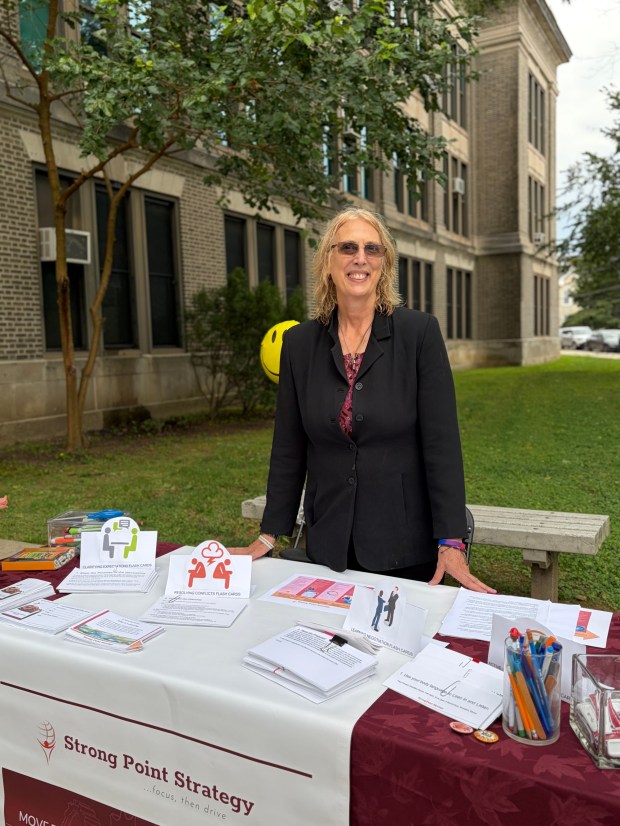 Sharon McCollick and her Strong Point Strategy program is looking to expand into other schools in the district through private funding. (Photo courtesy of John Katrina)
She couldn’t fulfill the order and lost the contract. In hindsight, likely due to a competitor who was working with JCP already.
There’s no amount of quality, effort, or good intentions that can overcome a powerful adversary that can cut your funding.
And this is where McCollick fell back down to her roots — bankruptcy, divorce, poverty.
“It was rock bottom” she tells me as if just another turn on the trail to eventually changing education, and therefore the world, for the better.
“I started writing strategic plans for businesses to climb out of the hole.” She speaks as if she’s relaying data, not tragedy.
She built a consulting business that focused on strategy and leadership, while never losing sight of that desire to help those less privileged.
Strong Point Strategy was born right along side, helping adults succeed, she wanted to help kids succeed — because so many who she thinks about “every day” helped her succeed.
“The curriculum’s core message is to advance individual leadership capability in every student.”
Sharon returns to the present and why we’re ultimately sitting down together.
“They have to see themselves as leaders because the foundation of leadership is leading yourself.”
And she brings us right back to that state of affairs in America and with it, RHS — the confluence of power concentration and the weakening of the citizen … now, we see the importance — directly addressing the strength of the individual, hands-on, connection to community, and feeling their worth.
It’s the power we lost in dehumanizing and that we can gain back in rehumanizing with education and programs like Strong Point Strategies.
This philosophy carries through from Principal Smalley’s vision as she states: “Strong Point provides our Cubs with deliberate, high-touch leadership experience in identified cohorts. Partnerships like this enrich our overall programming and show what happens when students receive targeted support — helping us reach our goal that every Roxborough graduate knows who they are, recognizes their gifts, and contributes to their community, and is prepared to pursue the future they choose with confidence.”
And this ethos seemed to be the exact antidote to the national funk we’ve been mired in since we lost our sense of community and power decades ago.
Grow strong citizens to shift power to the citizenry. Because if we change education to make more powerful citizens, we change the culture, and with it, the wayward power structure.
“We, the people,” is not a populist sentiment, an ideology, or a partisan talking point.
It is a spiritual imperative, a technology of governance, and a fractal of our biology.
It is breakthrough in intelligence that maximizes and balances power in the citizen. It is not a noble feast of patricians tossing breadcrumbs to plebians, it is a banquet of noblesse oblige, truthful balance, and dutiful bounty.
And that power comes from being mentors unto each other, in close human contact, “high touch,” and united in spirit.
Maybe the American Dream isn’t dead after all … maybe, it’s just down for the count like our own Rocky Balboa … and maybe it’s getting back on its feet…right here, in Roxborough.