
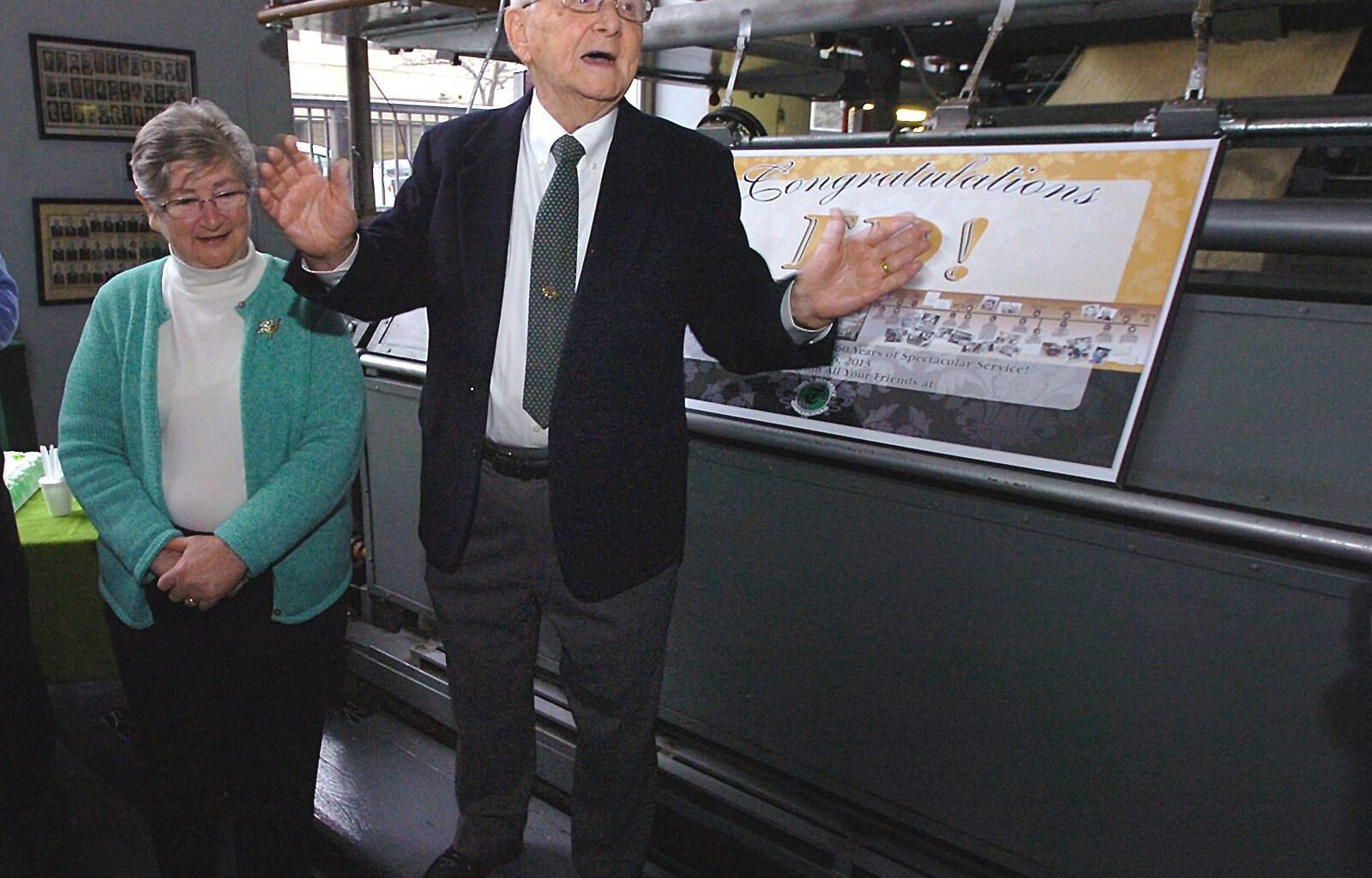
Described as a hard-nosed editor and old-school newsman with a knack for breaking news quickly and accurately, Ed E. Rogers died Thursday at the age of 97.
Throughout his more than six-decade career with Scranton newspapers, Rogers transitioned from a staff writer to state editor, city editor and managing editor before editing a publication for senior citizens after leaving the newsroom.
The Carbondale native never strayed far from the news.
“Back in the days of two-way radios, we would be going grocery shopping and on the way home he’d pick up the radio and say ‘Car 5 to city desk,’” said Rogers’ son, Kevin Edwin Rogers. “Everything he did — from when he got up in the morning to when he went to bed at night — was to get the scoop so he could get the story before anyone else. I remember sitting in our kitchen when (Vice President) Spiro Agnew resigned. The phone rang, and in our house the phone never rang more than once because dad answered it immediately. They thought Gov. Scranton was going to become vice president.
“The newspaper kind of defined him — he was always Ed Rogers from the Times.”

Ed E. Rogers (TIMES-TRIBUNE ARCHIVES)

At Steamton National Historic Site’s 2013 Railfest celebration, then-Superintendent Kip Hagen presents Railfest Grand Marshal Ed E Rogers, left, with a proclamation. Then-U.S. Rep. Allyson Swartz of Philadelphia observes in the background. Rogers served as the secretary of the former Steamtown Foundation board of trustees, a member of the Steamtown National Historic Site advisory and National Park Service Mid-Atlantic councils, and as railroad chairman during the Steamtown National Historic Site opening in 1992. (STEAMTOWN NATIONAL HISTORIC SITE PHOTO)

Then-Managing Editor Ed Rogers with Scranton Times newsroom staff, likely in the early 1980s. (COURTESY OF KEVIN ROGERS)

Ed E. Rogers, left, then-managing editor of The Scranton Times and The Sunday Times, presents actor Bruce Dern, center, and writer-director Jason Miller with a dummy cover for the newspaper in July 1982 for use in the film version of “That Championship Season.” The film was partially shot in Scranton in 1982. (TIMES-TRIBUNE ARCHIVES)

The Most Rev. John F. Swantek, center, prime bishop emeritus of the Polish National Catholic Church, after a Lenten soup and sermon series at Elm Park United Methodist Church in Scranton, with Ed E. Rogers, left, an Elm Park trustee who introduced him, and the Rev. C. Gerald Blake Jr., pastoral associate at the host church. (TIMES-TRIBUNE ARCHIVES)

Air Force and Civil Air Patrol personnel began Operation Hi-Water in this area on Oct. 13, 1956, with a simulated rescue of about 75 people. Here, CAP members brief reporters accompanying them on the mission. From left, Jack Scanella, WGBI-TV photographer; Ed Rogers, Scranton Times staff writer; WO Curtis Rogers, WO John Andrucik, Capt. Rodney Shaub and Lt. George Nelson. (TIMES-TRIBUNE ARCHIVES)

From left, Ed Rogers, state editor; Frank Parry, Sunday editor; and Joseph Oravec, Sunday news editor, examine page proofs of the first edition of The Sunday Times in October 1966. (TIMES-TRIBUNE ARCHIVES)
Show Caption
1 of 7
Ed E. Rogers (TIMES-TRIBUNE ARCHIVES)
Rogers’ daughter, Karen Rogers Baker, noted her father “lived and breathed” The Scranton Times.
“He always wore a white shirt and a tie, and he always had newspaper ink on his shirt,” she said. “He was proud of the work the whole paper did. In the late ’70s, he had one of the first fax machines ever that came in a big suitcase and he would send stories back to the newsroom. The pages would just roll around and somehow it made it all the way to Scranton.”
Rogers and his wife, Eleanor, spent more than 63 years together on their Huckleberry Hill Farm at Kizer Lake in Cortez, Jefferson Twp., where they raised their four children — Karen Rogers Baker and Kevin (Cindy Lee), both of Cortez; Kyle (Renee Tibbets) of Pomfret, Maryland; and Kathryn Bauer (Steven) of Newtown, according to his obituary.
Despite his strong appetite for news, Kevin Edwin Rogers stressed his dad remained present in his family’s activities.
“My brother and I played football and my sisters were in the band, and (my parents) never missed an event,” he said. “As important as the paper was to him, the family was more important.”
Rogers’ passion for photography led him to meet the love of his life when he first encountered Eleanor in the darkroom of the Scranton Times Building in the late 1950s.
“My dad loved photography and he spent a lot of time with (former photographer) Ike Refice,” Rogers Baker said. “My dad saw this pretty girl and wanted to find out who she was, and the rest is history.”
After retiring from the newspaper in December 1994, Rogers became the founding editor of Good Times for Seniors and held the position until May 2017, the end of his 73-year journalism career. He had a hand in the newspaper for decades, including The Scranton Times, The Sunday Times, The Morning Times and The Tribune.
“Ed was a good person who was a hard-nosed editor,” said George V. Lynett, the publisher of the newspaper during Rogers’ tenure as managing editor. “He had a very good instinct for tracking down interesting local stories. He was a good employee who served us well for many, many years. He loved to work. He really didn’t want to retire, and that’s why he stayed on as editor of that weekly paper.”
Pat McKenna — who served as associate editor of The Times-Tribune for decades — appreciated the trust shown by Rogers as he was breaking into the industry.
“Personally, we had disagreements, but he had confidence in me and assigned me to some major beats when he was the managing editor,” McKenna said. “I covered the construction of Lackawanna County Stadium and we uncovered some wayward bidding by the stadium authority that resulted in the project being delayed by a year because the state auditor general started an investigation based on our reporting. He loved news and he was unsparing in his pursuit of it. He set some pretty high standards in the newsroom for chasing the news and presenting it.”
McKenna also noted that Rogers, a “train nut,” played a big role in persuading Steamtown officials to move to Northeast Pennsylvania in the 1980s.
“He was one of the moving forces in getting Steamtown to relocate from Vermont to Scranton, both in his personal advocacy outside the newsroom and in ensuring that the newspaper covered it every step of the way,” McKenna said. “It’s really unfortunate that he died before the restoration of passenger rail service to New York, because that was truly one of his passions. He longed for the day when that would return.”
Larry Malski, president of the Pennsylvania Northeast Regional Railroad Authority, credited Rogers — a former chairman of the Lackawanna County Railway Authority — with leading the charge to preserve a big chunk of rail lines in the region.
“He was a great advocate who was extremely helpful in saving our heritage and our rail assets,” Malski said. “He was feisty, but he was also programmed in understanding what we had to do. He never gave up the fight with us. There were times we didn’t think we were going to save the Pocono line, but he was a stalwart in staying focused.”
Larry Holeva, executive editor of The Times-Tribune, called Rogers a “newsroom giant” who positively shaped many careers.
“He hired me away from the competition back in 1987, and because Ed had been a baseball writer in his early reporting days, he took a special interest in my work when I left the news staff to cover professional baseball,” Holeva said. “He wanted our coverage to be the absolute best in the region, and his advice to me was simple and timeless: ‘Read the best and write a lot.’ Ed’s stern mentorship, his integrity, and his passion for great storytelling shaped generations of local journalists.”
Bill Mang — who previously served as a sports editor and assistant city desk editor for The Times-Tribune — said Rogers’ competitive spirit pressed reporters to break stories fast and accurately when The Scranton Times and Scrantonian-Tribune were both publishing and competitive.
“The Times was the afternoon paper at the time, so there was a shorter news window,” Mang said. “We only had until like 1 p.m. to get the stories in. And, if there was a story in the Tribune the next morning that he thought we should have had, the person whose beat it was on would have to answer for that. He was demanding, but he certainly was fair. Getting it first and getting it right was vital.”
Mang recounted a tale from the mid-’80s when the zookeeper at Nay Aug Park brought a young tiger cub into the newsroom on a day Rogers wasn’t working.
“He was holding the tiger cub on the desk and, at one point, this very small animal made a tremendous roar,” Mang said. “Without missing a beat, one of the guys on the copy desk declared, ‘I thought he was off today.’ That was kind of indicative of his intensity.”
Kevin Edwin Rogers recalled when his father was first on scene when a fire ripped through several blocks in the Carbondale business district in 1955.
“We have a DVD of the radio broadcast where he’s telling what was happening during the fire,” he said. “It was his life. He wanted to tell the story.”