
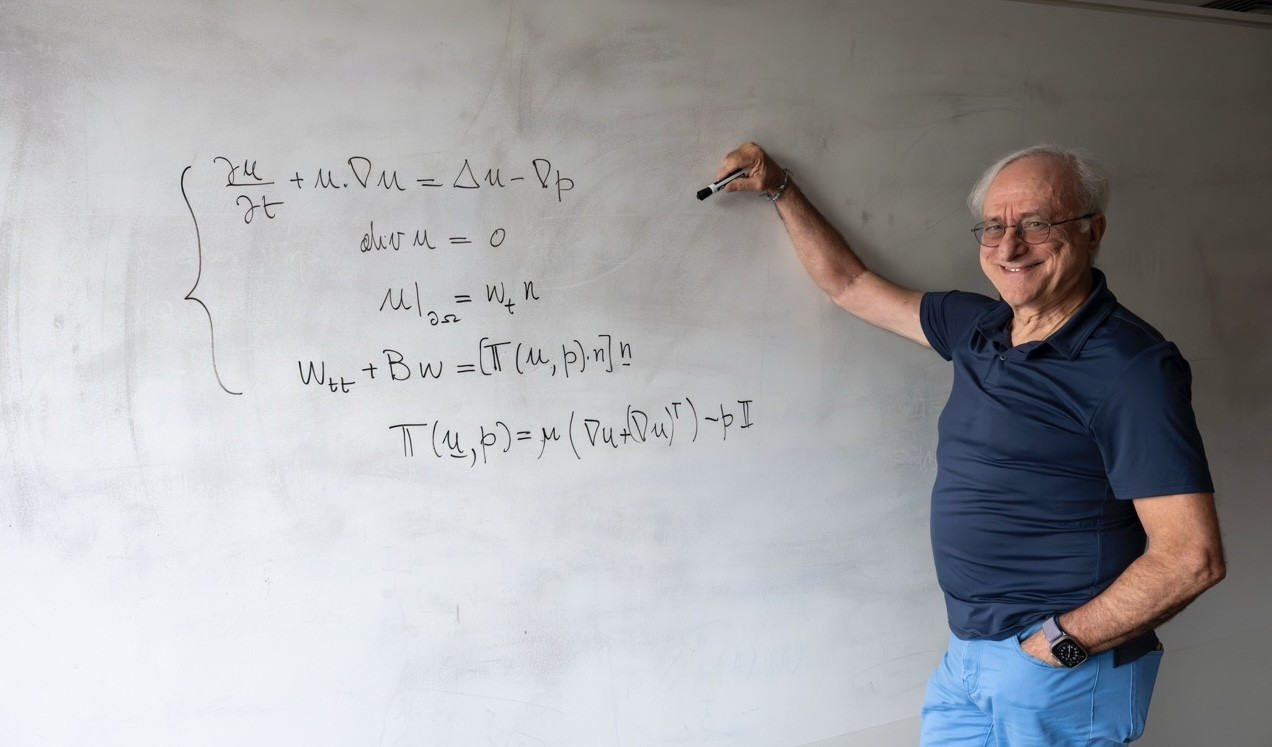
In an age of increasingly powerful computers, G. Paolo Galdi solves complex equations with pencil and paper. A distinguished professor in the Department of Mechanical Engineering and Materials Science at the University of Pittsburgh Swanson School of Engineering, Galdi has dedicated his scientific life to using rigorous mathematics to test models and better understand the complex interactions between viscous liquids and solid objects. His research is helping engineers design everything from safer bridges to novel micro- and nanotechnologies that could transform medicine.
On May 12, 2026, the Learned Society of the Czech Republic elected Galdi as a Foreign Member during its General Assembly. Galdi is recognized for his important contributions to the field of fluid-structure interaction and his mathematical analysis of the Navier–Stokes equations, which describe the motion of viscous fluids.
“It is a great honor to be recognized by the Learned Society of the Czech Republic and to be among these exceptional scholars,” Galdi said.
The Learned Society of the Czech Republic is the successor of the Royal Bohemian Society of Sciences (established in 1784) and is a body of leading scientists and scholars from a wide range of fields and countries. Galdi will be formally welcomed into the Society on September 15, 2026, in Prague.
Galdi’s foundational work, An Introduction to the Mathematical Theory of the Navier–Stokes Equations: Steady-State Problems, has become an indispensable reference in the field, shaping the work of at least two generations of researchers in mathematical fluid dynamics. He is also conducting research in fluid-structure interaction, a field that uses differential and algebraic equations to understand the interplay between a fluid, modeled by the Navier–Stokes equations, and a movable solid structure.
“A typical example is a suspension bridge,” Galdi said. “The bridge deck is held up by cables, and when wind blows above a certain speed, periodic waves can form and interact with the structure, causing the bridge to oscillate. When the frequency of these oscillations matches the natural frequency of the structure, resonance can occur, potentially leading to damage or even collapse.”
His research on the Tacoma Narrows Bridge, a suspension bridge in Washington State that collapsed in 1940, has illuminated shortcomings in the models used by engineers at the time of its construction.
‘;