
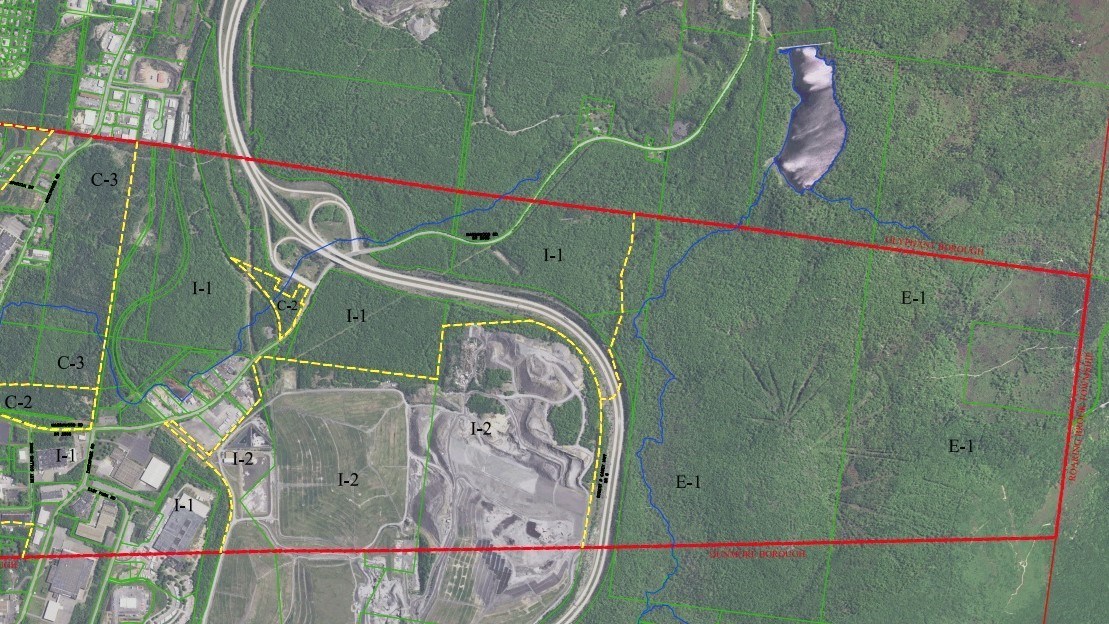
A Louis DeNaples-affiliated company wants Throop to allow warehouses across hundreds of acres of environmental conservation land, despite the borough already allowing the developments elsewhere in the town.
The zoning change sought by Theta Land Corp. would make warehouse and distribution facilities permitted across 700-plus acres in one of Throop’s most restrictive zoning districts along the Casey Highway. Throop is under no obligation to approve Theta Land Corp.’s request because warehouses are allowed in other zones, Zoning and Code Enforcement Officer Andy Hegedus said Monday.
“There’s nothing that has been approved, nothing’s been submitted, and tomorrow’s meeting is for factual information as to what’s the benefit,” Hegedus said, explaining council will decide. “They’ve got seven people they have to convince that this is the right thing to do for that land.”
Throop Borough Council will hold a public hearing at 5:30 p.m. Tuesday followed by a special meeting at 6 to consider the zoning amendment. The hearing and meeting will be at the Throop Community Civic Center, 500 Sanderson St., according to public notices published Aug. 27 and Sept. 3 in The Times-Tribune.
Hegedus expects Theta Land Corp. to make a presentation Tuesday about why council should allow warehouses on the land, and residents will have the opportunity to testify. While council scheduled a special meeting to consider voting on the legislation, the borough could table it and continue the hearing, he said.
Although the principal permitted use designation requested by Theta would normally bypass the public hearing requirement used locally to regulate warehouses and other industrial uses, Throop’s zoning ordinance stipulates that any building 30,000 square feet or larger requires conditional use approval from council.
Throop’s 2021 zoning ordinance principally permits warehouse and distribution facilities in its general commercial, light industrial and heavy industrial zoning districts, which encompasses nearly 1,400 acres spanning from Underwood Road to the Casey Highway, including the Keystone Sanitary Landfill, according to the ordinance and zoning map. With modern warehouses often in the 1-million-square-foot range, any proposal would most likely exceed 30,000 square feet, effectively making the developments conditional uses.
Neither the Lackawanna County Regional Planning Commission nor grassroots environmental group Friends of Lackawanna supports the zoning change. Friends of Lackawanna formed in 2014 to oppose the Keystone Sanitary Landfill and its expansion.
‘Path of least resistance’
Representing Theta Land Corp., attorney Jeff Belardi addressed the Throop Planning Commission about the change June 2 and addressed both planning and council July 7, according to meeting minutes. Attorney Christopher Caputo, on behalf of Atlanta, Georgia-based warehouse developer Core5, joined Belardi at both meetings. Core5 plans to build two warehouses in Scott Twp. off Route 107 near Interstate 81 — one warehouse just over 1.2-million square feet and another just shy of 700,000 square feet.
Belardi told the borough that they have two contracts with Core5, though only one of the warehouses falls into conservation land, according to June 2 minutes. The other proposed warehouse would be in Throop and Olyphant, and fall into Throop’s light industrial zone. The warehouses would use Marshwood Road for access.
Theta Land Corp. owns the entirety of Throop’s 735 acres of environmental conservation land east of the Casey Highway opposite the Keystone Sanitary Landfill. Landfill co-owner Louis DeNaples most recently signed an easement agreement in August 2025 as the president of Theta, according to Lackawanna County Recorder of Deeds filings.
Companies managed by his nephew, Charles DeNaples, the son of landfill co-owner Dominick DeNaples, sold hundreds of acres in Olyphant off Marshwood Road to a St. Louis-based developer who initially planned to build four warehouses but is now suing the borough to build seven data centers in their place. Charles DeNaples also applied for and withdrew plans in Olyphant for seven data centers.
Dominick DeNaples also entered into memorandums of sale in April and June with a PPL Corp. joint venture to explore developing power plants that could fuel data centers across more than 11 square miles in Lackawanna County’s Upvalley and Archbald.
During the July 7 meeting, Belardi told Throop officials that making warehouses principal permitted uses in the conservation zone was “the easiest thing to do,” rather than rezoning the land as an industrial use.
“It was the path of least resistance, being honest,” he said, pointing to potential outrage if they rezone it for industrial uses that also allow landfills. “Everybody’d be up in arms and think that that’s what was going to go over there.”
Throop council voted in July to amend its zoning ordinance to define and regulate data centers, carving out a 351-acre overlay in the conservation district to conditionally allow the developments, subject to restrictions. A group of residents is currently appealing that zoning change. Other uses in the environmental conservation district include agriculture, cemeteries, cell towers, commercial greenhouses and nurseries, prisons, mining, forestry, public buildings, public utilities, public recreation facilities, self-storage facilities and solar farms.
“The path of least resistance was to say, ‘Well, if you can allow a public utility in the (conservation) zone, there is nothing to stop PPL from putting an Invenergy type plant on that mountain,’” Belardi said, according to July 7 minutes. “We’re saying put a warehouse like it’s the least impactful use of the things that could go up there in our partition. If you’ve seen that, you see that there is even a wholesale nursery complex that would be bigger than the footprint of this warehouse.”
Belardi did not respond to a phone message at his law firm by 5 p.m. Monday.
‘The floodgates open’
Mary Liz Donato, director of the Lackawanna County Planning Department, said her department was not in favor of the zoning change after reviewing Theta’s submission. She called it an unusual request, explaining no other municipalities in Lackawanna County allow warehousing in conservation zones.
In its review, associate planner Bob Kenney questioned whether warehouses would conflict with Throop’s preservation goals in its zoning ordinance, Donato said. According to the borough’s zoning ordinance, one of its purposes is the “reservation of natural, scenic and historic values in the environment and preservation of forests, wetlands, aquifers and floodplains.”
The county also noted there are vacant properties in Throop’s light industrial zone where warehouses are permitted.
“Your conservation zones are your open space, your agriculture, small-scale development on larger lots, things like that,” she said. “The intent of those types of zones are to preserve as much land and forest cover or flood plains.”
Pat Clark, a leader of Friends of Lackawanna, urged council to deny the proposal.
“Once environmentally zoned land becomes warehouse land, the next changes become much easier, and when that property sits alongside a mega-landfill surrounded by proposed data center development and major natural gas infrastructure, we need to be very careful and pay very close attention to what uses could hit next,” Clark said. “We have seen what happens when towns give in — the floodgates open.”
One of Northeast Pennsylvania’s best features is its access to beautiful natural resources and forests, which is codified in environmental and protected zones, he said. With finished warehouses unoccupied in the county, allowing additional warehousing would be a double negative, Clark said.
“It doesn’t use up the supply of the asset that we have, and it destroys much of another asset that we do have,” he said. “This ownership group has never been one to ask for small things.”
He criticized Belardi’s characterization of taking the path of least resistance.
“If you’re seeking to get land that is already zoned environmentally to be something else, the path of least resistance is the exact opposite path that anyone should ever be able to take for such a request,” Clark said.