
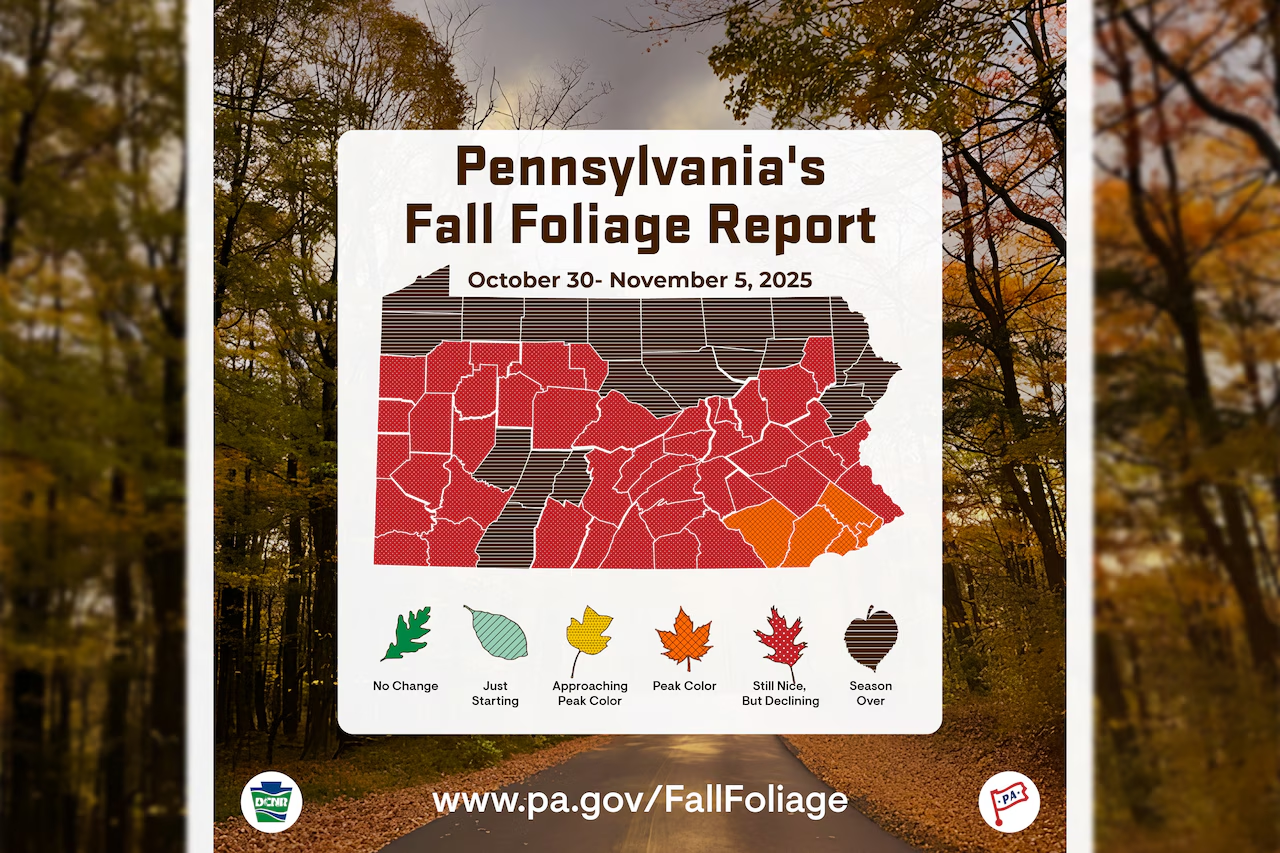
As the outside world normally is around this time each November, things have changed a lot. Many trees are already devoid of leaves while others are still covered with colorful ones. When the chlorophyll that makes the leaves green is no longer being produced, anthocyanin pigments in them turn the leaves red as the days shorten and cooler temperatures prevail.
Black walnut trees are almost all bare except for a few nuts still hanging on here and there. Along many roads you can hear your car wheels driving over their dropped fruits.
Small flowering dogwood trees are glowing wine red, as are tupelos, commonly called blackgum trees, along woods’ edges or in wet areas. And Callery pear trees, known as Bradford pears, have turned dark red or purplish.
Some of the most interesting and noticeable trees in our area are the American sycamores that prefer growing near water. Their creamy gray trunks stick out even during the summer, but they really stand out when their leaves are gone. However, unlike a lot of other trees, they drop their leaves so gradually that sometimes they still have a lot of them on in late fall.
In some developments you may see trees that look just like native sycamores, but they’re actually hybrids between sycamores and tropical plane trees. I well remember that they confused me years ago before I knew about these London plane trees that were planted because they’re tolerant of all sorts of city pollution.
But when it comes to fall color it’s the maples that make the landscape so pretty, even in New England. There are 13 native maple species in the country, and they all put on a good fall show.
Sugar maples may have orange to deep red leaves, while the leaves of silver maples are usually bright yellow or golden yellow. And red maple leaves can be so brilliantly bright that they take your breath away.
Around here there are also countless Norway maples whose leaves turn a bright yellow, but these maples are native to Europe. They were planted as landscape trees, but they’ve become so plentiful that they’re considered to be invasives, although they often hold their colorful leaves long after most other trees are bare.
And there are, of course, several different kinds of oak trees in our woodlands, some of which turn scarlet, red, orange, or shades of brown. And some old oak trees grow to be so big that people become emotionally attached to them.
That’s how I felt about one about a half mile down the road from our farm. It was on a neighbor’s property but every time I drove by their house I always found myself admiring the oak.
However, that will no longer happen because that big tree blew down across the driveway in recent winds. But luckily for them only a small number of its top branches landed on their roof.
The property owners called David to come look at it because he’s helped them with other trees at times. But there was nothing he could do because it had a 4-foot diameter. And the reason it blew down was obvious: Except for the outer edges, the entire insides of its bottom were completely empty.
If you purchase a product or register for an account through a link on our site, we may receive compensation. By using this site, you consent to our User Agreement and agree that your clicks, interactions, and personal information may be collected, recorded, and/or stored by us and social media and other third-party partners in accordance with our Privacy Policy.