

Contributed
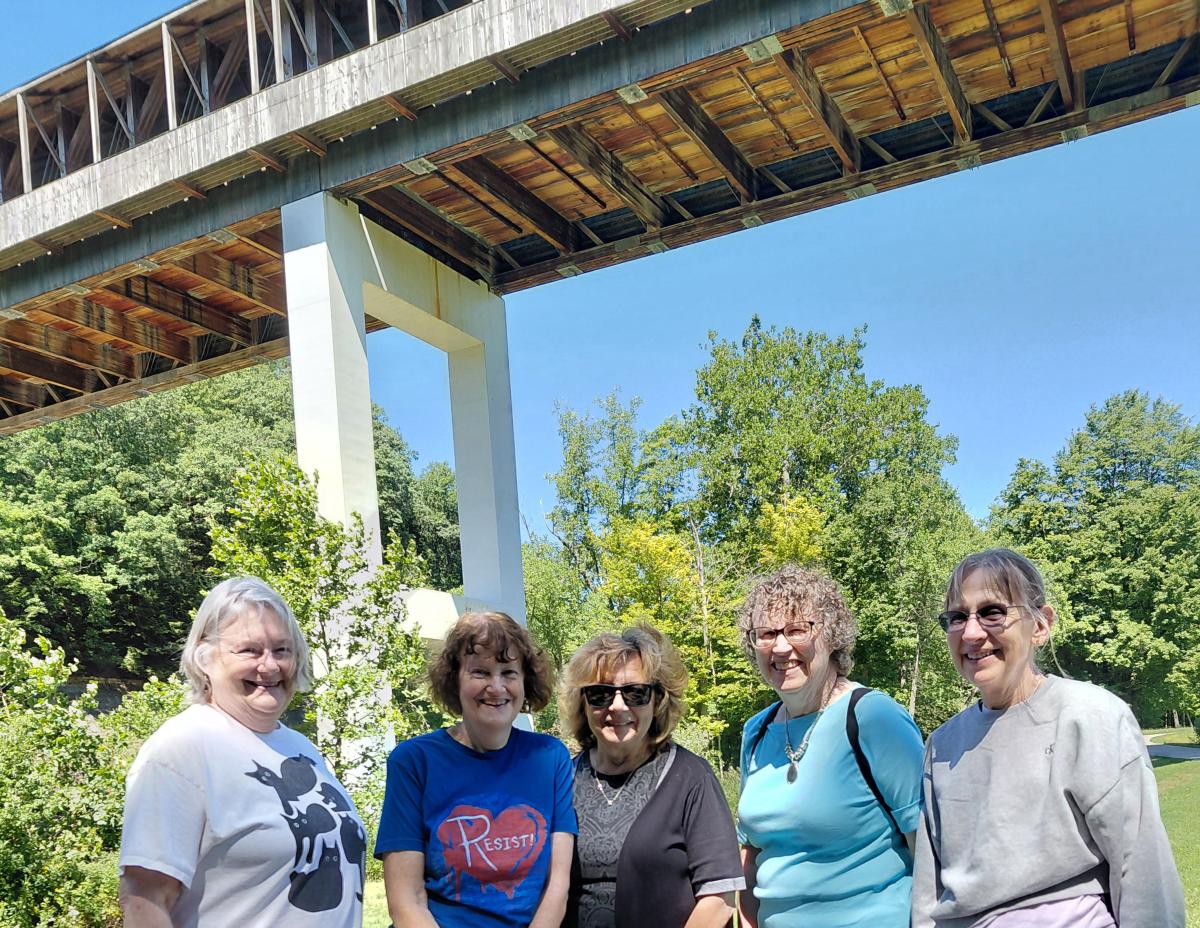
Friends (left to right) Claudia Gilmore, Liz Allen, Judy Capar, Brigid Edmonds, and Linda Duczman O’Connell pose near the Smolen-Gulf Covered Bridge in Ashtabula. It is the longest covered bridge in the U.S. Built in 2008, it replaced a metal bridge from 1948 which had, in turn, replaced the original covered bridge.
When four friends and I decided to celebrate our landmark birthdays together this summer, we faced two hurdles. Would we find a date that would work for everyone? And could we agree on an affordable destination with an easy drive from the East Coast, the Midwest and, of course, Erie?
In February, I created a shared calendar, inputting friends’ travel plans to Canada, Chautauqua, and Cleveland, grandkid birthdays and graduations, work and volunteer schedules (Erie SeaWolves for me), and one couple’s 50th anniversary.
Miraculously, five women, four husbands and one significant other were all free to meet on Sunday, Aug. 2.
But where? Linda, from Racine, Wisconsin, figured that out. “I suggested Ashtabula because I saw or listened to a story about how they always do a strong tourism business and people from Cleveland and maybe Pittsburgh, visit. Not too long a drive, free beach, covered bridges.”
Linda also discovered the Ashtabula Maritime and Surface Transportation Museum, 1071 Walnut Blvd., while Claudia from McKeesport suggested we visit the Hubbard House Underground Railroad Museum at the corner of Walnut Blvd. and Hubbard Hill Drive.
Judy, from Philly, found good rates at the Hampton Inn in Austinburg, Ohio (with free breakfast), while Brigid investigated restaurant reviews that led us to the Bridge Street Tavern for dinner (where I enjoyed a walleye sandwich) in the charming Historic Harbor District.
None of us has ties to Ashtabula but we quickly felt at home, thanks to the lakeside scenery we enjoyed, as well as the knowledge imparted by volunteers we met at both museums.
The weather was wet and gloomy when we arrived but we didn’t mind as we watched big waves crash onto the Lake Erie shoreline before going to the Maritime Museum. There, we learned that Ashtabula has weathered many ups and downs in industries tied to its port and railroads. The docents also talked about the deep love and pride residents feel for this harbor community.
The museum is awash with donated items, including the original lens from the Ashtabula light, made in France in 1896 – the exhibits are labors of love by volunteers. But the layout makes it easy to absorb the stories.
I was captivated as soon as I saw an exhibit with a model of the U.S. Brig Niagara. I thought about how similar Ashtabula and Erie are, with our historic ties to shipbuilding, the many Lake Erie tragedies that our communities have endured, the travails of our economies but, most importantly, our mutual pride in celebrating our Lake Erie heritage.

The Ashtabula Maritime and Surface Transportation Museum has an exhibit about the U.S. Brig Niagara. In addition to the model ship, it includes a letter opener made from a spike from the Niagara and a silver spoon from the Niagara. The donor is listed as Fred Head. (Contributed photo)
In an interview, I asked Kathy Warnes, the museum’s volunteer historian, about the similar histories of Erie and Ashtabula. A Michigan native, Warnes lived in Erie with her husband in the 1960s, got involved with the Erie Historical Museum (now the Hagen History Center) and also wrote for the Union City Times (now defunct).
Warnes, who has advanced degrees in history, explained the connections: “We territorial human beings like to think that the history of our most immediate area is the one that should be emphasized and held within its own territory. History cannot be constrained in territorial boxes. It insists on escaping intellectual constraints and following its own path.”
She provided me with many examples, including this one: “I think of the example of the Marquette and Bessemer, a train car ferry that transported rail cars full of coal, steel, and other products across Lake Erie to Port Stanley to exchange them with the London and Port Stanley Railroad, which subsequently provided access to the Grand Trunk Railway and the Canadian Pacific Railway.
“The ship met a tragic end on Dec. 7, 1909, when it disappeared into a violent winter storm on Lake Erie with more than 30 crew members aboard. On Dec. 12, five days after the ship disappeared, Lifeboat No. 4 from the Marquette and Bessemer No. 2 was spotted by a tugboat captain roughly 15 miles offshore of Erie. Inside were the frozen bodies of nine crewmen, along with the un-donned clothing of a tenth. The boat was towed into the port of Erie, where a large, grieving crowd gathered.
“The location of the lifeboat near Erie led many historians to believe that Captain McLeod initially tried to brave the storm to Canada, but ultimately turned the ship around to run downwind toward Erie or Conneaut for safety before the open stern flooded. This is clearly an Erie story as well as a Conneaut story and the story of every community where a crewman hailed from.
“Dr. David Frew, who taught at both Gannon University and Penn State Behrend, wrote one of the classical books about the tragedy (Long Gone: The Mystery of the Marquette and Bessemer No. 2) and a film crew from WQLN in Erie came to Conneaut a few years ago to film the story for its *Chronicles series (Secrets of the Abyss: Shipwrecks of Lake Erie, Season 2). We have some pictures of the Bessemer 2 and its story in the Maritime Museum,” she said.
There’s also the horror of the Ashtabula Train Disaster, about the Pacific Express passenger train that left Erie in a fierce blizzard on Dec. 29, 1876, headed to Chicago for New Year’s. While crossing the Ashtabula River, the bridge collapsed, sending 95 of the 170 passengers to their deaths.
But a visit to the Maritime Museum isn’t all about bleak news – there are upbeat stories as well as exhibits for youngsters that emphasize fun and education, rather than electronic wizardry.
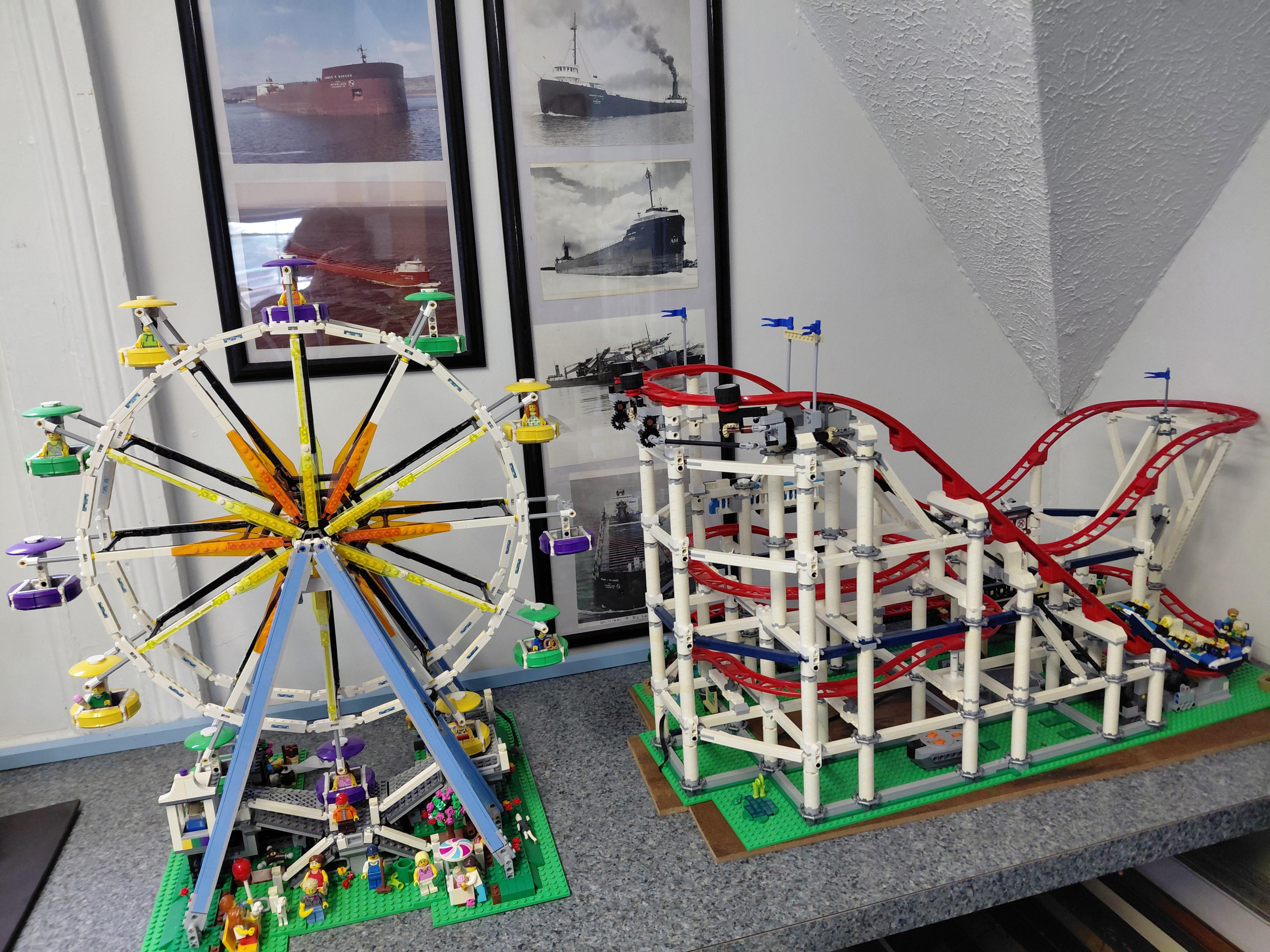
Amusement park rides built from LEGO are a delightful find at the Ashtabula Maritime and Surface Transportation Museum.
(Contributed photo)
“Kids like hands-on experiences, and we strive to capitalize on that trait to engage them,” said Warnes. “Student groups and (private) family groups are allowed to explore the pilot house. They can ring the ship’s bell. They can climb the stairs to the library to operate the battery-operated toy train, handle one of the rides from the Lego model of Walnut Beach Park, and sit at the library tables and work Great Lakes puzzles and read custom-written stories about the museum exhibits,” Warnes said. “One especially interesting story is about the life of Anna Turja Lundi, who survived the sinking of the Titanic and came to Ashtabula to live. There is also the story of Jennie the Titanic cat, and the story of Rev. Joseph Badger’s encounter with a bear.”
You’ll have to hurry to visit. In September, it’s only open Saturday, Sunday, and Monday from noon to 4 p.m. It will reopen on Memorial Day weekend. But in the off-season, it is available for group tours of 10 or more by reservation. Call 440-964-6847, email info@ashtabulamaritime.org or visit ashtabulamaritime.org. There is an admission fee.
We could have easily lingered longer at the Maritime Museum, but we had a 3 p.m. reservation for the Hubbard House Underground Railroad Museum.
There, volunteer docent Fred Robsel, a middle-school teacher, extolled Ashtabula’s strong leadership in the abolitionist movement. We quickly discovered that Hubbard House lives up to its tagline, “Against Slavery Then, Against Oppression Now.”
Andy Pochatko is a reference librarian at Harbor-Topky Memorial Library at 1633 Walnut Blvd., next to the museum. He has been a volunteer docent at the museum since 2012. “With the Underground Railroad site, what we try to do is to tell the story of the larger anti-slavery movement as we go along,” he explained. Thus, in the space of this historic house, visitors can also learn about the geography of the slave trade in Africa, the physical pain inflicted on enslaved people in this country and the genealogy of the political leaders from northeastern Ohio who fiercely opposed slavery, especially Congressman Joshua Reed Giddings.
Pochatko said it can be easy to exaggerate the number of enslaved people who passed through Underground Railroad locations. But the use of Hubbard House as a stop on the railroad made sense, he said. Looking at the geography of what is now West Virginia and what was then the slave state of Virginia, it is easy to see that the Pennsylvania-Ohio line was the shortest distance to reach Lake Erie for someone seeking freedom. Once a runaway slave reached Hubbard House, there was help to either get to Detroit or to Niagara Falls, to reach the land bridges, he said.
Our visit to Ashtabula was only 24 hours long. And we only managed to squeeze in visits to three of Ashtabula County’s 19 covered bridges. But our experience was good enough that we want to return someday. The good news for readers is that, in addition to visiting the two museums by appointment, there is a lot to do in Ashtabula before the snow flies.
On Oct. 3, Pochatko, the docent from Hubbard House, will lead what has become an annual “pilgrimage” about Underground Railroad operations in Ashtabula and Lake counties. This year’s program, in conjunction with the Lakeside Society for the Performing Arts, features a “Re-Viewing of Uncle Tom’s Cabin,” with a showing of a 1914 film adapted from the book.
“The 1914 film is significant. It has an African-American actor in the lead part, rather than a white man in black face,” he said. Theater organist Jay Spencer will accompany the film.
The program is at Bethany Lutheran Church, 933 Michigan Ave., at 2 p.m. Discussion will follow the film. The program is free but donations are appreciated.
Also mark your calendars for the 2026 Ashtabula County Covered Bridge Festival Oct. 10-11 in Jefferson, Ohio. You can learn more at coveredbridgefestival.org.
And did you know that Ashtabula County is home to more than 30 wineries, according to the Ashtabula County Visitors Bureau? I didn’t, either. That might lure my friends back next year.
Liz Allen brought cupcakes from Sontheimer’s Bakery in Erie to the 75th birthday party with her friends in Ashtabula. You can reach her at lizallenerie@gmail.com