
A new report from two Southwestern Pennsylvania nonprofits argues community-scale projects can create jobs at one-third the cost of large industrial projects — which are often subsidized by taxpayers.
The report’s authors make the case that small-scale development makes a big difference when judged collectively and deserves more consideration from investors.
The analysis was done by the Center for Social and Urban Research at the University of Pittsburgh and commissioned by Beaver County-based RiverWise and Allegheny County-based New Sun Rising.
Researchers looked at 21 projects across Allegheny and Beaver counties, and found that — together — they add $845 million in value to the region over a two-decade period. The projects also create a social return on investment of $123 million over the same timeframe.
The values comes from added jobs, increased incomes through training programs, improved energy efficiency, raised property values, and strengthened public health.
Daniel Rossi-Keen, executive director of RiverWise and a report co-author, said the region tends to look to large, industrial projects to spur economic growth.
“If you spend any time in Southwestern Pennsylvania, you have likely heard some sort of conversation that hearkens back to the way things used to be, and that longs for a return to better days,” Rossi-Keen said. “And very often that kind of narrative involves somebody or something coming from the outside to save the region.”
Rossi-Keen said the report shows another option: the “active economy.” That’s when a community realizes its own economic potential through project clusters designed to reinforce one another. The clusters identified in the report include real estate, workforce development, energy, creative industries, food and nature-based infrastructure, and active mobility.
The report argues that work across those clusters is more likely to last and benefit the communities that make it possible, keeping the generated wealth local.
The analysis said 574 jobs have been created across the portfolio of 21 local projects, which collectively cost $93 million to fund. It contrasts that with the 600 permanent positions at the Shell Cracker Plant in Beaver County, which received a $1.65 billion state tax credit to build in Pennsylvania.
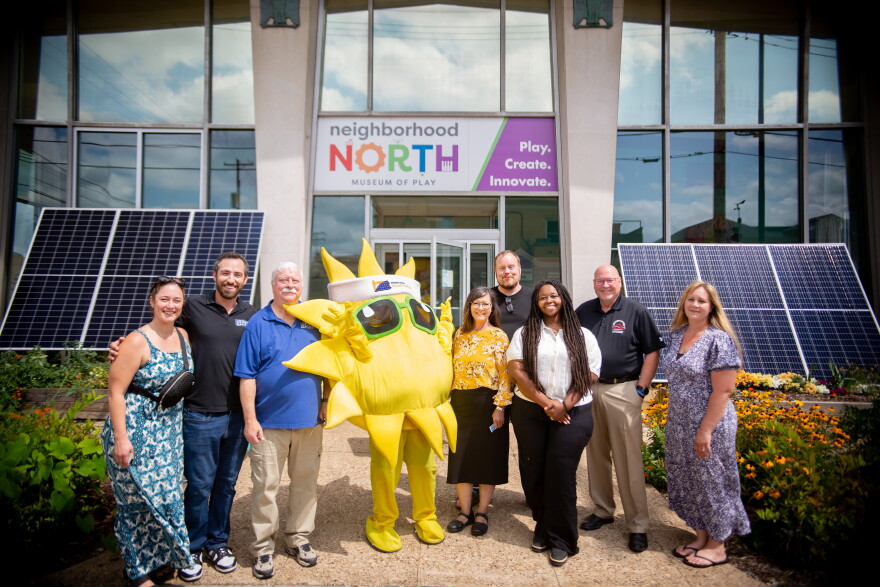
Daniel Rossi-Keen said the Neighborhood North: Museum of Play is a major driver of economic activity through its renovation of a historic building and draw in attracting tourism.
New Sun Rising executive director and report co-author Scott Wolovich said, for decades, economic development decisions have defaulted to larger single investments.
“I think one of the biggest challenges is that association for the public or even for elected officials or philanthropy — whoever the investors are — it’s 100% easier to wrap your head around a single-site development and what that means and its identity and just the scale of it,” Wolovich said.
Wolovich said small projects can be very important to their neighborhoods, but aren’t seen as regionally important. That makes it harder to get funding for those efforts.
“One of the things we wanted to do with this project was really help to lift up these hyperlocal projects and bring more awareness to their importance to the regional economy,” Wolovich said, “and therefore, hopefully, compel a shift in regional economic investment policy to think differently about how we’re allocating public funds, how we’re working to stimulate the regional economy and markets.”
One project he highlighted is the Millvale Food + Energy Hub, a former Moose Lodge that now houses small businesses and provides workforce training programs, as well as its own solar energy array and a stormwater system to help reduce flooding.
The hub has “turned into something that is both producing economic returns through small businesses and workforce and the real estate development itself, and it’s also doing these socially impactful things,” Wolovich said.
The analysis said the hub’s annual economic impact is more than $5 million in gross regional product and nearly $600,000 in social value.
Other projects in the portfolio include Neighborhood North: Museum of Play, Beaver County’s first children’s museum; Franklin Avenue Park, a public green space initiative in Aliquippa; and Urban Homestead in Pittsburgh’s Allentown neighborhood, which aims to support the creative, maker, and light manufacturing economies.
Rossi-Keen said the data collected in the report finally shows the real impact of overlooked development projects.
“As soon as you can look in the right way, you can see something that’s been in front of you the entire time. And I think that’s a little bit of the spirit of this project,” he said. “There’s some really cool stuff going on.”