
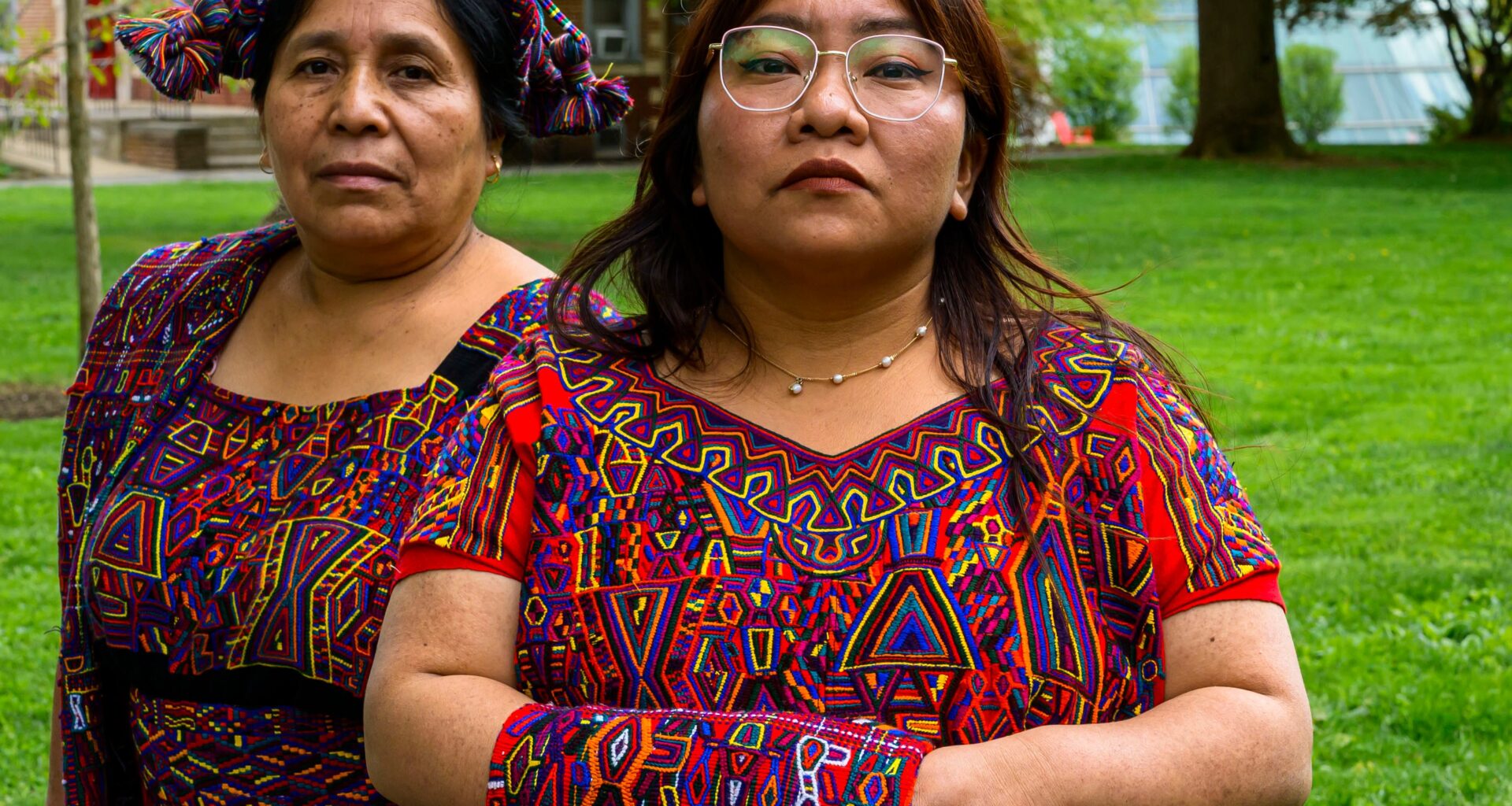
When Cristina Raymundo and Maria de Leon traveled from the Guatemalan mountains to the United Nations headquarters this spring, they stopped at Muhlenberg College to meet the collaborators who are bringing their work with indigenous women home to Allentown.
The Ixil Women’s Network aids survivors of domestic violence and helps Mayan women access hospitals and courts. Representatives from the network who are based in Allentown are acting as conversation partners for Muhlenberg students this fall and will teach workshops on how discrimination against women can lead to physical, emotional and sexual violence.
Members of professor Erika Sutherland’s Spanish for Healthcare course said the women’s stories offer a roadmap for those seeking to understand what it takes to become an activist.
Rahmya Hager, a junior majoring in political philosophy and Spanish who hopes to become a lawyer, said being an advocate is a “really cool and admirable thing to do,” but added that it’s hard to know where to get started, so she’s looking forward to learning more about how the women built their network.
Learning from the experiences of the Ixil Women’s Network will help Hager build on the knowledge she gained from her Public Health in Practice course that traveled to Panama in December to witness how local agencies serve indigenous women who struggle to access maternal healthcare.
Hearing directly from indigenous women in various Central American communities helps students grasp the importance of systemic issues. The key question, Hager said, is: “How has the structure failed and how can we fix it?”
Raymundo, whose first language is Ixil, a Mayan language, and who spoke in Spanish while Sutherland interpreted, told The Morning Call that the women in her community need healthcare workers and justice officers to respect their traditions and offer services in their language to alleviate the fear that keeps women from going to a hospital or reporting a crime.
Her community is dealing with sensitive issues, including underage pregnancies that result from sexual violence and high rates of infant and maternal death, Raymundo said. They’ve had success sending network members to accompany women to hospitals and courts, but building trust between indigenous women and government officials is not an easy process, she added.
The end goal is to transform reality so that women and girls no longer have to suffer violence, Raymundo said, saying women all over the world can find solidarity in sharing survivors’ stories.
“Our stories can help confront and survive it,” Raymundo said. “We should never be quiet about violence.”
The goal of raising awareness resonates with junior Joyce Sosa, a biology major and Spanish minor on the pre-physician assistant track, who said her career goal is to make members of underserved communities “feel seen and cared for.”
Both the Spanish for Healthcare and Public Health in Practice: Panama courses have Sosa thinking about how she could apply her future clinical abilities to overseas volunteer work.
Senior Alessandra Rodriguez, a psychology major and Spanish minor who is on the pre-law track, said the courses also made her reflect on how law and public health can work hand in hand.
“It definitely sparked an interest of a field I never thought I could enter or even think about,” Rodriguez said.