
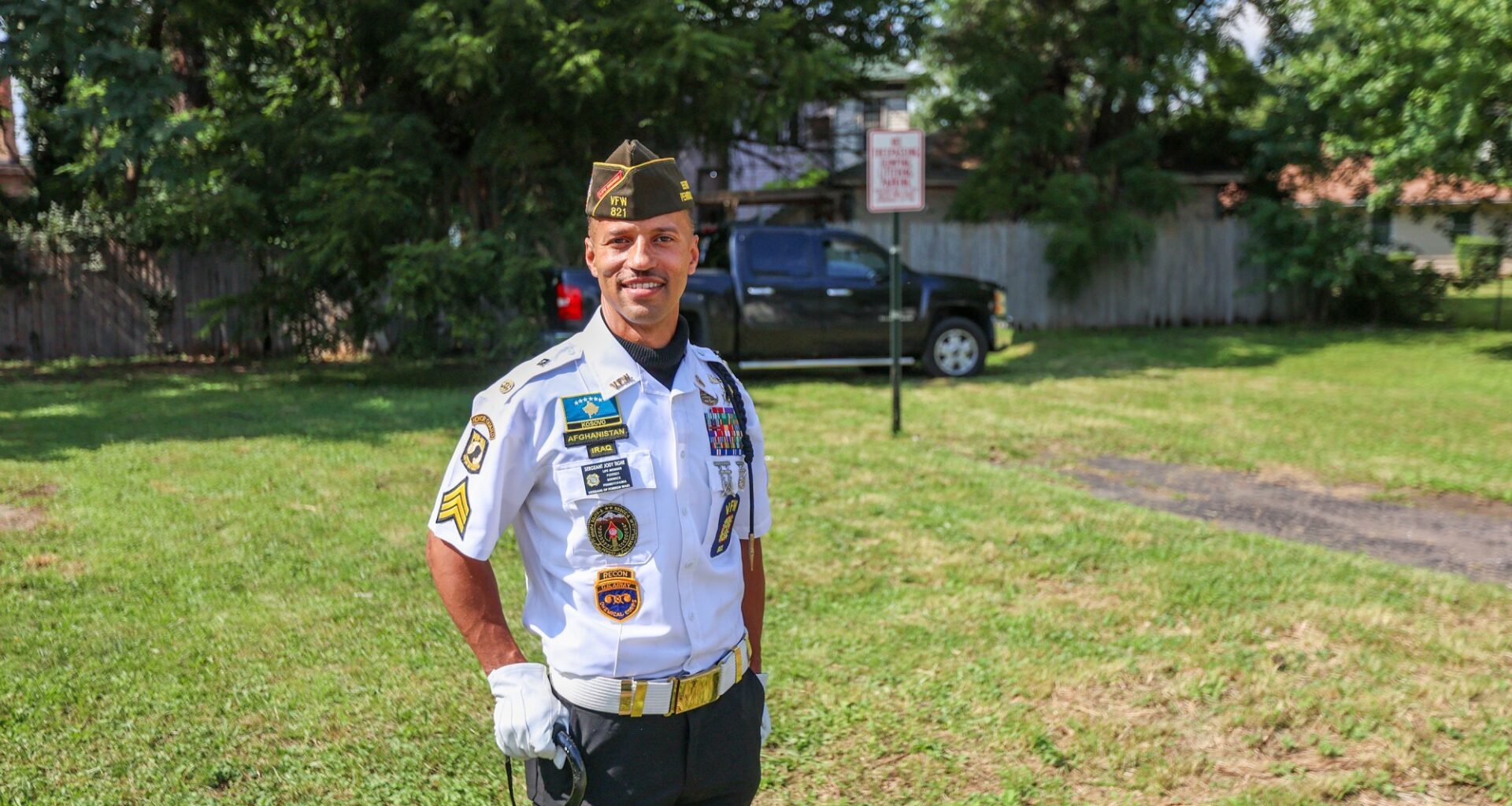
The board of directors of a nonprofit focused on helping people acquire affordable housing has removed a veteran as the first participant after learning about his criminal history and hearing allegations that some of the service medals he wore were invalid.
Maryann Velez, founder and chairwoman of United NEPA Alliance, said in August that the board chose Jody Tighe, of Scranton, to participate in the Welcome Home pilot program after a recommendation from the Veterans Oversight Committee.
The City of Wilkes-Barre had donated a parcel of land on Monroe Street for a handicap-accessible home that UNA would build and the program participant would either rent or rent to own at an affordable price.
“First, we would like to say thank you to everyone who reached out with concerns regarding Jody Tighe. We took each and every concern very seriously,” Velez said on Wednesday. “We received messages and calls regarding his criminal history, and we immediately paused and began an internal investigation.”
Velez said she received calls from various law enforcement agencies as well as residents who were either living in the neighborhood or in the building Tighe was convicted of setting ablaze in 2018.
“We are accepting full accountability for not doing our due diligence more thoroughly. We are going to utilize this lesson to strengthen our vetting process. We have had various law enforcement agencies offer to run in-depth, comprehensive background checks on any applicant that comes into the program, and we will utilize their services moving forward,” Velez said.
ARSON CHARGES
A review of Pennsylvania online court dockets and newspaper articles revealed that Tighe was charged with two felony counts of aggravated arson with bodily injury and one misdemeanor county of recklessly endangering another person in August 2018 in connection with an apartment building fire earlier that year.
The “intense” fire at 640 Willow St. around 2:41 a.m. on Feb. 19 displaced seven people, including an off-duty Scranton police officer, and left a city firefighter injured, authorities had said.
Detectives believed the arson was Tighe’s retaliation against a rival love interest. The off-duty police officer, Jamie Smith, was not the intended target, police had said.
The case continued for several years until Tighe pleaded guilty in January 2023. The court denied Tighe’s request to withdraw the plea and he was sentenced to four to eight years in prison. He had appealed the denial of the plea withdrawal but ultimately served the lesser range of his prison sentence.
QUESTIONS OF VALOR
Velez said she also received calls questioning the validity of some of the medals Tighe was wearing in photos that accompanied the August newspaper story on the Welcome Home program.
“There were some questions in regard to stolen valor, and we took those allegations extremely seriously, more so than we did with the arson. We understand with the arson charges, he served his time, he paid his debt to society. We were willing to work with him moving forward to ensure he had all the support he needed. But, when when the valor came into question, we worked with the Veterans Oversight Committee to verify and validate his service record,” Velez said.
She said the committee did validate and confirm that Tighe served in both the U.S. Marine Corps and the U.S. Army and was honorably discharged from both.
Velez said her understanding based on conversations with the Veterans Oversight Committee was that all of Tighe’s ribbons and medals would be listed on his DD-214 discharge paperwork, but some medals, including a Purple Heart, were not listed.
“I do understand that mistakes and omissions can be made, and there is a way to rectify that. I believe Mr. Tighe can submit paperwork to clear up any misunderstandings about his accolades and his medals that he claims to have received, but that solely lies and rests with Mr. Tighe. That would be up to him if he wanted to file that paperwork to help put the community’s minds at rest,” Velez said.
“Until we can receive verifiable documents in regard to the medals and accolades he has stated he has received, we decided it was best to pause and remove him from the program,” she said.
SUPPORTING THE DECISION
In a phone interview Wednesday, Tighe said he completely supported Velez’s and the board’s decision.
“While it was not (initially) asked of me, my criminal history certainly became the catalyst that put my candidacy into question,” Tighe said.
He believes Veterans Oversight Committee members were satisfied with documents confirming his military service and discharges he provided last week as well as his responses to questions and requests at a meeting with committee members and Velez last week.
Tighe also provided the newspaper with a photo of a letter dated March 10, 2022 summarizing his benefits from the Department of Veterans Affairs, as well as a photo of a rating decision from the VA for four service-related injuries.
The letters indicates he has a “service-connected disability” and the rating decision for each injury is 20% disabled from two of the injuries, 40% from a third and 70% from a fourth.
Tighe said it could take up to six months to receive amended discharge papers updated with all of his medals and ribbons, and it would be unfair to the Welcome Home program for him to ask the board to wait for that.
“In retrospect, if there were a list of 100 or 200 candidates, I would have voted for any other candidate because of how selfless I am. However, I was the only candidate to apply,” Tighe said.
SEEKING HELP
Tighe said he did not apply to have his discharge papers updated to include missing medals upon his discharge for a few reasons, including that he didn’t think he might need to prove his awards at some point.
He also didn’t update them because he was more focused on dealing with his injuries and “because of my failure to adjust when I returned from Afghanistan,” Tighe said.
Tighe said he believes Velez would have supported him for the program had he been totally forthcoming with his criminal history in an initial interview.
“That removes me from being the most-qualified candidate,” Tighe said. “That’s where I failed.”
Tighe called it “an honest mistake” for a nonprofit with a program that is “just starting off” not to have fully vetted his background. He called the experience traumatic for him as well as for Velez, and he hopes she can heal.
“I’m sure that she will and I hope with assistance from the VA to heal from it, too,” Tighe said. “Today, I decided to check myself in to the VA and seek treatment so I can heal in ways I have not been able to heal before.”
Tighe also said he withdrew from Johnson College, where he had enrolled to study architectural design and carpentry/cabinet making, so he could focus on his treatment at the VA.
MOVING FORWARD
Velez said the UNA board of directors closed applications for the Welcome Home program until the revamping of their vetting process is complete.
“We’re going to continue to move forward with the construction of the home, and we will eventually find a deserving veteran to move into that home,” Velez said.
She also wanted to clear up a misconception that some in the community might have about the program.
“Our program is an affordable housing program. We are not giving away homes to veterans. I wish we had the financial capacity to do that, but, we do not. Any applicant coming into this program would be required to pay rent in that home, but the purpose of it is to ensure that the rent is affordable. That is the whole purpose of this program,” Velez said.
“We’re witnessing unprecedented scenarios in communities right now where rents are skyrocketing and the average working family can’t afford to pay rent. So, that’s what we aim to do, to bring in affordable housing where our tenants can be able to afford their rent and live with dignity,” Velez said.
Participants also will have the option of entering into a rent-to-own agreement.
“Then, they have the opportunity to maybe fulfill a lifelong dream of owning their own home,” Velez said. “These aren’t opportunities that are easily afforded to everyone in our communities, and we wanted to open up those pathways.”