
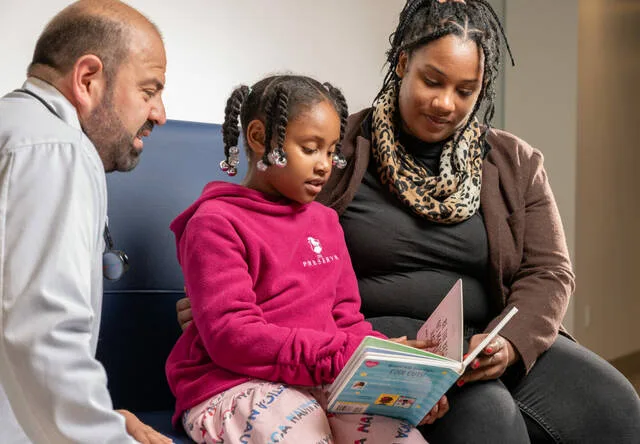
A mom once brought her 3-year-old preschooler, Melanie, to the pediatrician’s office for a well visit, and while mom and daughter waited for the doctor to come into the exam room, Melanie seemed to do everything except sit still.
“She was running around the room, spinning the chair, tearing at the paper on the table,” said Steve Wilmot, who was in the room at the time, exchanging a sympathetic glance with the mom.
When the doctor came in, he said he was going to start by giving Melanie a book.
“The mom was leaning against a wall, arms crossed, looking like ‘Ha! You’re not gonna get this child to sit down and be interested,’” Wilmot recalled.
Then the magic started to happen.
“I have a book for you, Melanie,” the doctor said. “There are pictures in it of children who look like you.”
Interested now, “the girl comes over, sits down on the floor and looks up at the doctor,” Wilmot said. “The doctor says, ‘Melanie, can you point to the little girl who looks like you? Can you point to the little boy holding the balloon? What color is the balloon?”
When Melanie identified the balloon as blue, the doctor looked at the mother and said, “Your daughter is so smart.”
Melanie beamed, the mother began to see the benefits of sharing a book with a child, and Wilmot, who had received permission to watch the interaction, was delighted.
As the executive director of Reach Out and Read Pennsylvania, Wilmot’s goal is to put books aimed at children ages 0 to 5 into pediatric offices across Pennsylvania.
“The pediatrician takes the books into the well visit, and he or she uses the book as an engagement tool, as a development assessment tool,” Wilmot said in a telephone interview. “They do it in front of a parent to demonstrate the importance of reading. And the child takes the book home.”
Reach Out and Read Pennsylvania hopes this interaction will change statistics for the better, increasing, for example, the 42.3% of parents who report reading to their babies every day, and increasing the slim 33% of third graders who can read at grade level.
“Shared reading is one of the most powerful tools we can offer,” Dr. Trude Haecker, Reach Out and Read Pennsylvania’s medical director, said via a news release. “What can look like a very small moment is actually something incredibly important. When a child curls up with a caregiver and a book, they are not just hearing words, they are feeling comfort, attention and connection. That’s something we can help nurture in the exam room and something families can continue at home every day, building a foundation for early literacy and lifelong resilience.”
Families trust their pediatricians, Wilmot said, so the doctor’s office is an ideal place to get a book. And, he added, starting an exam by talking about a book can reduce any anxiety the patient might be feeling about the appointment.
Reach Out and Read is able to supply age-appropriate, culturally appropriate books in the child’s own language at a discount because the organization buys in bulk.
Reach Out and Read Pennsylvania already serves more than 232,000 children annually through more than 545,000 well-child visits at 238 sites. It started in Philadelphia, but now seeks to branch out to the central and northern portions of Pennsylvania, including Luzerne, Lackawanna and surrounding counties.
If a clinic can’t afford books, Wilmot said, Reach Out and Read will work with them.
At one small clinic in Erie, he recalled, “it was one doc and one nurse. They couldn’t afford their book budget. The doc was paying out of his own pocket and was concerned about sustainability. I said, ‘I’ll go half with you, and we’re gonna find a grant, a corporation, someone (to finance the books).”
The benefits are not just about learning letters and words, Wilmot said, but about bonding and emotional closeness between child and caregiver.
“Some parents tell us they don’t read well,” he said. “Our response is, make up a story as you look at the pictures. And we can always hook you up with support for adult literacy.”
Sometimes a local community helps supply gently used books, he said. “All you have to do is go to a high school and have an assembly. Ask the students to bring in books they’ve outgrown. You’ll get thousands and thousands of books. It’s all about getting books into little hands.”
Endorsed by the American Academy of Pediatrics, Reach Out and Read on the national level serves children in all 50 states. The non-profit served more than 4.8 million children last year, providing 9 million free books. About 70 percent of the children served are from low-income families.
For more information about participating in Reach Out and Read, see myror.org/. To make a donation, see reachoutandread.org/.

Local journalism matters, and your support makes it possible. You can help sustain this work by making a donation or choosing one of our subscription options. Subscribers enjoy valuable benefits, including full access to our e-edition, a reduced ad experience on timesleader.com, and more.
Your support helps ensure independent, high-quality local news remains available today and for future generations. Thank you for standing with local journalism.
Click for subscription offers.