
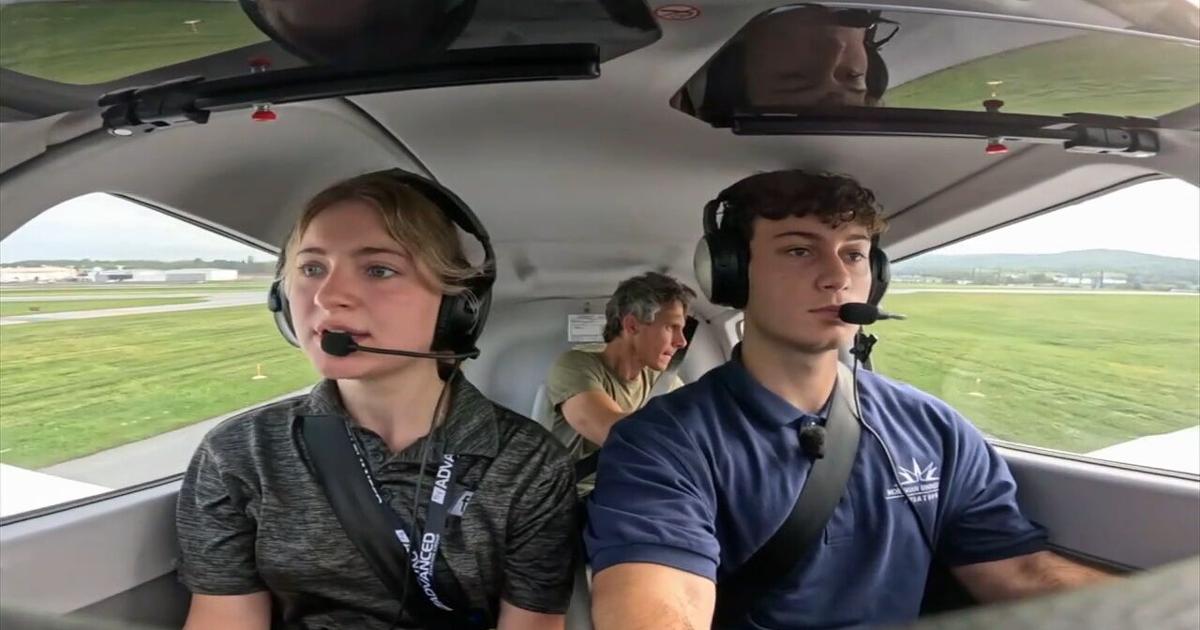
ALLENTOWN, Pa. — For Moravian University freshman Antonio Lopresti, the classroom can sit several hundred feet above the Lehigh Valley.
Lopresti is part of the inaugural class in Moravian University’s new aviation programs, which launched this fall with 23 students — 14 professional pilot majors and nine aviation management majors. The university is combining traditional academics with hands-on flight training designed to prepare students for careers across the aviation industry.
For Lopresti, that means some college days include something considerably different from the typical classroom experience.
“It’s just a crazy experience to go back to my dorms and say, ‘Oh, how was class?’ And he’s like, ‘Yeah, it was good.’ And I was like, ‘Oh, I flew a plane today,’” Lopresti said.
From the classroom to the cockpit
Moravian’s flight training is based at Queen City Airport in Allentown, with some training flights also taking place at Lehigh Valley International Airport. The university partners with flyGATEWAY Aviation Institute for its professional pilot flight training.
Students in the professional pilot program combine their Moravian coursework with FAA-certified flight training. The curriculum includes dual and solo flight time, pre- and post-flight briefings and stage checks, along with instruction in aviation weather, air traffic control, aeronautical decision-making, pilot performance and safety.
Lopresti flies three times a week.
Before getting into the air, however, students learn that flying starts on the ground. Lopresti worked his way through a lengthy pre-flight checklist, inspecting the aircraft before takeoff.
“All this you have to go through before you take off,” Lopresti said. “It’s a lot.”
Once in the cockpit, Lopresti works with flyGATEWAY flight instructor Izzy Hallam.
Asked the most important thing she tells a student pilot, Hallam’s advice was straightforward.
“Always be situationally aware and have fun,” Hallam said.
69 News went along for one of Lopresti’s lessons, filming from the back of the aircraft as it taxied down the runway, took off from Queen City Airport, and climbed several hundred feet into the air.
The lesson also offered Lopresti a look at one of the realities pilots have to learn to handle: changing weather.
As rain appeared ahead of the aircraft, Lopresti was reminded that there are still skills he has yet to learn.
“When you saw that rain moving in, what are you thinking?” 69 News reporter Bo Koltnow asked after the flight.
“I’m not qualified for that. That’s what I’m thinking,” Lopresti said.
“Not yet,” Koltnow replied.
“That’s next year, hopefully,” Lopresti said. “But yeah, it’s just — I got reminded of what my future is going to be.”
Training for careers beyond the cockpit
Moravian’s aviation initiative extends beyond flying airplanes.
Students also train with flight simulators, while the university’s aviation management program covers areas including airport operations, aviation safety, law, logistics, finance and leadership. Moravian also offers an Air Traffic Management minor.
Program Director Rachel Hall said the Lehigh Valley provides students with a particularly active environment in which to learn.
“There’s no better place to learn, right?” Hall said. “We’re in the busiest airspace in the country, and there is not an institution in this area where you can get your degree as well as get all your pilot certifications.”
Hall is a Gold Seal Certified Flight Instructor and an active corporate pilot. Moravian says she flies Falcon 900EX, Falcon 50EX, and King Air 350 aircraft and has a background in aviation safety and flight instruction.
Moravian says its Professional Pilot bachelor’s degree is a 120-credit program, with more than 60 credits consisting of FAA-recognized aviation coursework. The program is designed to lead students through training toward Certified Flight Instructor certification while also giving them an academic foundation in management.
Aviation management students, meanwhile, are being prepared for careers including airport operations, aviation logistics, flight dispatch, safety and compliance, and aviation business management.
Industry experience helping shape the program
Retired American Airlines Capt. Mark Cronin helped launch Moravian’s aviation effort and serves on the university’s Aviation Advisory Committee. Cronin is also the founder of the Velocity R Aviation Foundation.
“The objective here was to ensure that people understood what careers are available in the aviation aerospace industry, and then develop the training programs for them to succeed,” Cronin said.
Moravian’s Aviation Advisory Committee includes representatives and aviation professionals with experience at Boeing, American Airlines and United Airlines, along with representatives from the Lehigh-Northampton Airport Authority and other aviation organizations. The committee is intended to help align the university’s curriculum, safety training and career preparation with the industry’s needs.
Moravian says its location also puts students near major aviation markets including Philadelphia and Newark while providing access to airports and aviation businesses throughout the Northeast.
For students such as Lopresti, however, the larger aviation career begins with the fundamentals: inspect the airplane, understand the conditions, learn the controls — and get it safely back on the ground.
For now, each flight is another lesson in what Lopresti hopes will eventually become his career.