
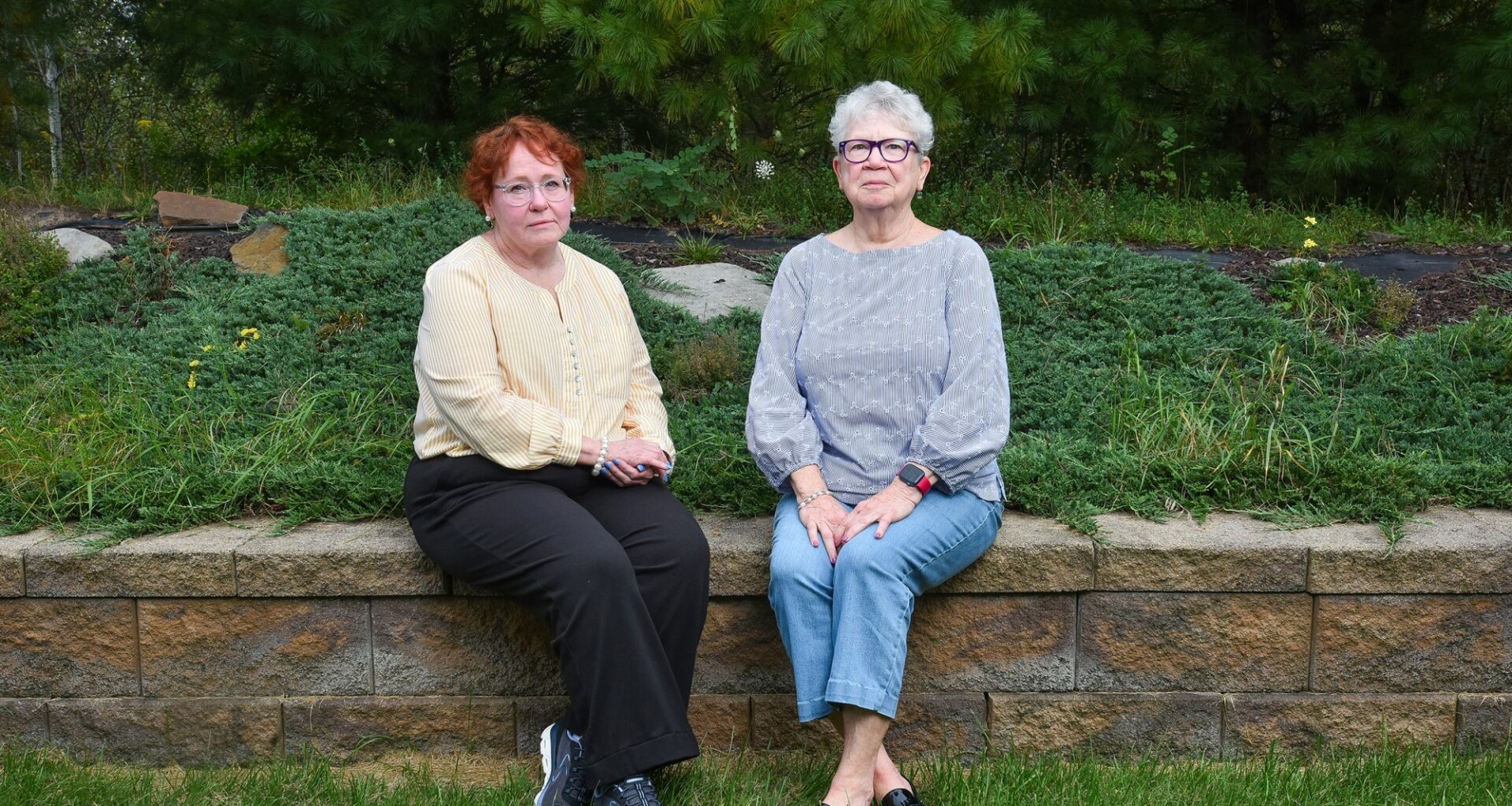
ARCHBALD — Meg and Kim Nudelman spend most mornings sipping coffee on their patio in a quiet backyard on Foxtail Circle, sitting in green wicker chairs and looking out onto rows of pine and birch trees.
The Nudelman sisters used to enjoy seeing the wildlife — birds, foxes, black bears and even the occasional snapping turtle — from the solace of their enclosed patio decorated with vibrant floral carpets and potted plants, but now, the two spend their time trying to figure out ways to stop Lackawanna County’s single largest data center from moving into their backyard.
Lurking just behind the thin treeline separating the Nudelmans’ townhouse from the former Highway Auto Parts junkyard, work is underway to prepare 70-plus acres for Project Boson — a 619,925-square-foot data center proposed by a company affiliated with Kriger Construction Inc., 99 Power Blvd., Archbald.

In the Highlands at Archbald where the Nudelman’s home is, located in the center unit in the bottom right, the 620,000 sqare-foot Project Boson is proposed to be built on the land of the former junkyard on Eynon Jermyn Road in Archbald Friday, September 18, 2026. (SEAN MCKEAG / STAFF PHOTOGRAPHER)

The tree line behind the homes at the Highlands at Archbald is what separates the property of the homeowners and the proposed 620,000 sqare-foot Project Boson to be built on the land of the former junkyard on Eynon Jermyn Road in Archbald Friday, September 18, 2026. (SEAN MCKEAG / STAFF PHOTOGRAPHER)
Show Caption
1 of 2
In the Highlands at Archbald where the Nudelman’s home is, located in the center unit in the bottom right, the 620,000 sqare-foot Project Boson is proposed to be built on the land of the former junkyard on Eynon Jermyn Road in Archbald Friday, September 18, 2026. (SEAN MCKEAG / STAFF PHOTOGRAPHER)
With a footprint larger than 10½ football fields, Project Boson borders the Highlands Archbald housing development off Eynon Jermyn Road on two sides. Just across the street, the same developer is seeking approval from Archbald for a 400-megawatt Essential Energy LLC natural gas power plant near Archbald’s Staback Park.
“I feel it’s going to be the death of me,” said Meg Nudelman, 66, a two-time breast cancer survivor with bad asthma. “But where do you go? We’re not young.”

Archbald resident Meg Nudelman questions Essential Energy LLC’s sound engineer during a conditional hearing on Monday, June 22, 2026, at the Valley View High School in Archbald. (FRANK WILKES LESNEFSKY / STAFF PHOTO)

Archbald resident Meg Nudelman applauds during the special meeting on data center applications at the Archbald Borough Building in Archbald Friday, March 27, 2026. (SEAN MCKEAG / STAFF PHOTOGRAPHER)
Show Caption
1 of 2
Archbald resident Meg Nudelman questions Essential Energy LLC’s sound engineer during a conditional hearing on Monday, June 22, 2026, at the Valley View High School in Archbald. (FRANK WILKES LESNEFSKY / STAFF PHOTO)
Meg and her sister, Kim Nudelman, 75, moved into their townhouse nine years ago to settle into in their older years, enjoying the peace of a largely retirement-age street. That changed last year when Archbald Data & Energy Center LLC filed land development plans and a zoning permit application for Project Boson, initially proposing three data centers before merging them into one giant building. Other companies tied to Kriger Construction propose four data centers and three natural gas power plants across Bell Mountain in Dickson City.
“It never even entered our mind,” Meg Nudelman said, discussing the prospect of a massive data center and power plant near their home. “It’s so peaceful. … We got it because it was one-floor living for our older years that we could navigate.”
While Project Boson does not need conditional-use approval from Archbald council, it still requires final land development approval from the borough, as well as permitting from the Pennsylvania Department of Environmental Protection.
In its review of Project Boson’s National Pollutant Discharge Elimination System permit application, otherwise known as its stormwater permit, the DEP identified technical deficiencies across 23 categories. The Aug. 26 letter provided about 140 comments ranging from minimizing stormwater to existing soil contamination and lack of investigation into potential groundwater contamination from a junkyard that had operated for nearly 70 years.
There are 51 data centers proposed in Archbald across six projects, with another developer considering at least two more data centers in the Valley View Business Park.
‘Reduce stormwater volume’
PDC Realty LLC, 99 Power Blvd., Archbald, purchased the former junkyard in August 2025 for $1.575 million. Kriger Construction President Jim Marzolino most recently signed a corrective deed for the property in August as a member of PDC, according to Lackawanna County recorder of deeds filings.
Kriger Construction is listed as the equitable owner of the property in its Aug. 18, 2025, major land development preliminary plan filed in Archbald; Kriger Construction Vice President David Stiles signed Project Boson’s subdivision/land development application the same day.

Data center developer Jim Marzolino answers a question during a question-and-answer session at the Blakely Borough Building on Wednesday, Aug. 13, 2025.
(FRANK WILKES LESNEFSKY / STAFF PHOTO)

Kriger Construction Inc. Vice President David Stiles, who signed Essential Energy LLC’s conditional use application, looks on during a conditional use hearing in the Valley View High School auditorium in Archbald to consider the 400-megawatt natural gas power plant on Thursday, May 21, 2026. (FRANK WILKES LESNEFSKY / STAFF PHOTO)
Show Caption
1 of 2
Data center developer Jim Marzolino answers a question during a question-and-answer session at the Blakely Borough Building on Wednesday, Aug. 13, 2025.
(FRANK WILKES LESNEFSKY / STAFF PHOTO)
Marzolino declined to comment when reached by phone Friday. Emailed requests for comment from Stiles were unsuccessful.
Although data centers are no longer allowed in the general commercial land bordering the Highlands, the developer applied in Archbald before the borough restricted its zoning in November to regulate data centers. By applying before Archbald amended its zoning, the development is grandfathered under a principal permitted use designation that forgoes the conditional-use hearings used to regulate other projects like Wildcat Ridge and Project Green Mountain.
Project Boson’s zoning permit application describes just over 1.6 million square feet of impervious area, meaning buildings, parking lots, roads and other structures that water can’t permeate, covering about 43% of the 3.75-million-square-foot site.
In its technical deficiency letter, which is part of a back-and-forth exchange where the DEP identifies issues and gives the applicant a window to address them in a response, the department notes that Project Boson would increase stormwater runoff by 210,439 cubic feet in the event of a two-year storm, which is a storm that has a 50% chance of happening in any given year. That means during a bad storm, Project Boson could generate nearly 1.6 million gallons of runoff.
“The Department recommends the applicant explore other options to reduce stormwater volume,” the DEP reports, recommending that, “Due to increase in volume coming from the site, easements from the downslope property owners are suggested.”
‘Too close to residences’
Bernie McGurl has spent the past 40 years working with Northeast Pennsylvania’s waterways, including 32 years as the executive director of the Lackawanna River Conservation Association. Although he stepped down from executive director, he remains a senior project manager for the group.
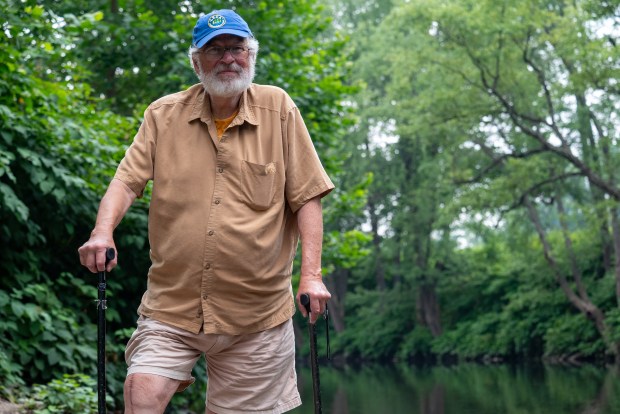 Bernie McGurl, former head of the Lackawanna River Corridor Association, at Sweeney’s Beach in Scranton on Tuesday, Aug. 5, 2025. (REBECCA PARTICKA/STAFF PHOTOGRAPHER)
After reviewing the deficiency letter and its recommendation to seek out easements from nearby properties, McGurl came to a simple conclusion: “There’s no place to put the stormwater up there.”
“What the mining companies did 150 years ago was disrupt, disturb, destroy all of the drainage areas. The topography of the landscape was turned inside out to mine the coal, both underground and then surface strip mining activities, and that ruptured the flow of water across the surface of the valley,” McGurl said. “Some of the water will infiltrate down through the broken rock and soils into the subterranean mine pool into the huge complex of mine voids under the valley, but that’s not something that we really want to encourage because it has to be treated. It comes out into the (Lackawanna) river as mine drainage.”
While some abandoned mine lands could support data centers, McGurl stressed his opposition to the developments, especially Project Boson’s location.
“I don’t think there’s a spot in the valley right now that’s appropriate. One or two of them could have some potential, but the sites in Archbald are definitely not appropriate,” McGurl said. “They’re too close to residences. They need to be at least a mile away — preferably more.”
Generating nearly 1.6 million gallons of runoff during a bad rainstorm is significant near neighborhoods, he said.
“It’s going to fill up the street in front of your house with 3-4 inches of flowing water really quickly, and maybe up to a foot and cause a lot of flash flooding around the facility,” he said. “I don’t think we ever anticipated any kind of development at this scale in the valley.”
‘That soil is toast’
Beyond stormwater issues, the DEP’s deficiency letter addressed the site’s contamination from the longtime junkyard.
The review notes that a January 2025 environmental site assessment found benzene and other chemicals in concentrations exceeding residential concentrations near a former 275-gallon storage tank, but a remediation report submitted July 31 did not include that area of concern. Neither the site assessment nor report included a groundwater investigation, so it’s unknown if groundwater contamination is present, according to DEP.
“Due to the scale and historical usage of the site, remaining soil contamination may be present in areas not characterized or remediated in previous environmental investigations,” the DEP wrote, recommending that workers wear personal protective equipment during remediation and construction.
Asked about whether he expects groundwater contamination, McGurl chuckled for about 10 seconds before saying, “I hope your recording machine is picking up the laughter — yeah, that soil is toast.”
“It’s a brownfield site, so you have to treat it like there’s hazardous materials in the soil, and the hazardous materials in the soil when they get wet, they get taken up by the water — stormwater or infiltration into groundwater — and when they’re dry, and they get kicked around, they become airborne,” he continued.
‘Needs to be addressed immediately’
Tamara Misewicz-Healey, an industrial hygienist and mother of three young children in Archbald, has spent the past year fighting data centers after co-founding the Stop Archbald Data Centers movement with her husband, Justin Healey.
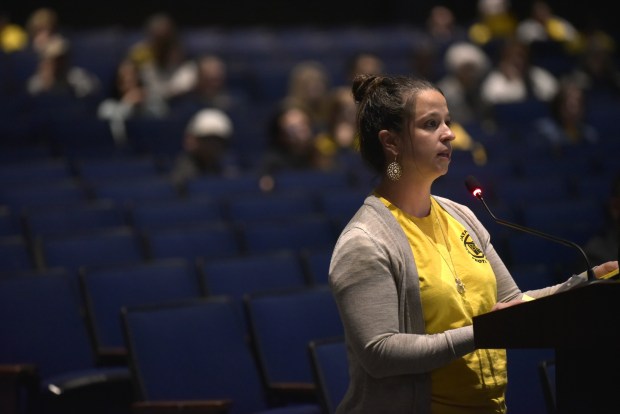 Tamara Misewicz-Healey, co-founder of Stop Archbald Data Centers, asks questions during an Archbald Borough Council meeting at Valley View High School on Monday, May 11, 2026. (CHAD SEBRING/STAFF PHOTO).
Project Boson raises serious concerns next to the Highlands and across the street from the borough’s Staback Park, she said.
“When you’re looking at contaminants like that, those are carcinogens, neurotoxins, and with those, there’s really not a safe limit,” Misewicz-Healey said. “It’s just the more you’re exposed, the higher your risk gets.”
If soil isn’t properly removed from the site, strong winds can blow the dust into nearby communities, she said. Even if residents don’t inhale it, the dust could coat playgrounds and yards, exposing residents through their skin. Runoff from the rain can also carry it into streams and rivers, she said.
“There are a lot of questions that should be explored, and I think this needs to be addressed immediately,” she said.
Numerous studies have linked benzene exposure to blood cancers — lymphomas, she said.
“Children are especially susceptible to environmental carcinogens as their bodies are developing at a higher rate — higher rates of replication — and they don’t have the full mechanisms that we do as adults,” Misewicz-Healey said. “They also have different behavioral practices, so their heart rate is quicker, so they tend to breathe a lot more air per their body mass, so they have that higher route of exposure through inhalation. But they also generally have higher rates of exposure through dermal because they touch everything.”
She contends Archbald’s previous zoning, even when it principally permitted data centers in commercial zones without defining them, was intended for small-scale commercial data centers — not an industrial hyperscale building like Project Boson.
“It should just absolutely not be in the location it’s being proposed in,” she said. “It should be in a heavy industrial zone, well away from community everyday life.”
Misewicz-Healey also worried about the impacts on the numerous older residents living in the Highlands.
‘This can’t happen’
Living next to a junkyard wasn’t much of a disturbance for the Nudelman sisters. Sometimes they would see an old school bus through the treeline when the leaves fall in the autumn or they’d hear a worker pulling parts from a vehicle, but it didn’t really bother them.
Project Boson changed that.
Getting up from her kitchen table, Meg Nudelman picked up a black pouch with a decibel meter in it that she keeps next to the kitchen window facing Project Boson, explaining she and her sister monitor the noise next door. As Meg Nudelman demonstrated the meter, her sister flipped through a calendar, with decibel readings scribbled under each date.
“When they were cutting down the trees, it got to 57 (decibels),” Kim Nudelman said.
Archbald’s zoning ordinance limits maximum daytime decibel levels to 55 dBA at residential property lines.
Noise and air emissions have emerged as two central concerns surrounding the bus-sized backup generators that data centers rely on during power outages.
When Archbald adopted its standards for data centers in November, it exempted backup generators from noise restrictions during testing and outages, but that waiver won’t apply to Project Boson under the legacy zoning allowing it to proceed as a principal permitted use.
Fleets of diesel generators put out significantly more fine particulate matter — tiny particles 30 times smaller than the width of a human hair — than natural gas power plants with the same output. The U.S. Environmental Protection Agency cites numerous studies linking exposure to health problems, including premature death in people with heart or lung disease, nonfatal heart attacks, irregular heartbeat, aggravated asthma, decreased lung function and increased respiratory symptoms, such as irritation of the airways, coughing or difficulty breathing.
That’s especially concerning for a cancer survivor with asthma like Meg Nudelman.
As the Nudelmans shared their concerns about the cumulative effects of data centers, their doorbell rang. Their neighbors, Karen and Jim Timmons, stopped by to visit. The Timmonses have lived on Foxtail Circle for a decade.
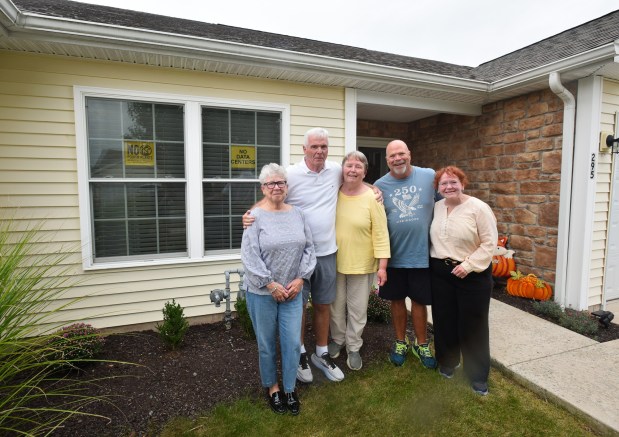 Residents of the Highlands at Archbald Kim Nudelman, Jim and Karen Timmons, Andy Jerome, and Meg Nudelman stand in front of the Kim and Meg Nudelman’s residence in Archbald Thursday, September 17, 2026. (SEAN MCKEAG / STAFF PHOTOGRAPHER)
A cancer survivor herself, Karen Timmons, 70, has testified at public hearings in Archbald to emphasize the impacts of data centers and a power plant on herself and her neighbors.
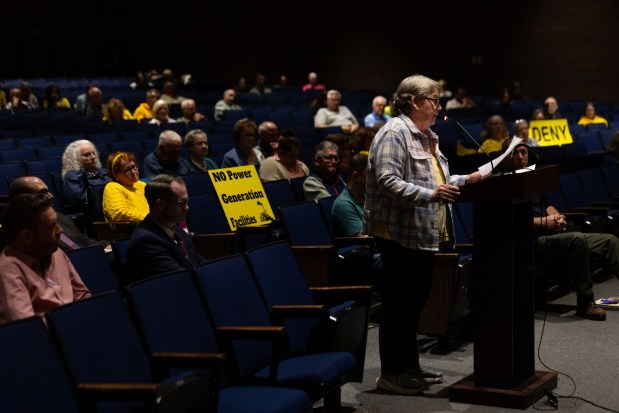 Archbald resident Karen Timmons questions Essential Energy officials during a conditional hearing on Monday, June 22, 2026, at the Valley View High School in Archbald. (FRANK WILKES LESNEFSKY / STAFF PHOTO)
Kim and Meg Nudelman initially taught them about data centers, and as the Timmonses learned more about the developments, they became increasingly horrified.
“Oh my God, this can’t happen,” Karen Timmons said. “We can’t have this in Kim and Meg’s backyard, let alone across from us.”
Nearly all of their neighbors are 65 or older, she said.
“The air emissions are especially of concern for vulnerable groups,” she said. “All four of us do feel an obligation to take care of the neighborhood.”
As a retired educator, Jim Timmons, 73, spent 11 years as an assistant principal and later principal in the Valley View School District, whose nearest school is less than half a mile from Project Boson on Columbus Drive.
“I don’t understand how any of this could be so close to this neighborhood, all the homes back here and the school district,” he said.
He described a sense of helplessness.
“The morality of all this is squashed,” Jim Timmons said. “There’s no morality with this.”
The DEP gave Project Boson until Sept. 25 to respond to its deficiency letter, or else the department could deny or withdraw the application. Alternatively, if the developer does not believe the deficiencies can be fully addressed within the time frame, it should consider a voluntary withdrawal, according to DEP.
If the project moves forward, McGurl wants the DEP to “hold their feet to the fire.”
“When it starts to rain and you get a heavy storm, you’re going to find out, and I don’t think we need to do that,” McGurl said. “Let them figure out a way to say, ‘Hey, we’re going to be the most responsible, absurd stormwater managers on the planet.’”