
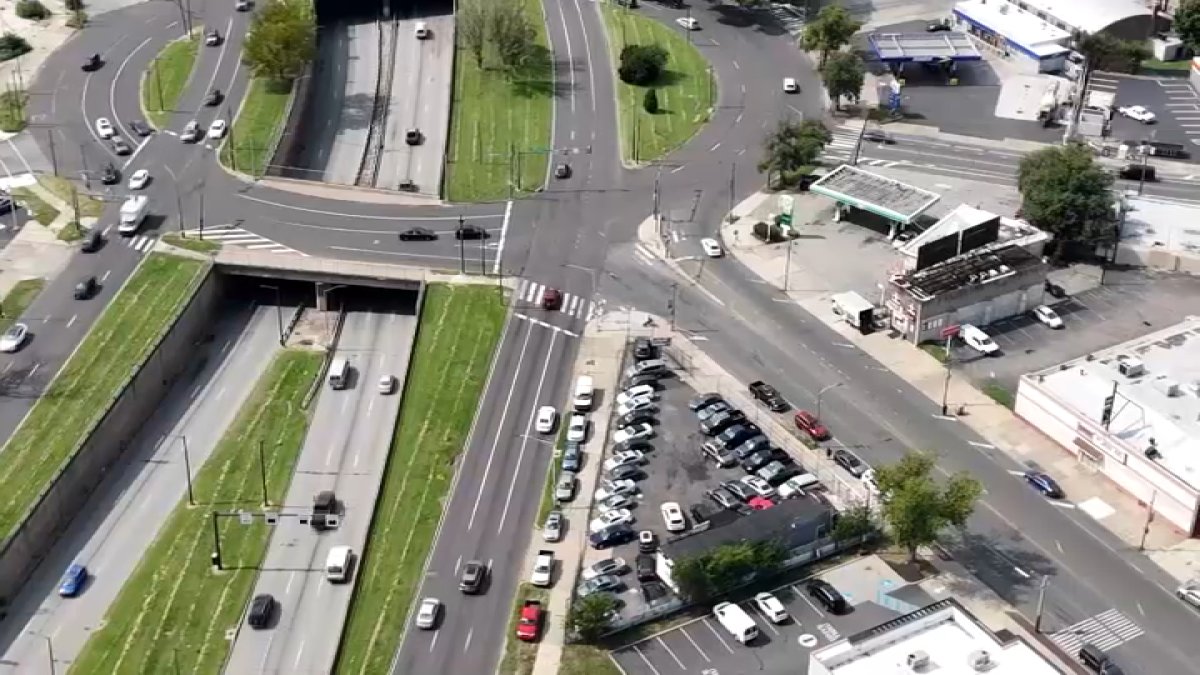
Philadelphia and PennDOT are moving ahead with $134 million in changes to Roosevelt Boulevard by 2030, with projects aimed at improving traffic flow and pedestrian safety along one of Philadelphia’s most dangerous roads.
At the same time, supporters are renewing a decades-old push for a subway beneath the boulevard as the city and state consider longer-term transit options for the corridor.
The project on the boulevard is grouped into three stages: “Today,” “Tomorrow,” and “Reimagined.”
Projects that will be wrapped around the end of 2026 include the addition of automated speed cameras, improvements at the Summerdale/Adams intersection and Southampton Road intersection, improvements to crossover lanes (Cottman to Red Lion), addition of SEPTA Direct Bus B, and the installation of Business Access and Transit (BAT) Lanes (Bustleton to City Line).
The “tomorrow” projects are targeted by the end of 2030, including upgrades to traffic signals and lanes, shorter pedestrian crossing distances, sidewalks and other pedestrian safety improvements.
“In addition, they’ll see landscaping improvements along key sections of the boulevard, as well as improved bus stops and some parking enhancements as well,” Kyle Brown, a city planner with the Philadelphia City Planning Commission, said.
A huge change is coming for a section of the Garden State Parkway in Ocean County that’s known for crashes and congestion. NBC10 Jersey Shore Bureau reporter Ted Greenberg takes a look at what’s to come.
Public meetings about the planned projects are set to begin next month, allowing residents to learn more and provide feedback. The first will be held virtually on Oct. 8 at 7 p.m.
An engagement session on the stretch from Pratt to Old Lincoln Highway will be held on Oct. 13 from 6 p.m. to 8 p.m. at Kleinlife, 10100 Jamison Avenue.
A separate engagement session will be held the following week, focused on the stretch from Broad Street to Pratt Street, on Oct. 14 from 6 p.m. to 8 p.m. at Esperanza Arts Center, 4261 N 5th Street.
Traffic safety is a major motivation for the changes. Between 2018 and 2022, Roosevelt Boulevard accounted for 10% of all traffic deaths in Philadelphia, according to the City Planning Commission.
The city says pedestrian crashes have been cut in half since speed cameras began operating on the boulevard in 2020.
State Rep. Jared Solomon, who represents Northeast Philadelphia, said the planned improvements are welcome but wants to see more progress on the longer-term vision for the boulevard.
“In the end, a couple signal changes, a couple crosswalks, rejiggering some particular intersections, that’s not what is the real inspiring work that we need to do,” Solomon said.
Philadelphia and Pennsylvania are studying three longer-term transit possibilities for Roosevelt Boulevard: bus rapid transit, light rail and a subway.
The city’s project website said the preferred recommendation is anticipated by 2026, but city planners said Thursday that more engagement will happen into 2027.
“There’s really nothing more to study. We know the options. We know the benefits. We know that the biggest obstacle is always the cost,” Solomon said.
A 2025 study by New York University’s Marron Institute of Urban Management projected a subway could attract 51,000 to 62,000 daily riders (depending on the model).
Years ago, SEPTA said the projected cost was at least $10 billion. It is now potentially much more.
While the topic was not discussed directly, subway supporters brought their case to the Philadelphia City Planning Commission, arguing that plans need to be advanced so the project could compete for federal infrastructure funding in the future.
“We can’t get that infrastructure dollar if the plans are not ready,” Dr. Jay Arzu, an advocate for the Roosevelt Boulevard subway, told NBC10.
Arzu said supporters believe a subway could also spur economic development in Northeast Philadelphia.
“We would be turning the Boulevard of Death into the Boulevard of Life,” Arzu said.
This story was originally reported for broadcast by NBC Philadelphia. AI tools helped convert the story to a digital article, and an NBC Philadelphia journalist edited the article for publication.