
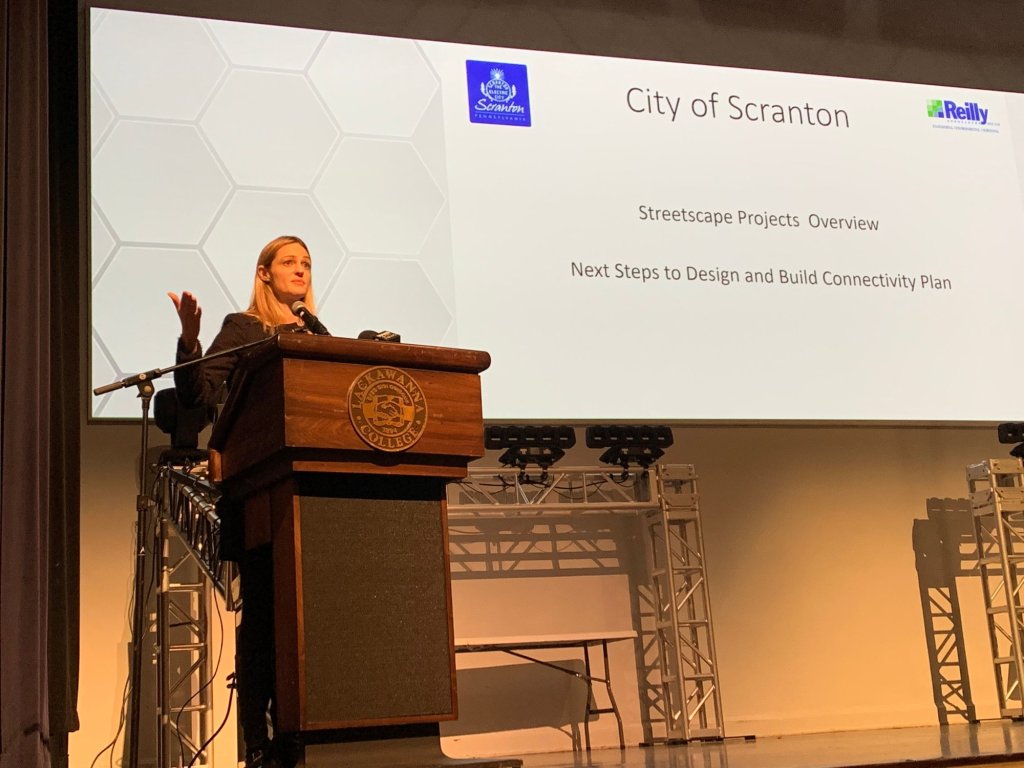
The $27 million price tag is the primary drawback of Scranton’s proposal to make its downtown more walkable by reworking its streetscapes and traffic patterns.
Citizens will — and should — question whether spending that type of money elsewhere benefits them more, no matter what gains officials say the proposal will provide, or how badly change is needed.
We encourage residents of Scranton to do the difficult thing when it comes to the exhaustive proposal announced in October by recently reelected Mayor Paige Gebhardt Cognetti. Look at it as a long-needed investment in a downtown business mainframe teeming with potential but begging for something, anything, to make it a destination for residents and visitors.
At the same time, it is imperative for communities throughout the region to follow Scranton’s lead and understand the numerous and obvious benefits of walkable, connected downtowns. With some planning and ingenuity, it could be the most cost-effective way to provide quickly the necessary revitalizations of our downtowns.
Even at a budgeted $27.3 million — funded with nearly $14 million from the federal American Rescue Plan Act that has to be spent by October, as well as other federal, state and local dollars — the diverse people backing the project, who have opened businesses and provided services in downtown Scranton, shouldn’t be ignored.
Several small businesses wrote letters to city council expressing support for the project. The board of directors of Scranton Tomorrow did the same, saying “infrastructure and streetscape investments have a proven track record of boosting local economies and improving residents’ quality of life.” The potential benefits to safety for pedestrians were touted by both the University of Scranton and the Lackawanna Blind Association. Scranton Police Chief Thomas Carroll said his department supports the project, and Fire Chief John Judge added his expectation that implementing it would “definitely increase public safety.”
Getting about half of it paid for through use-it-or-lose-it ARPA funds is no small bonus for Scranton. It increases the bang for the city’s buck on necessary infrastructure changes like improved lighting, new sidewalks, bike lanes, crosswalk signals, curb bump-outs and underground utility wires. But it should serve as a template for other similar projects that could improve walkability in communities throughout the area, as proponents insist smaller-scale, effective changes could be made quickly, and at minimal costs.
And, we need them.
Walk Score, a website frequently cited by Realtors that analyzes walkability in communities, rated the 37 largest cities in Pennsylvania based on walkability scores and ease of transportation via biking. Northeast Pennsylvania’s largest communities did not score well.
With a score of 64 out of 100, Hazleton led the way in this quadrant of the state. That was still just 12th best out of those 37 cities.
At 62, Wilkes-Barre tied for 14th. Scranton, at 58, ranks 21st and is easily the state’s largest city rated outside the top 20 on the walkability scale. None were in the top 17 in bike scores.
There are reasons for all of this, ranging from the mountainous terrain to the aging infrastructure around the area, but it all paints a picture. Communities here can learn from cities like Lancaster and Allentown that have improved walkability over the last decade, continue to do so, and experience strong results from business and cultural perspectives.
Jeff Speck — the renowned urban planner and author whose 2012 book “Walkable City: How Downtown Can Save America, One Step at a Time” essentially served as the impetus for walkability studies nationwide — said the path to walkability starts with the simple premise of redesigning streets to slow down traffic. Achieving that goal usually means reducing the amount of driving lanes and/or the size of lanes, reverting one-way traffic patterns to two-way, making spacious intersections smaller, inserting four-way stop signs when possible instead of traffic lights and installing parallel parking spaces along curbs.
In an “if it’s not broke, why fix it” world, some of these changes seem miniscule and hardly cost-efficient. But, they make sense.
Stop signs have proven effective in slowing traffic and limiting preventable accidents involving pedestrians. Slower traffic makes walking and biking more inviting. The easier it is to walk and bike around a downtown, the easier it would be to live there. The easier it is to live there, the more attractive the area would be for businesses. The more businesses want to be there and get settled in, the more those who live outside the city want to be part of the scene. Many of those changes, Speck said, lead to increased safety and can be implemented within a year or two.
There are simple measures communities can take, with some planning, to make our neighborhoods more connected, our citizens healthier and our downtowns more fertile for business. Our elected officials should always be on the lookout for ways to achieve this all-important goal.