
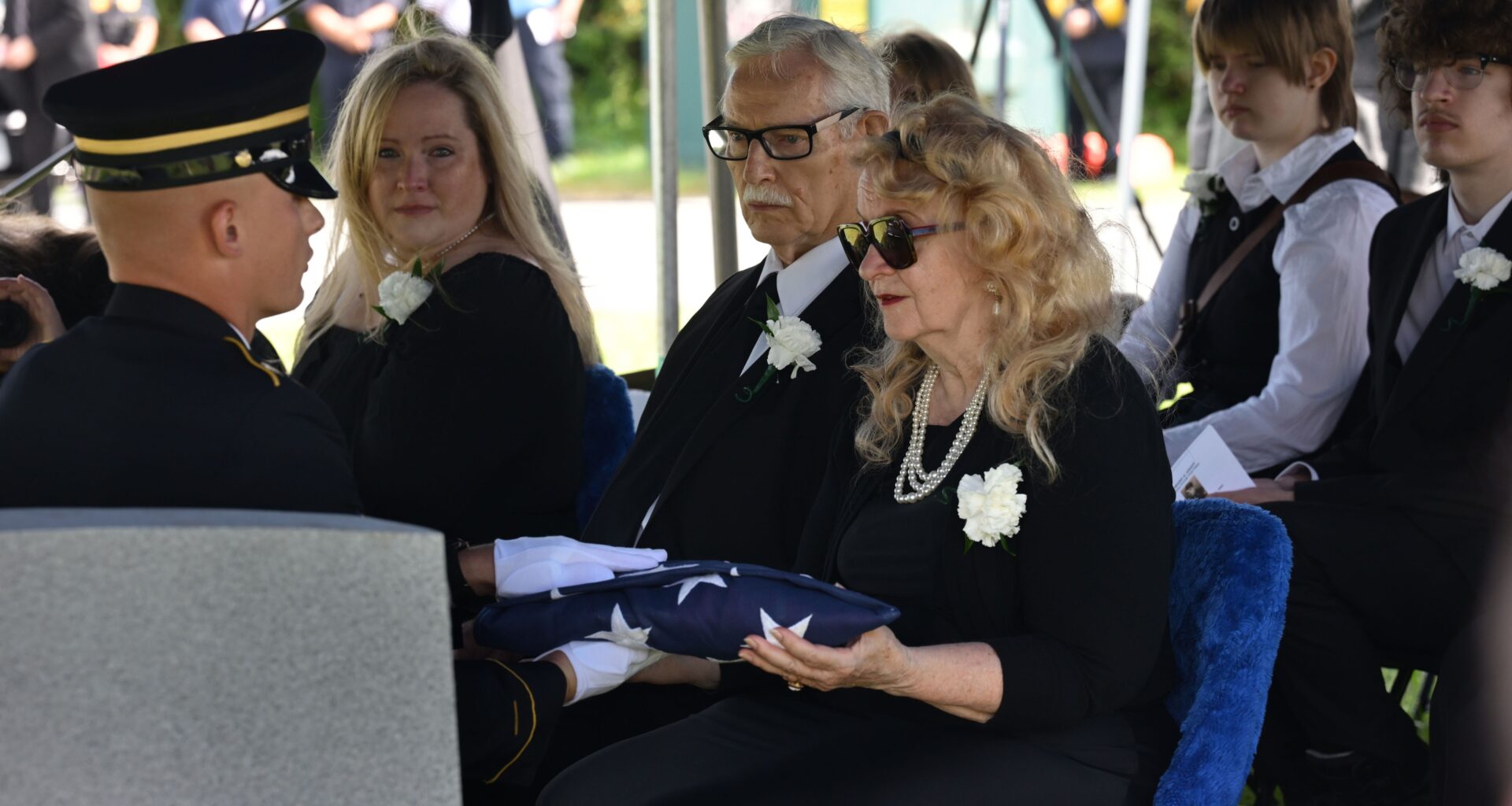
Private First Class Howard G. Krapf was laid to rest in Fairview Cemetery in Whitehall Township on Monday, 82 years after he was gunned down in a German forest, defending the United States and its allies during WWII.
Krapf, who was 26 when he was declared missing by the Army, was laid to rest next to his mother, Stella V. Krapf, who for years signed her beseeching letters to the military, “from a broken-hearted mother.”
A white-gloved honor guard carried Krapf’s flag-draped casket, and Whitehall Mayor Joseph J. Marx Jr. welcomed Krapf’s family, who traveled from all over the country to witness the burial.
Joan Vannatta, Krapf’s niece, said the occasion was both somber and miraculous, the result of extensive historical research and advances in DNA technology that allowed military scientists to finally put a name to remains recovered more than 80 years after the Battle of Hurtgen Forest on the Belgian-German border, one of the longest campaigns of the war which resulted in 33,000 American casualties.
“He fought for our country and now he is home,” Vannatta said. “Thank God for our military, who stand up and fight for us.”
Researchers have been working for decades to identify the remains of WWII soldiers like Krapf who went missing in action. His family first learned there was progress in the search two years ago when a Dutch historian e-mailed Aaron Vannatta, Krapf’s great nephew, looking for Krapf’s relations.
Though family members were initially hesitant to believe Krapf had been identified after all these years, calls from the military and local dignitaries followed, and Krapf’s funeral was arranged.
Though she never met her uncle, Joan Vannatta, a former Parkland High School American Sign Language teacher who acted as a sign language interpreter at Krapf’s funeral, recalled with sadness the sight of her grandmother watching for a telegram to be delivered with news of her son.
“She lived the rest of her life not knowing what happened to him,” Vannatta said.
Aaron Vannatta, who gave Krapf’s eulogy Wednesday, said he was shocked by the emotions that overcame him as he contemplated his great-uncle’s sacrifice.
“Howard represents one of the greatest, if not the greatest, generations this country has ever known. This generation was willing to sacrifice, to put their lives on the line for valor, and for others,” he said.
Before being inducted into the Army in November 1942, Krapf was an employee at Brown’s Shoe Factory. His brother, Henry Krapf, also served in the war. He survived, and died in 1995 at age 78, according to Morning Call archives.
Howard Krapf’s remains were identified by the Defense POW/MIA Accounting Agency. He was killed during a battle with German forces on Nov. 8, 1944, according to a statement from the military.
He was shot in the hand, prompting him to jump up in pain. He was then hit and killed by enemy machine gun fire. He served in the Army with Company B, 1st Battalion, 12th Infantry Regiment, 4th Infantry Division.
Members of Company B witnessed his death; however, graves registration personnel did not have his remains to confirm he had been killed, and he was listed as missing in action, according to the statement. That status remained until after the war ended, and in October 1945 his status was changed to killed in action.
During his service, Krapf received Expert Rifleman, Expert Machine Gunner and Expert Infantry awards.
Marx said Krapf will be honored with a Hometown Heroes banner that will be flown near Krapf’s Front Street home, as well as a memorial brick on the Veteran’s Memorial Plaza outside township headquarters.