
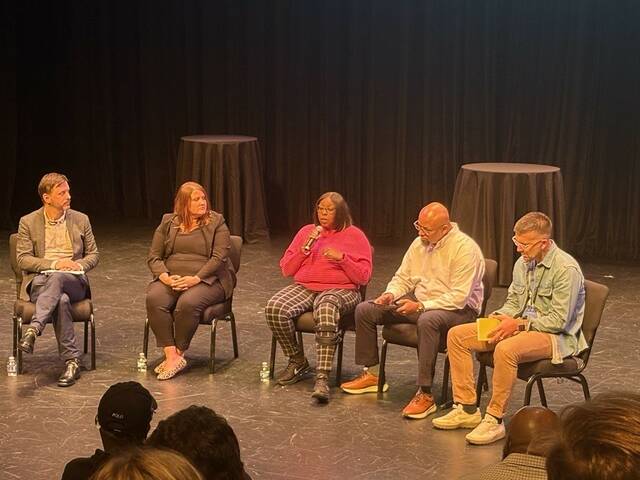
Jason Boll sees Pittsburgh Public Schools’ sweeping reconfiguration plan as a chance to serve city students better.
“This plan is coming, and we mourn the loss of some really great places and spaces where people have memories,” said Boll, a Perry High School teacher, during a panel discussion on North Side schools Monday night at the New Hazlett Theater.
“But we have this opportunity that’s in front of us to build something that is better than what we’ve had and not as good as it will be 10 years from now.”
The meeting, focused on the future of public education in the North Side, drew about 60 people.
“We do not want more families to choose to leave the city schools,” said Chris Sweeney, co-chair of One Northside’s education committee, which organized the event. “There is amazing potential for North Side schools if we can figure out how to tap into all the resources we have currently.”
Under the school district’s Future-Ready Facilities Plan, approved by the school board in May, nine schools and 12 buildings will close.
A number of North Side schools are affected. Allegheny 6-8, King K-8 and Manchester K-8 will close at the end of this school year. Allegheny PreK-5 will relocate to the King facility and become a dedicated, neighborhood elementary school. Morrow will also become a dedicated elementary school.
The Allegheny building will become the new home of Schiller 6-8 neighborhood middle school.
A new, early childhood center will open in the Allegheny Annex, beside the school, and the district is renovating its Northview Heights facility to serve as a kindergarten through fifth grade elementary school and English Language Development center in the 2029-30 school year. When Northview opens, Spring Hill will close.
The plan, as a whole, has faced significant community pushback, with concerns over equity, student disruption and its execution.
Monday’s meeting struck an optimistic tone.
Sweeney said the One Northside group did not advocate for or against the school closure plan.
“We see this as an opportunity to provide input for schools remaining open — how can we make these schools the best they possibly can be?” he said of Monday’s meeting.
Middle school
Boll is excited for the neighborhood middle school at the Allegheny building. Unlike now, middle school students will be under one roof from sixth to eighth grades before attending Perry for high school.
“I hope people take away that this is the moment, this is the time to push on people that our voice is being heard and to create something better than what we have, with all due respect to what we have,” he said.
Parent Hallie Thyben, of Marshall-Shadeland, agrees that the middle school has great potential. Her son, Arthur, 10, is in fifth grade at Allegheny.
Still, Thyben has questions and concerns over how the plan will shake out, and plans to be involved in the process as much as possible. She hopes the schools can lean on help from community partners through the transition.
“The middle school has such an opportunity to be a model for other middle schools in the state and further, if we do it right,” Thyben said. “We have 10 months — you want it to be the best middle school it can be.”
The director of curriculum and development in the Burrell School District, Autumn Turk, was a panelist at Monday’s meeting.
A reconfiguration of the Burrell schools last year created the opportunity for “studios,” personalized-learning classes that cater to students’ interests instead of traditional arts and humanities courses.
As a result, those students and teachers are more excited to engage in coursework and attend school, she said.
“After we got past that hurdle of things being a little hard, some beauty started to emerge,” Turk said. “Our teachers were really excited and rejuvenated about teaching again. Kids were really excited because not only did they have these studio-based experiences connected to the real world, they had choice.”
Changing the narrative
The panel also touched on the realities and inequities in North Side schools.
The North Side schools have a 42% capture rate, meaning 2,382 students who live in the North Side attend a public school there, said James Fogarty, executive director of A+ Schools, an educational advocacy nonprofit focused on city public schools.
Perry’s enrollment has grown from 2020 to 2025. Still, Fogarty said, smaller Pittsburgh Public schools don’t offer the same opportunities others do. King, Manchester and Morrow did not offer Algebra I classes.
At the high school level, Perry in the 2023-24 school year only offered four Advanced Placement classes, Fogarty said, while Allderdice in Squirrel Hill had 30. However, Perry is now offering four college in high school classes through a partnership with the University of Pittsburgh, he said.
Fogarty said the statistics have ripple effects: In the class of 2019, less than 10 graduates from Perry, Westinghouse and UPrep (Milliones) went on to complete college or trade school.
Dawn Gordon, King’s principal, said many of her students are faced with food insecurity, housing instability and trauma all before they arrive at school. About 84% of King students are considered economically disadvantaged.
“My priority at Pittsburgh King has really become: ‘How do we service the child as a whole, and how do we provide not just the students with what they need, but also the educators who are in front of them to be able to service them?” Gordon said.
This year, King started the Healing Project, which provides trauma-informed care with teachers, Gordon said. In turn, that will better train them to educate students.
“We are an educational institution first, but we also know before we can even get to that part, we have to address the challenges that our students are walking into school with,” she said.
At King, 13% of students in the 2024-25 school year were proficient on the English Language Arts state assessments, according to state reporting. Just less than 3% were so on state testing for math.
“Although those are what our test scores look like — and they give me chills every time I see them — it’s not a matter of our kids cannot read, or our kids can’t do math,” Gordon said. “What are the challenges and the distractions that they’re dealing with, when they go to those math classes or they go to the reading classes, and that’s really what we’re trying to focus on.”
Gordon is also trying to reverse the narrative that King is a “bad school.” She highlighted the district’s Welcome Wednesdays initiative, where parents can schedule a tour of the school during the school day, tutoring and student-teaching partnerships with Duquesne and Point Park universities, and the school’s step team performing with the Pittsburgh Cultural Trust.
Those are examples of how community organizations can work together with schools, said Dennis Henderson, executive director of the Manchester Youth Development Center. He hoped the meeting was the launch of organizations intentionally working together with public schools.
“We’re very fortunate to have such a diverse plethora of resources for kids in this region,” he said. “A lot of times, though, we fail to recognize the tremendous amount of resources we have for youth right here on the North Side.”
Prior to becoming King’s principal, Gordon worked at UPrep, in the Hill District, and Westinghouse, in Homewood.
“I see myself doing a lot of comparisons of, ‘The East Side had this, but the North Side didn’t have this,’ ” she said. “My hope in the next five years with the transition is that the same opportunities and access that I’ve seen my East Side students having access to, my North Side students will have access to, and that we’ll start to see equity within our schools on both the East Side, the North Side, the West and the South.”