
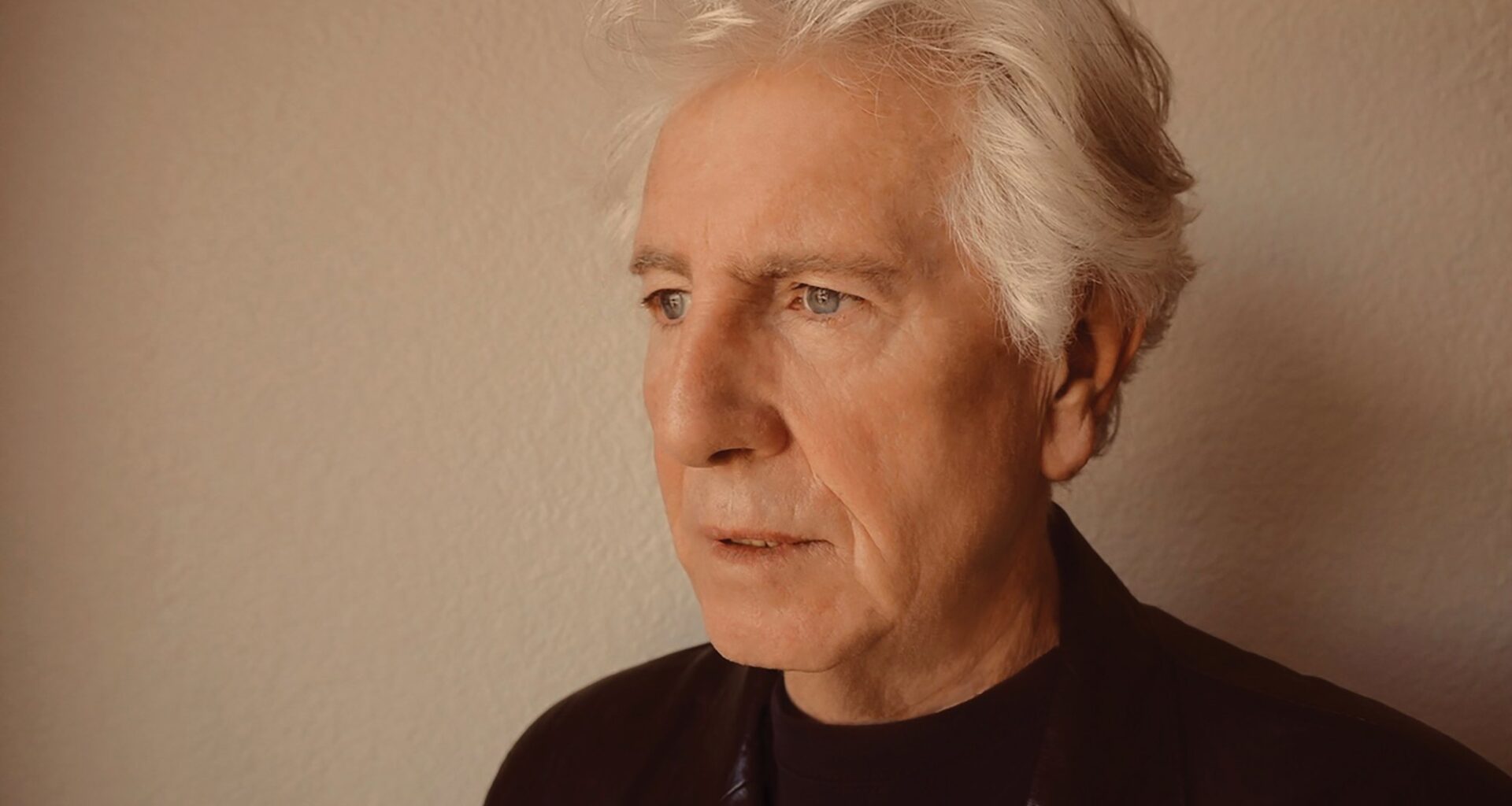
Graham Nash has built one of rock’s most storied careers in the decades since he first topped the charts with The Hollies on 1960s hits like “Bus Stop” and “Look Through Any Window.” Born during World War II in Blackpool, England, where his mother had been evacuated from the family’s hometown of Salford, Nash grew up working class in the north of England.
Following his success with The Hollies, he relocated to Los Angeles in 1968, where he joined forces with David Crosby and Stephen Stills to form the legendary Crosby, Stills & Nash. The band went on to create its own chapter in the Great American Songbook with signature songs that include “Suite: Judy Blue Eyes,” “Teach Your Children,” “Our House,” “Marrakesh Express,” and “Just a Song Before I Go,” among many others.
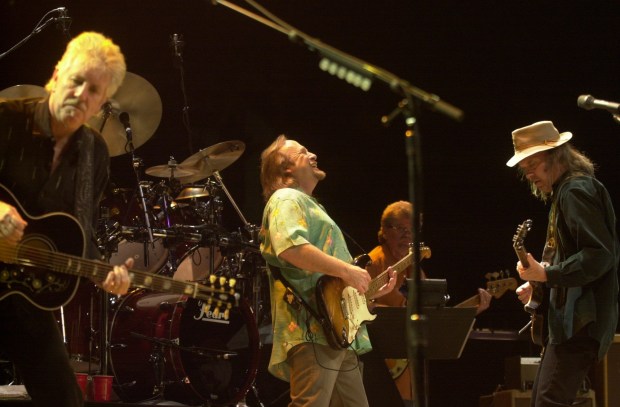 From left, Graham Nash, Stephen Stills and Neil Young of Crosby, Stills, Nash, and Young, perform at a concert at Madison Square Garden. (James Kelvom)
Nash is a two-time Rock & Roll Hall of Fame inductee — one for each band — and was appointed by Queen Elizabeth II as an Officer of the Order of the British Empire in 2010 for his services to music and charity. Meanwhile, his solo albums have sold well over a million copies, beginning with 1971’s “Songs for Beginners,” which included the politically charged protest anthems “Military Madness” and “Chicago.” That side of the band had become all the more evident when Neil Young came on board and they recorded the rapid-response song “Ohio” in the aftermath of the Kent State shootings.
Nash’s most recent studio album, “Now,” released in May of 2023, is a deeply personal collection of 13 songs featuring a reunion with his original Hollies co-founder Allan Clarke on the track “Buddy’s Back.” “American Songwriter” awarded the record four out of five stars, praising the album for “conveying the calming and caressing sound that all so frequently added its soothing sobriety to CSN and CSNY.”
Nash is currently in the midst of a 2026 tour across the United States, with a sold-out stop Thursday at Lehigh University’s Zoellner Arts Center. He is joined by a versatile three-piece backing band consisting of keyboardist Todd Caldwell, bassist Adam Minkoff, and multi-instrumentalist Zach Djanikian. We caught up with him to talk about the current political climate, carrying on the live legacy of the CSN catalog, and why his classic protest songs remain intensely relevant today.
Q: Your “Now” album was recently praised for finding profound meaning in everyday occurrences. Do you find your observational lens as a writer has zoomed in or zoomed out as you’ve gotten older?
A: Now that I’m 84, you tend to realize that life may be coming to an end soon, though I certainly hope to be here until I’m at least 100. You don’t deal with nonsense very well. You tend to focus on what’s really real.
Q: Looking at larger issues versus very personal things, it seems you’re connecting with both. Is that true?
A: Very much so. My wife, Amy, sent me an incredible quote from Nina Simone: “No matter what kind of an artist you are — a painter, or a musician, or a sculptor, or anything like that — you have to reflect the times in which you live.” I’m constantly aware of what’s going on around me personally, and certainly what’s going on in the world generally.
Q: Looking back at “Songs for Beginners,” how do you view the writer you were back then compared to the writer you are today?
A: In a simple way, we thought Richard Nixon was mad. Crazy. Look what we’re dealing with today. I really don’t believe that many of the people who voted Trump in for a second term were voting for all the stuff he’s doing right now. He’s becoming an autocrat and a dictator, he wants to destroy democracy, and he wants to align himself with other dictators around the world. I don’t think they would have voted for any of this.
Q: You’re bringing deeper cuts and rarities into the setlist right now to reflect the current political climate — “Military Madness,” “Immigration Man,” and “Chicago,” in particular.
A: I’m honored that my music has lasted so long in people’s minds, but at the same time, I realize we don’t learn from history. Songs like “Immigration Man,” “Military Madness,” “Chicago,” and even “Teach Your Children” are still incredibly relevant today.
Q: When I first heard “Immigration Man,” I assumed it was a slightly tongue-in-cheek song about your personal experience, maybe with an H-1B visa problem or something.
A: Right, right.
Q: But listening to it now feels very different than it did back then. When you perform it live today, do you feel that shift as well?
A: It’s more intense now, because, you know, stuff about immigration policy of this country is on the front pages of The New York Times today. When we play “Immigration Man,” audiences understand what the policies of the United States are. It seems anyone who is Black or brown needs to be deported in Trump’s world.
So it was a personal experience, but I’ve managed as a writer to realize that I’m just like everybody else. You know, what happened to me may have happened to you, which is the case in many of my songs.
Q: David Crosby passed away a few years ago, Stephen Stills is no longer touring, and Neil Young is avoiding the CSN catalog. Does being the sole active touring custodian of these songs change the weight they carry?
A: Yes, they seem much heavier to me now. That’s what we wanted to do with CSN and CSNY. We wanted people to be able to shake their ass and have a good time, but we also wanted them to think about what we were saying.
Q: Did that work?
A: I believe it did. The hippies were a good thing. They wanted you to love your brother and believed that peace is way better than war. I think that’s happening again. Look at all the “No Kings” protests around the world. Viewing it from our generation, I have hope that Generation Z is the next generation doing that. That’s why “Teach Your Children” is still relevant. There’s a lot you can learn from your kids, and a lot they can learn from you. Young people today are brighter, they think more, and they’re not as easily brainwashed.
Q: Looking back on your journey — from The Hollies and CSN to CSNY, Crosby & Nash, and this latest solo tour at the age of 84 — what is the one thing that has stayed with you through it all?
A: Something my mother told me when I was a child. She said, “Follow your heart. Your heart knows what’s good, your heart knows what’s bad. Life is full of choices, make sure you make the right choice.” I’ll never forget that.
Bill Forman is a freelance writer.