
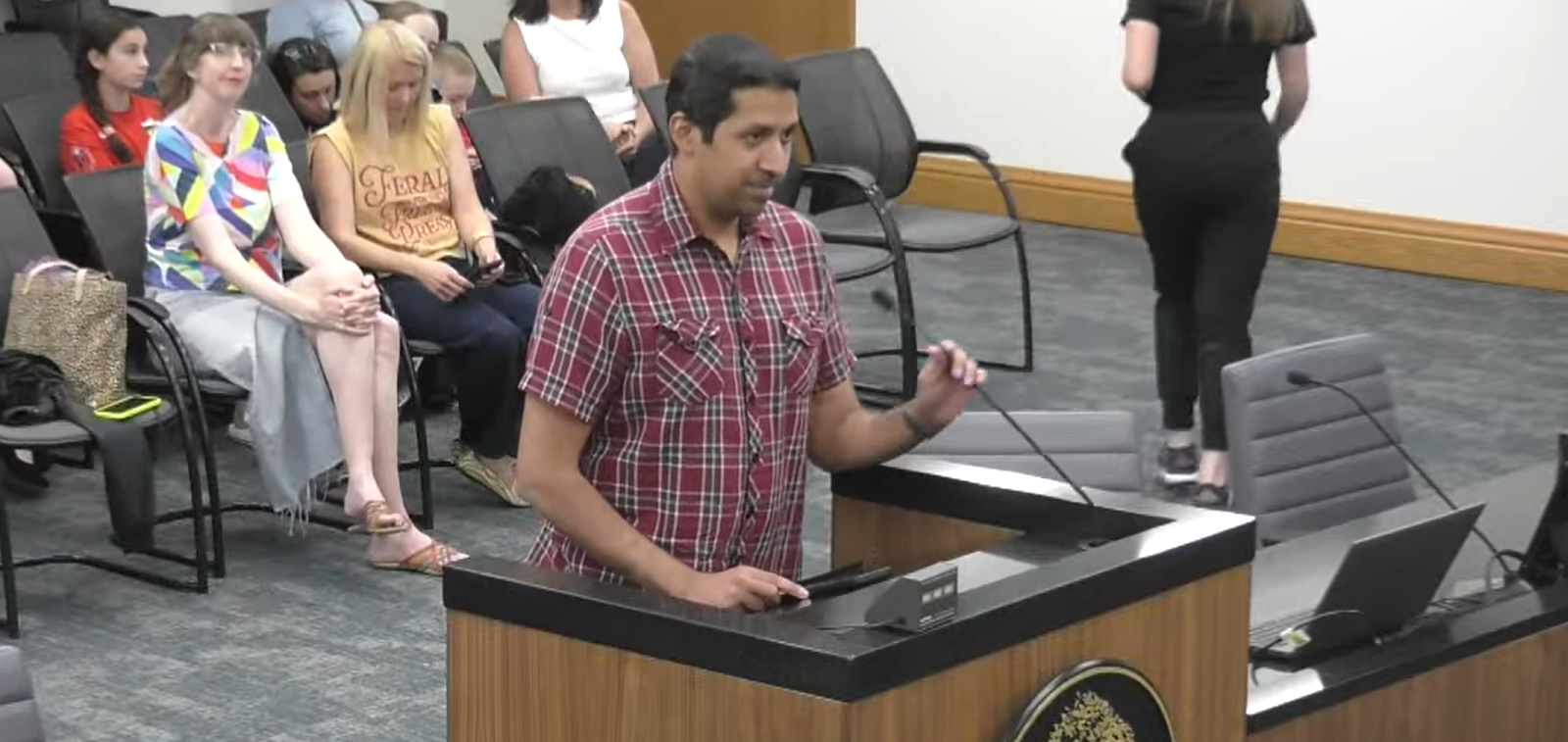
An Erie resident challenged the Town’s handling of Mayor Andrew Moore’s resignation Tuesday night, arguing that the wording of Erie’s Home Rule Charter may require Town Council to declare the mayor’s seat vacant before Moore’s announced departure in November.
During public comment (49:00), Ashraf Shaikh pointed to Section 2.06 of the charter, which says a vacancy occurs when a mayor or council member submits a written resignation to the town clerk and directs council to declare the vacancy at its first meeting following receipt of the resignation.
“The town council shall declare a vacancy,” Shaikh said, quoting the charter. “That’s a shall, no wiggle room.”
Following Shaikh’s comment, Moore thanked him and said he would ask the town attorney to comment on what had been raised. Council then continued with public comment.
Moore announced Sept. 15 that he intends to resign effective immediately after the Town Council adopts the 2027 budget, currently scheduled for Nov. 10. The Town has said Mayor Pro Tem Brandon Bell will then automatically become mayor and serve until the next mayoral election in November 2028.
But the language of the Town Charter raises questions about when Moore’s seat legally becomes vacant.
This section of the Erie Home Rule Charter says a vacancy occurs when the mayor or a council member “submits their resignation in writing to the Town Clerk.” The following subsection says that at the first Town Council meeting following receipt of a resignation, council “shall declare a vacancy.”
The provision does not explicitly address a resignation submitted in advance with a future effective date.
Shaikh argued at Tuesday’s council meeting, Sept. 22, that because Moore has already submitted his resignation, the language requires council to declare the mayoral vacancy now rather than after the budget is adopted in November.
“Nothing in these words says anything about an effective date of resignation or similar,” Shaikh said.
Shaikh compared Erie’s charter with provisions in other Colorado home rule municipalities that explicitly address future-effective resignations. He argued that the absence of similar language in Erie’s charter means receipt of the resignation itself triggers the vacancy provisions.
“The town council is required by the charter to declare a vacancy tonight and fill the vacancy per the provisions and timelines laid out in the charter,” Shaikh said.
In information published after Moore announced his resignation, the Town said Moore will remain mayor until he leaves the seat following adoption of the budget. Bell would then automatically assume the mayor’s office.
The Town has also said Bell would remain mayor until November 2028 because the Sept. 4 deadline for adding candidate races to the November 2026 ballot had already passed by the time Moore announced his resignation.
Section 2.06 states that when a mayoral vacancy is declared, the mayor pro tem automatically becomes mayor “until a successor Mayor is chosen by the electors at the next regular municipal election.”
The distinction could matter because the charter uses the phrase “next regular municipal election,” while the Town has described November 2028 as the next regularly scheduled mayoral election.
If Bell assumes the mayor’s office, his District 2 council seat will become vacant. The Town has said the seat would remain vacant until the winner of the November election takes office in January.
 The council meeting was still underway at the time of publication. Moore indicated that the town attorney would address the issue raised by Shaikh.
This is a developing story and will be updated as the Town Council meeting progresses.