
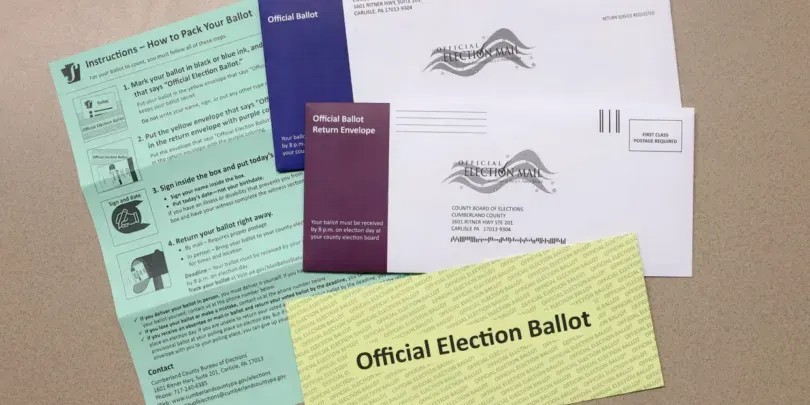
Pennsylvania does not have early voting in the traditional sense — no rows of polling places open for two weeks before Election Day, the way voters in Georgia or North Carolina experience it.
What it has, since the legislature passed Act 77 in 2019, is no-excuse mail voting: any registered voter may apply for a ballot, and in every county, a voter can walk into the county election office, apply, receive the ballot, and cast it on the spot in a single visit. Bucks, Delaware, Montgomery, and Chester Counties call this “voting on demand.”
Whatever the label, it functions as Pennsylvania’s early voting — and conservatives have spent six years treating it like poison.
That reluctance was understandable after 2020. It is no longer rational, and it is no longer free. Every week a Republican voter waits to cast a ballot he has already decided how to fill out is a week Republican turnout operations are spending money they don’t need to spend. It’s also a week you spend receiving political communications that will stop as soon as we know you’ve voted.
Every county in Pennsylvania reports mail-ballot applications and returns to the state, and from the state those files flow to the voter-file vendors — L2, TargetSmart, and their competitors — who resell updated files to campaigns, parties, and outside groups. In a competitive cycle, those files refresh several times a week once mail voting opens, and more often as Election Day approaches. Campaigns call this “ballot chasing”: tracking who in their target universe has returned a ballot so they can stop chasing that voter and start chasing the next one.
Once the file shows you voted, you disappear from the call list. You disappear from the text-banking queue. Your household drops out of the next mail piece, and the volume of mail addressed to you slows, over the following weeks, to nearly nothing. Not because anyone became less interested in your vote — because a marginal dollar spent contacting a banked voter is a dollar wasted. Once you vote, that same dollar gets redirected to the voter three doors down who has not yet returned a ballot and who might still be persuaded or pushed to show up.
Vote as early as you can. It’ll mean fewer robocalls. Fewer texts at dinner. A mailbox that empties out instead of filling up with the same four glossy mailers, forwarded and refashioned, week after week.
Democrats figured this out years before Republicans did. Their coalition adopted no-excuse and mail voting early, built the ballot-chasing infrastructure around it, and banked its voters weeks ahead of Election Day — freeing its GOTV (get out the vote) dollars to chase the persuadable and the unreliable, while a large share of Republican voters sat in the “unknown” column until they showed up, or didn’t, on a single Tuesday, a huge disadvantage for Republicans.
Some will object that early voting invites problems — a candidate stumbles in the final week, a scandal breaks, and the early voter is locked in. Fair enough; that risk is real, and no one should cast a ballot before they have made up their mind. But that objection proves too much if it is stretched into a rule against ever voting early. Most voters — conservative voters very much included — know who they are voting for well before Election Day. Waiting past that point buys you no additional certainty. It buys the other side’s opposition research more time to find you, and it costs your own side precious dollars to keep reaching out to you.
The comparison is not close. A voter who has already decided gains nothing by delaying, and loses the one thing delay was ever going to cost him: quiet. A campaign or a party that gets voters banked early gains something concrete — a smaller, cheaper, more targeted persuasion universe for the final stretch, aimed at the voters who can still be persuaded to vote for their candidate.
If you know how you are voting this cycle, don’t wait for a line on Election Day and a mailbox full of pleas to come out and vote. Request your mail ballot, or walk into your county election office and vote on demand. Get yourself off the list. Then let the operation you support spend what it saved chasing someone who still needs the push.
Jonathan S. Goldstein, Esq. is an attorney with an active, nationwide firearms law practice. He was the co-author of an amicus brief in New York State Rifle & Pistol Ass’n v. Bruen that Justice Alito favorably cited in his concurrence. See 597 U.S. 1 (2022) (Alito, J., concurring) (slip op., at 6). Mr. Goldstein is also a Lecturer in Law at the University of Pennsylvania Carey Law School, from which he graduated and where he teaches a course in firearms law. Mr. Goldstein is also a member of the board of the National Rifle Association. He writes here in his personal capacity and not on behalf of any institution or organization.