
One of south Bethlehem’s landmark buildings is on the market.
The owner of the Flatiron building at 301 Broadway is looking to sell the five-story, mixed-use building that opened in 1911 and has been owned by Sycamore Hill Farm Development LP for the last 20 years.
The company is closely intertwined with the Stone House Group led by Larry Eighmy, Darren Cassel and Rob Butch. Stone House, which is headquartered in the Flatiron building and describes itself as a “leading provider of energy, facilities, and project management services, helping organizations and institutions across the world achieve their sustainability goals,” has been installing various green energy amenities over the years.

Larry Eighmy of The Stone House Group does a presentation on the past, present and future of the historic Flatiron Building on Broadway on Tuesday, Sept. 22, 2026, in Bethlehem. (Monica Cabrera/The Morning Call)

Larry Eighmy of The Stone House Group does a presentation on the past, present and future of the historic Flatiron Building on Broadway on Tuesday, Sept. 22, 2026, in Bethlehem. (Monica Cabrera/The Morning Call)

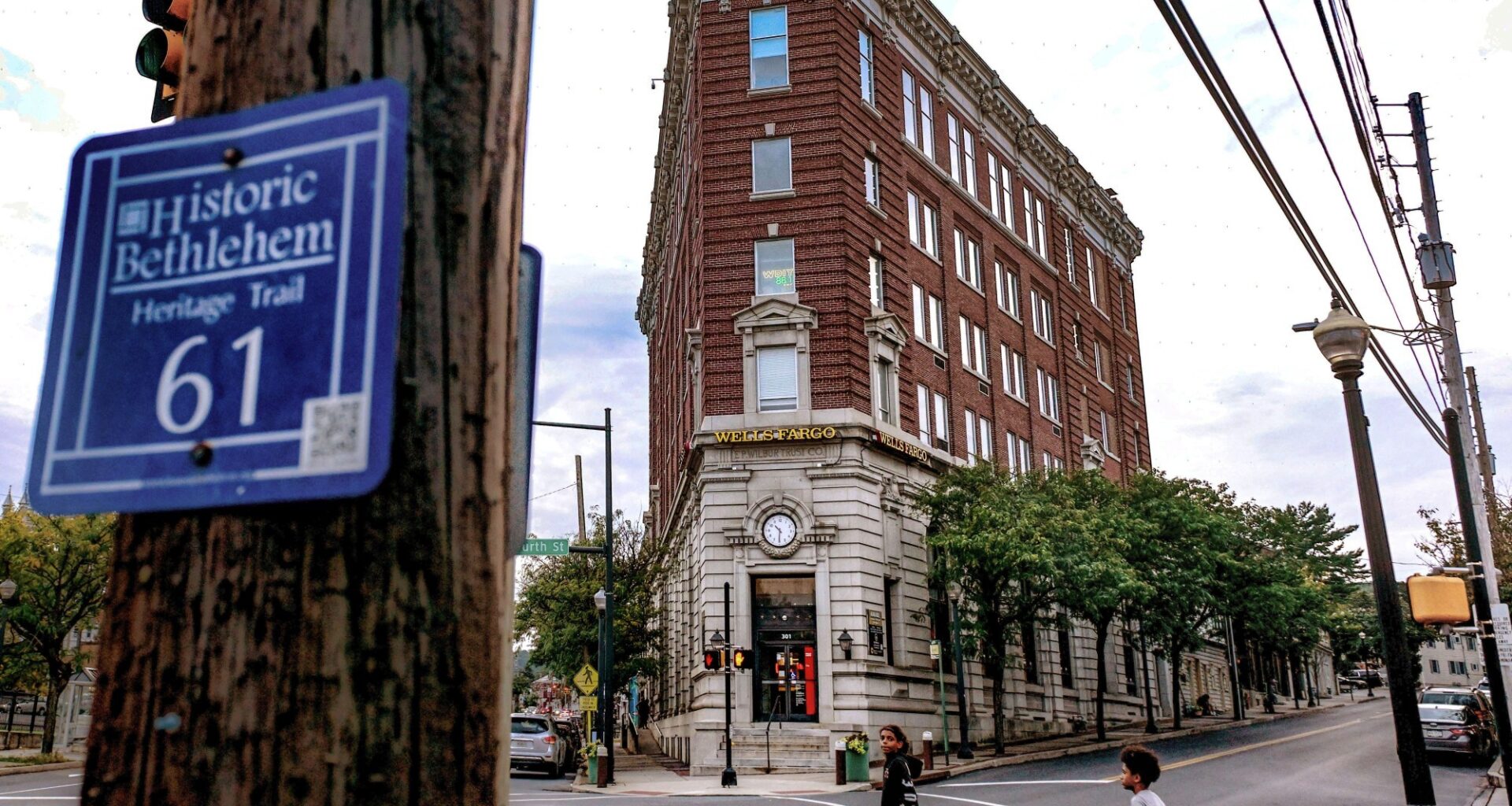
The historic Flatiron Building, seen here Tuesday, Sept. 22, 2026, on Fourth and Broadway on the south side of Bethlehem, houses businesses and nonprofits, including public radio station WDIY, and is anchored on the first floor by a Wells Fargo bank. Built in 1910 for banker E.P. Wilbur, it was prized for its masonry and brick exterior. The building was designed by A.W. Leh, a prominent architect who designed many mercantile and public buildings. (Monica Cabrera/The Morning Call)

The historic Flatiron Building, seen here Tuesday, Sept. 22, 2026, on Fourth and Broadway on the south side of Bethlehem, houses businesses and nonprofits, including public radio station WDIY, and is anchored on the first floor by a Wells Fargo bank. Built in 1910 for banker E.P. Wilbur, it was prized for its masonry and brick exterior. The building was designed by A.W. Leh, a prominent architect who designed many mercantile and public buildings. (Monica Cabrera/The Morning Call)

Larry Eighmy of The Stone House Group does a presentation on the past, present and future of the historic Flatiron Building on Broadway on Tuesday, Sept. 22, 2026, in Bethlehem. (Monica Cabrera/The Morning Call)

Larry Eighmy of The Stone House Group does a presentation on the past, present and future of the historic Flatiron Building on Broadway on Tuesday, Sept. 22, 2026, in Bethlehem. (Monica Cabrera/The Morning Call)

Tony Hanna, left, of Hanna Development Consulting, speaks with John Wargo of Core Real Estate Team on Tuesday, Sept. 22, 2026, at The Flatiron Building on Fourth and Broadway on the south side of Bethlehem. (Monica Cabrera/The Morning Call)

The historic Flatiron Building, seen here Tuesday, Sept. 22, 2026, on Fourth and Broadway on the south side of Bethlehem, houses businesses and nonprofits, including public radio station WDIY, and is anchored on the first floor by a Wells Fargo bank. Built in 1910 for banker E.P. Wilbur, it was prized for its masonry and brick exterior. The building was designed by A.W. Leh, a prominent architect who designed many mercantile and public buildings. (Monica Cabrera/The Morning Call)

The historic Flatiron Building, seen here Tuesday, Sept. 22, 2026, on Fourth and Broadway on the south side of Bethlehem, houses businesses such as Seven Sirens Brewing Company and nonprofits including public radio station WDIY, and is anchored on the first floor by a Wells Fargo bank. Built in 1910 for banker E.P. Wilbur, it was prized for its masonry and brick exterior. The building was designed by A.W. Leh, a prominent architect who designed many mercantile and public buildings. (Monica Cabrera/The Morning Call)
Show Caption
1 of 9
Larry Eighmy of The Stone House Group does a presentation on the past, present and future of the historic Flatiron Building on Broadway on Tuesday, Sept. 22, 2026, in Bethlehem. (Monica Cabrera/The Morning Call)
“This was our experiment,” Eighmy told The Morning Call on Tuesday evening. “This was our case study. I think we’ve proven it can be done, and now it’s maybe on to the next generation.”
The opportunity was announced after Eighmy and Cassel made a presentation about how Stone House redeveloped the building after Sycamore Hill Farm bought it for $1.3 million in March 2006. It was hosted by REI Partners Group, an Allentown real estate education and networking group.
John Wargo, a Realtor with the Core Team from Realty ONE Group Supreme, said south Bethlehem is a hot market as more young people look for housing. Students at nearby Lehigh University are remaining in the city after getting their diplomas.
“So, full circle, Lehigh students aren’t leaving Bethlehem,” he said. “They’re graduating, they’re taking jobs right here in the Valley. South Bethlehem has become a place to be.”
It’s part of the trend where people want to live near where they work.
“Do you want to drive up past the Blue Mountain, where land is available cheap, to build a house or a building at $350 a square foot that requires people to drive?” Wargo said. “Or do something better for the community, right here, at $250 a square foot in an area that you know is going to be [growing]?”
Wago said an asking price has not been listed and added the new owner would have the opportunity to work with Stone House Group on continued development, such as building additional apartments or adding tiny homes to a roof area.
He said there is potential for up to 100 feet of vertical growth under current zoning and redevelopment concepts.
Cutting edge
The Flatiron building is known for its triangular shape that was made necessary by its location at the Five Points intersection. The property is bordered by Broadway, West Fourth and Wyandotte streets.
It was designed by A.W. Leh and built for the E.P. Wilbur Trust Co.
Wilbur — a nephew of businessman and Lehigh University founder Asa Packer — founded the bank in 1870 and lived nearby in his mansion.
Eighmy said when it opened, the Flatiron building was considered cutting edge as it featured a fireproof steel frame and hot water for its tenants.
The building is still used for banking, with a branch of Wells Fargo on the ground floor. Other businesses and nonprofits in the mixed-use area include the studios of WDIY-FM public radio, Seven Sirens Brewing Co., Lehigh University department offices and Humanitarian Social Innovations.
There are nine commercial spaces and 11 apartments and 64,000 square feet of overall space.
During its ownership, Stone House retrofitted the Flatiron into a LEED Gold Certified mixed-use green building, including a $2 million green roof installation in 2015. The upgrades that earned the Leadership in Energy Environmental Design rating reduced the building’s overall carbon footprint by 75%, according to the Lehigh Valley Sustainability Network.
Eighmy said renovating an older building can shrink a carbon footprint, because it holds back embodied carbon, which is greenhouse gas emissions generated by new construction and subsequently from maintenance.
“Reduced carbon comes in two forms really: operational carbon, which means better energy performance, and embodied carbon, which means using and understanding the way materials are carbon-intensive,” Eighmy explained. “If you’ve been able to remake a building like this three or four times over, you’re an embodied carbon winner.”
Eighmy and Cassel also explained potential tax incentives for the area including the Federal Opportunity Zone and the Keystone Innovation Zone, which includes LERTA tax abatements along with eligibility for Historic Tax Credits, energy incentives and affordable housing programs.
“When you consider incorporating these energy efficiency technologies in your buildings, the total initial cost may be higher, but the net capital cost of the project after incentives and grants and tax credits is going to be lower,” Cassel said, “and the operating costs for the next 20, 30, 40 years are going to be lower.”
Morning Call reporter Evan Jones can be reached at ejones@mcall.com.