
Archbald is looking to rein in its zoning for data centers, restricting future projects to industrial land and requiring new developer-funded studies, ranging from evaluating the cumulative effects of data centers on the community to assessing their impacts on property values.
One year after residents overwhelmingly testified against Archbald’s regulations for an industry now looking to build at least 51 data centers throughout the town across six projects, the borough drafted a more stringent set of standards governing data centers. Archbald’s new 26-page draft ordinance addresses concerns raised by residents throughout the past year, borne out of dozens of hours of meetings and public hearings with data center and power plant developers.
Stop Archbald Data Centers member Michael Pilch, who testified against the initial data center ordinance last year, was among the borough residents to provide suggestions and information to council and the borough’s professionals when they crafted the new legislation.
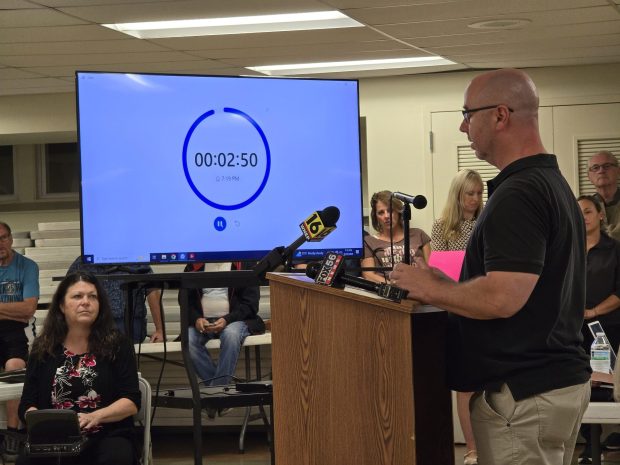 Archbald resident Michael Pilch shares his fears about how data centers could impact water and electricity in his testimony during a zoning hearing at St. Thomas Aquinas Church, Archbald, on Monday, Sept. 29, 2025. (FRANK WILKES LESNEFSKY / STAFF PHOTO)
Data centers are heavy industrial facilities requiring significant resources and infrastructure — they should not be next to homes, parks and schools, Pilch said.
“The proposed ordinance shows that the borough council really listened to residents — the concerns that have been raised over the past year,” he said. “I’ve attended several meetings along with other residents and shared those concerns about zoning and land uses, and I think council deserves the credit for listening to those concerns, hearing those concerns, and working with professionals to determine what changes are appropriate for Archbald.”
Zoning amendments only apply to future developments — not retroactively — though if the borough denies a data center campus or a developer withdraws, any subsequent applications would be bound to the new standards.
Archbald received one of Lackawanna County’s earliest data center proposals in January 2025 when officials with Wildcat Ridge approached council at a work session touting a $2.1 billion investment, opening the door for a rush of speculative development that transformed the borough into a data center hotspot.
Archbald’s overarching zoning ordinance, which the town enacted in March 2023, did not define data centers, but it principally permitted them in multiple commercial and industrial zoning districts. As principal permitted uses, data centers needed preliminary and final land development approval from the borough without having to abide by specific conditions tailored to the industry, nor any requirements for public hearings.
Project Gravity, Project Boson, Project Scott and Project North all applied under that principal permitted use designation, though Project Scott subsequently filed a conditional use application as well. The developer of Project Boson also proposes a 400-megawatt Essential Energy LLC natural gas power plant across the street from the data center on Eynon Jermyn Road.
To put up guardrails, the borough adopted a zoning amendment to address data centers last year. Although it limited their development as conditional uses across four overlay districts while establishing restrictions on the industry, residents pushed back against the legislation during a Sept. 29, 2025, public hearing, arguing it was still too permissive and allowed data centers in too many locations.
Multiple data center representatives also attended that hearing, though they did not address council.

Project Green Mountain Attorney Jeffrey Wilhelm, seated in front, with Wildcat Ridge Data Center Campus Project Manager A.J. Magnotta seated behind him, left, and Wildcat Ridge Attorney Edmund J. Campbell Jr., right, attend a public hearing at St. Thomas Aquinas Church in Archbald on Sept. 29, 2025. Essential Energy and Project Boson Attorney Michael Mey and Attorney Ray Rinaldi, who has represented Project Green Mountain and Project Gravity, stand in the rear. (FRANK WILKES LESNEFSKY / STAFF PHOTO)

Project Green Mountain Attorney Jeffrey Wilhelm of Pittsburgh-based Reed Smith LLP, center, answers a question during an Archbald Borough Council meeting at Valley View High School on Monday, May 11, 2026. (CHAD SEBRING/STAFF PHOTO).

Wildcat Ridge Data Center Campus project manager AJ Magnotta (left) and attorney Edmund J. Campbell Jr. speak during a public hearing at the Valley View High School in Archbald on Wednesday, Jan. 28, 2026. (FRANK WILKES LESNEFSKY / STAFF PHOTO)

Attorney Edmund Campbell speaks during the hearing on the Wildcat Ridge Data Center Campus at Valley View High School in Archbald Wednesday, September 9, 2026. (SEAN MCKEAG / STAFF PHOTOGRAPHER)

Essential Energy LLC’s air quality expert, Nicole Wilson of engineering firm Earthres, and Attorney Michael Mey react to questions during a conditional use hearing in the Valley View High School auditorium in Archbald to consider the 400-megawatt natural gas power plant on Thursday, May 21, 2026. (FRANK WILKES LESNEFSKY / STAFF PHOTO)

Raymond Rinaldi, attorney for Archbald 25 Developer LLC, answers questions from the public during the hearing for the organization’s proposed “Project Gravity” data center campus at Valley View High School on Tuesday, Jan. 06, 2026. (REBECCA PARTICKA/STAFF PHOTOGRAPHER)
Show Caption
1 of 6
Project Green Mountain Attorney Jeffrey Wilhelm, seated in front, with Wildcat Ridge Data Center Campus Project Manager A.J. Magnotta seated behind him, left, and Wildcat Ridge Attorney Edmund J. Campbell Jr., right, attend a public hearing at St. Thomas Aquinas Church in Archbald on Sept. 29, 2025. Essential Energy and Project Boson Attorney Michael Mey and Attorney Ray Rinaldi, who has represented Project Green Mountain and Project Gravity, stand in the rear. (FRANK WILKES LESNEFSKY / STAFF PHOTO)
A divided council ultimately adopted that ordinance in November; all four council members who voted in favor of it have since left office or resigned.
In April, Stop Archbald Data Centers co-founder Tamara Misewicz-Healey, who was an early critic of the zoning amendment, presented council with a petition signed by 800-plus residents calling for the resignations or removal of multiple borough officials. The petition contended the borough violated public trust, citing communications between borough officials and data center developers where the developers received draft data center ordinances and contributed their own. Former Council President Dave Moran, Vice President Richard Guman and Councilwoman Marie Andreoli, all of whom voted in favor of the ordinance with former Councilman Francis Burke, resigned the same day.
Prior to council adopting the ordinance, residents had urged the borough to limit data centers to industrial land across the Casey Highway. Instead, the legislation created four overlay districts, including at the sites of the Wildcat Ridge, Project Scott and Project Green Mountain campuses.
The new proposed ordinance removes those overlays and makes data centers conditional uses in the borough’s general industrial zoning district, which encompasses the Valley View Business Park around Archbald Heights Road.
Notably, the proposed ordinance removes the borough’s noise exemptions for data center backup generators, which have emerged as a central concern. The November ordinance exempted generators from the borough’s noise limits during outages and routine testing and maintenance. However, during a July public hearing on Wildcat Ridge, Archbald’s sound expert, J. Michael Spencer of JMS Acoustics LLC in Bethlehem, criticized that exemption, saying at the time, “I believe that this exemption was specifically developed originally by data center people because there is no reason, from a scientific standpoint, looking at this from acoustics, to exempt the loudest sound sources on the site that have the ability to most negatively impact the health, safety and welfare of residents.”
The draft ordinance prohibits data centers from using their emergency and backup power systems for peak shaving and grid support; it also requires any generators to adhere to the most stringent tier of emissions standards. Throughout the summer, grid operator PJM requested and received multiple emergency orders from the U.S. Department of Energy allowing it to tap data centers to use their backup generators to reduce demand on the grid.
Last year, residents also advocated for Archbald to regulate data centers based on low-frequency sounds outside of the standard decibel range, or dBA. The draft ordinance now regulates those low-frequency sounds, known as dBCs, with about 8 pages of the ordinance focusing on sound and acoustics studies.
Other elements of the new ordinance include:
• An environmental impact study requiring applicants to disclose the impact of their data centers on the environment, public health, safety and welfare. It includes soil, surface water, ground cover, topography, ground water, water supplies, sewage and solid waste disposal.
• A public health impact analysis evaluating the potential impacts on public health, safety and welfare during both construction and operation. The analysis must address noise, air quality, lighting, cumulative impacts and mitigation measures.
• A thermal impact and heat dissipation study evaluating the heat produced by data centers and its impacts.
• A community emergency response action plan to assist first responders and emergency management officials.
• A traffic impact study evaluating both construction and operational traffic.
• A property value impact assessment evaluating proximity, visual impacts, noise, lighting, traffic and other site-specific characteristics on home values.
• Mandatory bonding.
• A decommissioning and site restoration plan.
Council will next have to vote to advertise the proposed ordinance, once finalized, and the zoning map for a public hearing to give residents the opportunity to present public comment before the ordinance is ultimately passed, borough solicitor Jay O’Connor said.