
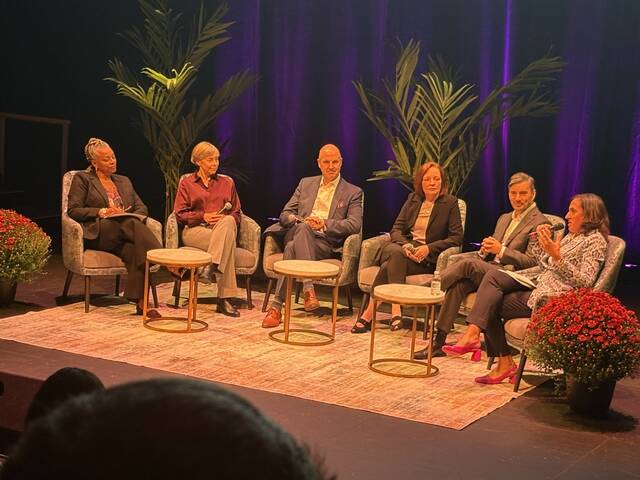
At the first annual Pittsburgh Cultural Trust Community Meeting on Wednesday at the O’Reilly Theater in Downtown Pittsburgh, Trust president and CEO Kendra Whitlock Ingram presented a surprising and encouraging statistic: since reopening after the covid-19 pandemic, the Trust has generated nearly $1 billion in economic impact.
“In 2025 alone, more than 600,000 people came to the Cultural District for events presented by Trust programming,” Whitlock Ingram said.
The meeting’s presentation was an opportunity for leaders from the Trust and other arts organizations that call Downtown’s Cultural District home to discuss the current state of Pittsburgh’s arts scene and look to next steps.
“For more than 40 years, the Cultural Trust has been a part of the Downtown Pittsburgh story, helping to transform the neighborhood through arts and creating a place where people can come together,” Whitlock Ingram said. “The past 18 months have really been an extraordinary period of progress for the Cultural Trust and Downtown.”
In attendance were a number of local elected officials, including Mayor Corey O’Connor, Allegheny County Executive Sara Innamorato, state Sen. Jay Costa and several others.
“Our Golden Triangle is a destination for all of us, a place where people come to work, visit, gather and experience so much of what makes Pittsburgh great,” Innamorato said. “And really, for the next generation, it’s going to be a place where more and more individuals and families call this place home.”
Whitlock Ingram announced that the Trust commissioned an economic impact study last spring to examine only Trust programming. She presented several of the figures from the study.
“In a typical year, the Cultural Trust alone generates more than $175 million in regional economic impact and supports 1,700 jobs,” she said.
She emphasized that the 600,000 people who came to the Cultural District for Trust programming also ate at restaurants, parked their cars and supported local businesses.
“But the value of this work is not only economic. The arts contribute to the quality of life, creating experiences people value, giving residents and visitors reasons to spend time in Downtown and making the city seem more welcoming, active and connected.”
The Cultural Trust also provided value through local artists’ fees and jobs for local union stagehands, helping not only to bring performances and artists to the city from all over the world, but also bolstering the arts community here at home.
“All of that was measured before Arts Landing opened,” she added.
But Arts Landing has some of its own impressive statistics to boast. Trust Chief Administrative Officer Hayley Haldeman shared the good news on the Downtown outdoor space, which soft opened for the NFL Draft in April and had its grand opening during the Three Rivers Arts Festival in June.
Over the Arts Festival’s two weekends, Arts Landing welcomed 110,000 people, Haldeman said.
“Those moments proved that Arts Landing could work in scale. But we know that a successful public space is measured not only by its big moments, but how people are using it on ordinary days. Those early numbers are more than encouraging. Since opening, Arts Landing has welcomed more than 350,000 people. Even on non-event days, we are seeing a baseline of more than 1,000 daily visitors,” she said.
Those visitors are doing activities such as using the playground space, strolling, playing pickleball and doing schoolwork. Plus, there have been more than 70 days of programming at the outdoor space since it opened, as well as public visual art on view for all.
“In 2027, we plan to expand opportunities for community organizations and groups to bring their own activities to Arts Landing,” she added.
The Trust is working on a new strategic plan, which will take the organization through 2030. Some items they are looking to in the near future are working towards making Pittsburgh a launching pad for Broadway tours; a “refresh” of the Agnes R. Katz Plaza on Penn Avenue; and a renovation of the audience space in the Byham Theater.
Whitlock Ingram also brought the heads of several other Cultural District organizations up for a panel discussion, including Dr. Brett Ashley Crawford, interim president and executive producer at the newly formed Confluence Theater of Pittsburgh; Nick Dragga, executive director of Pittsburgh Ballet Theatre; Bill Powers, general director of Pittsburgh Opera; Melia Tourangeau, president and CEO of Pittsburgh Symphony Orchestra; and Janis Burley Wilson, president and CEO of August Wilson African American Cultural Center.
“I think of the arts, and their presence Downtown, both in the past and for the future, as that they’re both the glue and the sparkle,” Crawford said during the discussion.
“Students, seniors, young professionals, not-so-young professionals, we’re finding that everyone wants the same thing. They really want places to connect, to feel a sense of togetherness. A cohesiveness,” Burley Wilson said.
All of the organization heads agreed that one of the biggest issues isn’t getting folks to come to Downtown, but to return after an initial visit. The Cultural Trust’s PNC Broadway in Pittsburgh series can draw as many as 100,000 people to the Benedum Center for big shows such as “Wicked,” but Dragga pointed out that organizations are only likely to return between 10 to 30% of audiences.
“Even small changes can have a demonstrative impact,” he said. “I think the difference between generations is maybe their expectations on connection to the art and on how they feel.”