
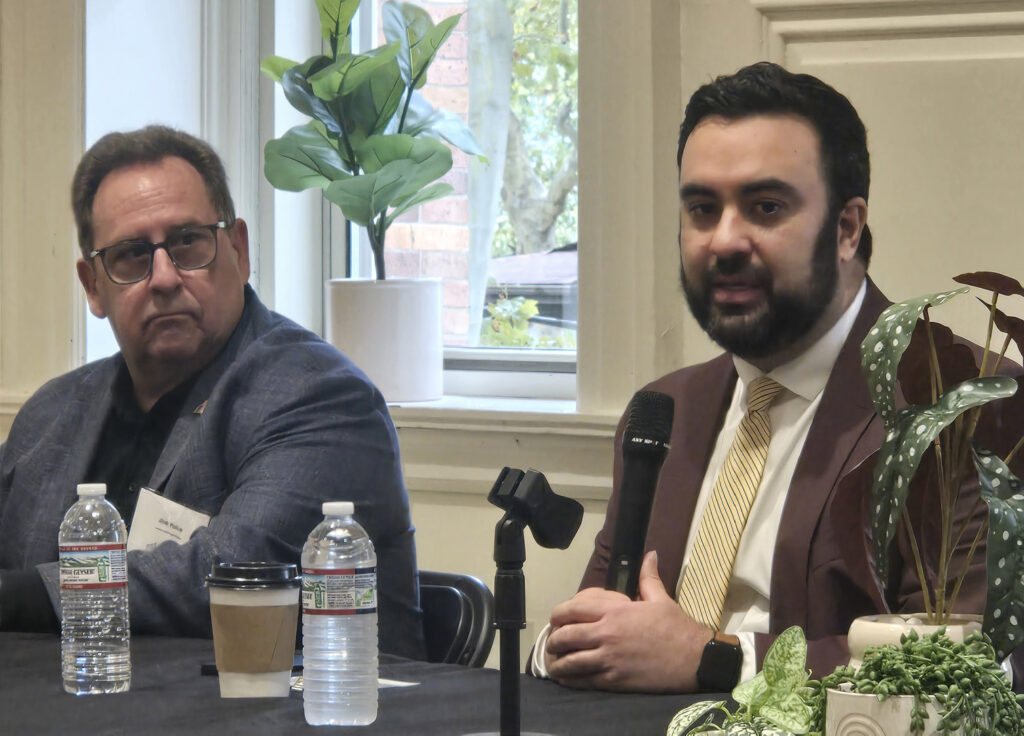
Steel Valley Accelerator hosted a legislative breakfast featuring state and county leaders.
By THOMAS LETURGEY
For the MVI
The ability of three different communities to collaborate was the takeaway from the inaugural State of the Steel Valley Legislative Breakfast Wednesday morning in Homestead.
Welcomed by Carnegie Library of Homestead Executive Director Carol Shrieve, hosted by Steel Valley Accelerator Executive Director Katlyn (Kat) Weiser and opened by Homestead Mayor Mary Nesby, the event hosted about 110 people over coffee and a buffet.
Shown at the State of the Steel Valley legislative breakfast from left: Munhall Mayor Rob Falce, state Senator Nick Pisciottano, Homestead Borough Mayor Amanda Loutitt, and Director, Allegheny County Economic Development Lauren Connelly. Photo by Thomas Leturgey.
Homestead, West Homestead and Munhall are among the communities (Whitaker Borough is the other) that share the 15120 zip code and frequently work together for a combined benefit. Aaron Kleiber, marketing and engagement director for Steel Valley Accelerator, explained that the communities make up the “Steel Valley” but are still a part of the much larger “Mon Valley.”
State Sen. Nick Pisciottanno, D-West Mifflin, Munhall Mayor Rob Falce, Allegheny County Economic Development Director Lauren Connelly and Homestead Borough Manager Amanda Loutitt, had a panel discussion about progress made in the communities, and what stakeholders need to do to continue the growth.
Weiser, who has led the Accelerator for nine months, said she was “thrilled” with the turnout, which included leaders from the City of Pittsburgh as well as all of the Steel Valley boroughs, the Steel Valley School District, and Allegheny County Treasurer’s office.
All of the Steel Valley communities share the waterfront along the Monongahela River and the Eighth Avenue corridor. Weiser talked of the “vision” for the Steel Valley, and “the best days are ahead of us.”
“This is what collaboration looks like,” Nesby added. “We recognize the strength of the communities we call home.” She said it has been good to witness the neighborhoods evolve” because of “collaboration, not competition.”
Weiser, Pisciottano and Connelly all talked of the Mon Valley Forward project. According to its website, the initiative “is a focused effort to strengthen economic competitiveness in the Mon Valley by guiding business attraction, job creation, site readiness, workforce alignment, and strategic public investment. The Mon Valley includes communities along the Monongahela River in southeastern Allegheny County and nearby municipalities that share economic, transportation, and workforce connections to the river corridor.”
“What you see here is communities that took a bad situation and turned it into a positive,” said Pisciottano of the Steel Valley neighborhoods that were rocked for decades by the closure of the steel industry. “It was unprecedented across the county.”
A comparison between Pittsburgh’s Lawrenceville neighborhood was discussed. After decades of difficult economic times and considered a downtrodden community along the Allegheny River, Lawrenceville and its Butler Street corridor became a trendy urban destination that critics, researchers, city planners and residents decry as one of the most heavily gentrified neighborhoods in Pittsburgh.
Some observers say Butler Street is similar to the 8th Avenue corridor with aged storefronts and similar housing stock.
Falce was quick to say that the Steel Valley isn’t like Lawrenceville as property values and housing have skyrocketed in that city neighborhood the past two decades. “(The Steel Valley) is a diamond in the rough,” he said, adding that with entertainment, new business and new industry “we can make it special.”
Connelly, who before joining Allegheny County’s Economic Development wing, she served as executive director of the Lawrenceville Corporation, a grassroots coalition that helped the neighborhood grow. She said Lawrenceville’s growth is like the Mon Valley’s in “growth opportunity and quality of life.”
Loutitt said those in the Steel Valley “don’t talk as much about our recreation amenities.” She touted the Great Allegheny Passage as one, as well as the “Homestead Frick Park.” That’s the small neighborhood park at 200 E. 10th Ave.,in Homestead, and not the 644-acre park in Pittsburgh’s city limits. “It’s a beautiful park in the center of town.”
She also said Pisciottano is helping with Local Share Account grants and she agrees that the area “has the potential for development like Lawrenceville.”
Pisciottano touched on the 8tht Avenue corridor and the communities they are investing in but also focused on the nearby river.
“For a long time, the river was not a place that anybody wanted to go, but we have changed that into the fact there are over 70 different species of fish in the Monongahela River now. There are whole new ecosystems of coral and aquatic life developing on the floor of the river.”
He calls the river a huge recreation space, “I don’t think we’ve tapped into yet” and “the three communities have the advantage of access to the river that isn’t constrained by railroad tracks, which is a big problem up-and-down the Mon Valley.” Railroad tracks along the Steel Valley communities are further away from the river than many similar towns. Because of that obstacle, many people aren’t legally allowed to get to the river.
Nesby also asked the panelists to add quality-of-life issues, including those for everyone from children to seniors be considered.
One year from now, the group hopes to host the second legislative breakfast. Falce noted that Munhall’s Main Street project could have renovations, and Loutitt said there could be movement on the 8th Avenue corridor.
Pisciottano said he expects the Mon Valley Forward initiative to be introduced “and the things that come with that will provide a very clear framework on how we go forward. When we’re having this event a year from now, I think we’ll be talking more about the specifics of what came out of that and how those get implemented.” He then joked, “If we’re having this event in the middle of the Mon river on, you know, some new infrastructure there, that would be great too, but that might be aggressive.”